Reflections on 56 Years of the Fair Housing Act
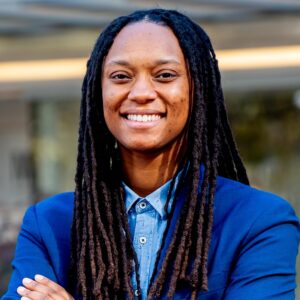
By DiNesha Rucker a 2022 Fellow in the Housing Justice Program DiNesha is hosted by the Homeless Persons Representation Project, Inc.
Each April, we celebrate National Fair Housing Month. This year marks the 56th anniversary of the passage of the Fair Housing Act of 1968, which prohibits discrimination based on race, color, religion, sex, familial status, national origin and disability in the sale or rental of homes and other housing-related activities. This April, it is important to reflect on the fervorous fight that led to this landmark legislation and thoroughly reexamine how we, as legal change agents, can continue to shape and transform systems to ensure fair housing for all.
Through my work, I am often reminded of how important the promise of the Fair Housing Act is. I have observed gaps between the ideals that this Act instills and the realities of navigating housing laws and housing court. As a Homeless Youth advocate, I have seen how the programmatic and bureaucratic structures of federal housing programs negatively impact transition-aged youth struggling with mental illnesses.
As a Homeless Youth advocate, I have seen how the programmatic and bureaucratic structures of federal housing programs negatively impact transition-aged youth struggling with mental illnesses.
DiNesha Rucker /
2022 Fellow in the Housing Justice Program
My client Pauli’s case illustrated this gap. Pauli* was a 24-year-old Housing Choice voucher recipient facing eviction due to thousands of dollars in unpaid rental payments. At age 24, Pauli already had a long history of homelessness but fortunately received a conversion voucher while residing in residential housing for homeless, transition-aged youth ranging from 18-24 years old. While there, Pauli was diagnosed with several mental and cognitive disabilities including bipolar disorder and depression. These disabilities impacted Pauli’s ability to complete everyday tasks, and as a result, found it difficult to secure and maintain employment.
Pauli consequently fell behind on nine months of rent. Initially, Pauli continuously tried to contact the Housing Authority’s general inboxes and several staff at the Housing Authority directly to report their loss of income. Those communications either went unanswered or inadequately responded to for months. Pauli, despaired and paralyzed by the fear of returning to homelessness, was under an exorbitant amount of anxiety and fell into frequent bouts of depression.
Subsequently, eviction proceedings were initiated against Pauli. In response, I worked with Pauli to mount a Fair Housing defense against the eviction and request a retroactive rent adjustment. We were successful with the Housing Authority conceding, on record, that Pauli was not responsible for the alleged amount. However, the question remains: why were my services necessary? Why was this young person’s housing ever in jeopardy?
We were successful with the Housing Authority conceding, on record, that Pauli was not responsible for the alleged amount. However, the question remains: why were my services necessary? Why was this young person’s housing ever in jeopardy?
DiNesha Rucker /
2022 Fellow in the Housing Justice Program
Although Pauli’s case highlights obstacles that typical participants face while navigating federal housing programs, it is important to consider these obstacles within the context of their specific circumstances. Pauli was not only a transition-aged youth but was also dealing with several mental and cognitive disabilities. When reexamining programmatic and bureaucratic structures, we must consider the vulnerabilities of these populations.
Often, transition-aged youth in federal housing programs struggle to effectively navigate the complexities of the program or the structure of housing authorities. Homeless youth are still developing mentally, emotionally, and socially, and require unique services and support until they are able to sufficiently support themselves in adulthood. Additionally, participants may have varying abilities to navigate the systems put in place and respond to issues arising during their program due to mental or cognitive disabilities.
Practices and patterns of housing authorities may also be harmful to the mental health of those suffering from disabilities.
The complexities of federal housing programs and the bureaucratic structure of housing authorities generate inaccessibility. Pauli experienced confusion with program requirements and frustration related to how to respond and who to contact regarding emerging issues. When authorities did attempt to respond, direct contact information was gatekept and Pauli was stonewalled by inadequate responses. This threatened Pauli’s housing stability and negatively impacted their mental health for months.
The spirit permeating through the Fair Housing Act is accessibility. Like a ramp into a building, systems must be structured with equitable safeguards to ensure that our most vulnerable populations have access. The reality remains that many people with disabilities are being evicted, even when meritorious claims exist. It is imperative that we consider how we can possibly ensure that the system protects our most vulnerable populations from the onset—during National Fair Housing Month and throughout the rest of the year.
*Indicates the client’s name has been changed for the sake of privacy.
To learn about the other Fellows working to increase access to fair housing through our Housing Justice Program, click here To read more about DiNesha’s work, click here.
The spirit permeating through the Fair Housing Act is accessibility. Like a ramp into a building, systems must be structured with equitable safeguards to ensure that our most vulnerable populations have access.
DiNesha Rucker /
2022 Fellow in the Housing Justice Program
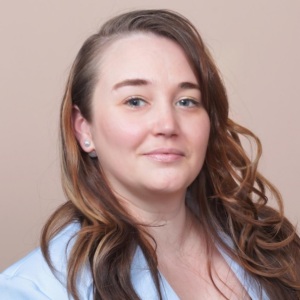
By Adrieanna Hutson, a 2022 Fellow in the Disaster Resilience Program. Adrieanna’s project focuses on providing civil legal aid to communities in the aftermath of disasters, such as tornadoes, and on increasing the resilience of communities to future disasters.
As a result of climate change, there is a need for increased infrastructure to sustain communities throughout the U.S. and beyond. Environmental and climate disasters increase in frequency and intensity each year, so building resilience is a necessary response to climate change. It is imperative that we respond to the changes that climate change is bringing, regardless of mitigation efforts, and the changes that have already occurred. For example, the increased frequency and intensity of weather-related disasters, such as extreme heat. Extreme heat events—such as heat waves—are incredibly dangerous to the health and safety of communities.
The impact of such disasters is multiplied when they occur in areas of the country that don’t have the necessary infrastructure in place to offset the high temperatures. When communities are unprepared for extreme heat, large groups of people may fall ill and even die—an occurrence that will get significantly worse if resilience isn’t established. This is especially evident when people, usually in the South or Midwest, don’t have access to air conditioning. The complex issues that extreme heat presents are exacerbated by another problem: the increasing unaffordability of housing.
Extreme heat is the number-one weather-related cause of death in the U.S., killing more people most years than hurricanes, floods, and tornadoes combined. Further, the number of heat-related fatalities is expected to rise due to climate change; waves are starting earlier and lasting longer. Arkansas, where I live and work, has the third highest rate of heat-related death in the nation; with Arkansans in urban environments at the highest risk. Heat is especially dangerous for disabled and elderly populations. However, children are also particularly vulnerable because they may not be able to regulate their body temperatures as effectively as adults. Children with disabilities have been removed from the biological parents’ home because the home is not safe for the children, in the absence of air conditioning, due to extreme heat.
Arkansas, where I live and work, has the third highest rate of heat-related death in the nation; with Arkansans in urban environments at the highest risk.
Adrieanna Hutson /
2022 Fellow in the Disaster Resilience Program
The U.S. Department of Housing and Urban Development (HUD) has put into effect regulations for National standards for the condition of HUD housing. These regulations state that extreme heat is a health and safety hazard, and that the unit must be free of such hazards:
The inside, outside and unit must be free of health and safety hazards that pose a danger to residents. Types of health and safety concerns include, but are not limited to carbon monoxide, electrical hazards, extreme temperature, flammable materials or other fire hazards, garbage and debris, handrail hazards, infestation, lead-based paint, mold, and structural soundness.
The regulations don’t explicitly require HUD housing to provide air conditioning but do require compliance with state and local requirements and impose an obligation to free the unit of extreme temperatures. The assumption is probably something like, “if air conditioning is necessary for safety, then the local law will reflect that.” For the time being, those are the tools that HUD has given us.
However, given the climate changes that are occurring and that we anticipate, I believe that state and local governments, as well as HUD, have to do more to ensure that low-income people are not being exposed to extreme temperatures.
Read about the Disaster Resilience Program here. To learn more about Adrieanna’s work, click here.
I believe that state and local governments, as well as HUD, have to do more to ensure that low-income people are not being exposed to extreme temperatures.
Adrianna Hutson /
2022 Fellow in the Disaster Resilience Program
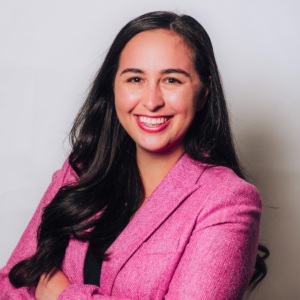
By Sophia Genovese, a 2022 Fellow in the Disaster Resilience Program at the New Mexico Immigrant Law Center, where she is also a managing attorney.
The decision to leave one’s home country is unimaginably challenging. People do not want to leave their homes, but they know they have no other chance for survival than to flee.
The journey to the United States is dangerous. Every single person I’ve spoken to who has migrated to the US has faced kidnapping, extortion, and physical violence at the hands of criminal actors throughout Central America. They consider themselves lucky because they made it—though not everyone does. People are aware of these risks before they flee their home countries and still make the decision to leave, indicating just how significant the threat of harm is back home.
In my role at the New Mexico Immigrant Law Center (NMILC), I work directly with people who immigrate to the US and are seeking humanitarian protection as well as people from Afghanistan who aided the US military effort in the war against the Taliban and assist people fleeing political persecution by their governments in Nicaragua, Venezuela, and El Salvador. I counsel people fleeing horrific violence by guerrilla groups and other armed actors whom their governments are unable and unwilling to control.
I encounter people simply seeking safety and dignity for themselves and their families, who, once at the US border, face additional barriers to protection. For example, border patrol officers regularly return people to Mexico in violation of international and domestic laws, and dark-skinned people are unable to access border processing appointments because the technology used by our government cannot recognize darker faces—just to name a few.
I encounter people simply seeking safety and dignity for themselves and their families, who, once at the US border, face additional barriers to protection.
Sophia Genovese /
2022 Fellow in the Disaster Resilience Program
If permitted entry into the US, individuals are either given instructions to appear in immigration court at a later date, or alternatively, they are sent to an immigration detention facility. In my work at NMILC, I encounter people with nearly identical backgrounds and no criminal history, but one will be released while the other is detained —a random and arbitrary decision driven by the availability of US Immigration and Customs Enforcement (ICE) bed space with disastrous consequences.
If someone is detained in ICE custody, they are far less likely to obtain legal counsel and far more likely to lose their cases and be deported. Only 10-14% of all detained immigrants secure legal counsel compared to nearly 40% for non-detained immigrants. Immigrants in civil immigration proceedings, including those who are detained, are not appointed free legal counsel. Often, many detained immigrants in New Mexico appear unrepresented in their proceedings. There are only approximately six pro bono attorneys in New Mexico, including myself, who can assist detained immigrants. That is six attorneys for approximately 2,000 people.
There are only approximately six pro bono attorneys in New Mexico, including myself, who can assist detained immigrants. That is six attorneys for approximately 2,000 people.
Sophia Genovese /
2022 Fellow in the Disaster Resilience Program
Even people in detention who have legal counsel are denied asylum at far higher rates than non-detained asylum seekers. Only 3% of unrepresented detained people win their applications. Represented detained immigrants are successful 32% of the time, compared to a 78% success rate for non-detained immigrants with legal counsel.
Many factors impact a detained person’s ability to win their application. At its core, though, immigration detention intentionally disempowers, disorients, and creates insurmountable barriers for asylum seekers to win their asylum claim. Every day, legal practitioners observe people with strong asylum claims lose and be deported back to danger due to barriers such as the inability to access information in one’s own language, the Biden administration’s asylum ban, and horrific mistreatment and human rights abuses in detention centers.
As an immigration attorney who works with immigrant communities in a border state, I have observed the violent consequences of certain policies intended to curb immigration. The result is rarely an end to migration to the US. Instead, we observe people driven further into the shadows and made vulnerable to smugglers and traffickers and an increasingly backlogged immigration system. We’re witnessing a stripping of access to free and fair immigration systems in communities that could otherwise be invested in.
An alternative vision does exist wherein people have access to basic dignity and due process. For example, case management models where families have immediate access to social and legal services are far less costly to taxpayers and far more effective with integrating families in the US. Investments in these systems have benefited immigrants and citizens alike and help to ensure that immigrant neighbors have what they need to thrive and contribute to their new homes. Likewise, a return to compliance with international standards for qualifying for refugee status would have an immediate, life-changing impact on millions of people across the country. Winning asylum would improve access to work authorization and stability, that is otherwise not attainable under our current legal system.
Until we meaningfully invest in these policy alternatives, the US government will continue to cause harm to immigrant communities and cause further chaos in our immigration system.
To learn more about the Disaster Resilience Program, click here. To learn more about Sophia’s work, click here.
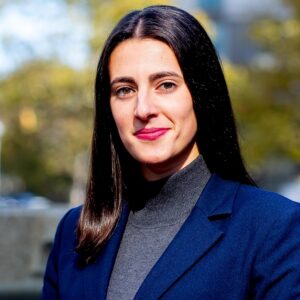
By 2022 Fellow Audrey Hertzberg, who is hosted by Sanctuary for Families and sponsored by Latham & Watkins. Audrey authored this in observance of International Women’s Day, which aims to celebrate women’s achievement, raise awareness for discrimination, and take action to drive gender parity.
International Women’s Day is traditionally a time of year when people share how they support women and girls in their day-to-day lives, companies, relationships, and more. This year, I’m hoping to elevate the voices of the countless women who come through the doors of the Sanctuary for Families EMPOWER Center, where I work as a trial litigator. EMPOWER is the first Medical-Legal Partnership in New York City to provide family law representation to survivors of sex and labor trafficking.
During Women’s History Month, we have an opportunity to celebrate the accomplishments of women we look up to. But it’s just as important to talk about the challenges with which women are confronted. As reported by my host organization, almost three women are killed by their intimate partners every day in the United States. While men are more likely to be killed by shooting, women are more likely to be beaten, strangled, and stabbed to death—much more intimately violent crimes. The perpetration of violence against women is, unsurprisingly, closely related to other identities that have been so purposefully marginalized. Black women are murdered at rates three times higher—and Indigenous women six times higher—than their White counterparts. 96% of the trans individuals murdered in 2021 were trans women or transfeminine people.
During Women’s History Month, we have an opportunity to celebrate the accomplishments of women we look up to. But it’s just as important to talk about the challenges with which women are confronted.
Audrey Hertzberg /
2022 Equal Justice Works Fellow
A significant portion of male homicides by a female partner occur in the context of women acting in self-defense against abuse. In New York State, where I work, our legislature has passed the Domestic Violence Survivor’s Justice Act (DVSJA), intended to allow incarcerated survivors of gender-based violence to have the circumstances of their abuse taken into account for early release. The legal standards for proving abuse, however, are still prohibitively high. Among other things, this barrier regularly prevents incarcerated women, like my former client Abigail* who fought for her life during a brutal domestic violence attack, from seeking recourse through the DVSJA.
Other women who have experienced gender-based violence include survivors of trafficking who are forced to navigate pervasive stigmas in Family Court. This is exemplified in cases pertaining to care and custody of children. It is common to hear advocates of the child welfare system talk about the importance of shifting attitudes towards formerly trafficked mothers. However, in many cases, mothers whose prior trafficking is revealed may unfortunately be treated as though they are unfit to parent.
When Jackie’s* husband was arrested for domestic battery committed against her in front of their children, the Administration of Children’s Services opened a case against him, and Jackie was told she would be forced to share her story in a courtroom. Though she expressed her hesitation to re-live the abuse, she was issued a subpoena stating that she could be arrested if she did not come to court to testify. Because Jackie does not have immigration status, an arrest was particularly terrifying to her. Once in court, I was able to explain her background to the Judge. After thirty minutes of questioning about what proof I had that Jackie was trafficked and could substantiate her fear of testifying, the Judge finally excused her appearance. Jackie’s reception was not trauma-informed—she was treated like a liar. Most survivors of trafficking have no proof of their trafficking.
Exacerbating this problem, New York State does not provide a right to counsel for parents against whom the state has initiated a Child Neglect investigation. Many don’t know that the right to parent is codified by federal law. In my opinion, to terminate a person’s parental rights is one of the most extreme legal injuries that the government can inflict.
Removing children from their families into foster system placements has been provably tied to later involvement in the juvenile criminal system and to further exploitation, such as labor and sex trafficking. It causes difficulty for children who lose access to the warm certainty that comes with growing up in a loving, safe environment, with access to their own culturally significant heritage.
In my opinion, to terminate a person’s parental rights is one of the most extreme legal injuries that the government can inflict.
Audrey Hertzberg /
2022 Equal Justice Works Fellow
It only takes one anonymous complaint to open an investigation. One complaint, true or false, from anyone, may lead to a Child Protective Specialist (“CPS”) standing in the living room. Take my client Diane*, whose 17-year-old child arrived late to high school even though his mother sent him out the door exactly on time, triggering an investigation for educational neglect. My client Emily’s* six-year-old daughter slept in bed with her at night, a common cultural experience for moms around the world, triggering a physical neglect investigation for failure to provide adequate shelter. In the event one of these accusations is “indicated” and found to have a basis, the mother would have a record with Albany’s Central Registry, potentially preventing them from working in a care-giving position or any that will request a background check from the Registry.
A parent can challenge an indicated finding, and even appeal them. The final appeal is called a “Hearing”, despite the fact that you should picture a trial, though the rules of evidence do not apply. Additionally, a parent is not necessarily joined a lawyer, but the government is always represented by one. Like in my client Laura’s* case, it can take over six months to find out if an appeal was successful in having a name removed from the Registry.
The state’s failure to provide counsel to mothers facing repercussions in the child protective system, and by extension defending their right to parent their own children, is unacceptable. This is especially true when you consider that, in New York State, a Black mother is three times as likely to have her parental rights terminated as her White counterpart. This International Women’s Day, it’s important to acknowledge how far we have come in supporting survivors of gender-based violence. Taking it a step further, we should also focus on the many ways that survivors endure continued mistreatment, even years after escaping their abusive partners. The harsh realities of the legal system are nothing like what is depicted on television in high profile, Los Angeles courtrooms nor an episode of “Law and Order: SVU” where survivors are supposed to get the last word. On a day-to-day basis, hundreds of thousands of women are singled out and in many ways targeted for their status as survivors. It’s time to consider centering these women on the other 364 days in the year as well.
To learn more about our Fellows working to advocate for women’s rights, click here. To learn more about Audrey’s project, click here.
This International Women’s Day, it’s important to acknowledge how far we have come in supporting survivors of gender-based violence. Taking it a step further, we should also focus on the many ways that survivors endure continued mistreatment, even years after escaping their abusive partners.
Audrey Hertzberg /
2022 Equal Justice Works Fellow

This blog was authored by Remi Gavlick, a 2022 Fellow in the Disaster Resilience Program. Remi is hosted by the Migrant & Immigrant Community Action Project (MICA Project).
In my Fellowship at the Migrant & Immigrant Community Action Project, I primarily assist clients in filing asylum, U-Visa, and T-Visa Applications in Missouri. Obtaining legal status by winning an asylum claim or being granted a T-Visa or U-Visa not only offers stability and security to my clients—it opens them up to additional benefits if a natural disaster, such as a tornado, occurs.
When faced with disasters, the Federal Emergency Management Agency (FEMA) may be able to provide assistance to qualified non-citizens, such as legal permanent residents and non-citizens granted asylum, a T-Visa, or a U-visa. Applicants who do not fall within one of these categories may still apply for federal assistance—namely, when they are a guardian of a child who is a U.S. citizen if they live in the same household. FEMA says that all individuals—regardless of their immigration status—may be eligible for various services such as crisis counseling assistance, disaster legal services, and other programs that provide medical care, shelter, food, and water if they are affected by a major disaster.
While it is encouraging that FEMA offers assistance to those who do not qualify as a non-citizen as long as they have a U.S. citizen child they live with, it can seem daunting for someone who is undocumented to ask the government for help. Those who live in the United States without status often try to remain undetected by the government, and it is understandable why they might not feel comfortable applying for disaster assistance, even if the help is desperately needed.
Additionally, immigrants who are new to Missouri may not be familiar with natural disasters that are common to the Midwest; specifically, tornados. Tornado damage is devastating to anyone, but especially to someone who is new to the country and does not know how to ask for help. Immigration status and fear of being undocumented should not be barriers when asking for disaster relief assistance. This is one reason why the work of organizations like MICA Project is so important.
Tornado damage is devastating to anyone, but especially to someone who is new to the country and does not know how to ask for help.
Remi Gavlick /
2022 Disaster Resilience Program Fellow
Growing up in Missouri, I know how to stay safe during a tornado watch or warning. I am extremely fortunate I have not yet needed to ask for disaster assistance from FEMA. I want to help my clients who have been affected by a tornado, or who may be affected in the future, to feel safe asking the government for help. I especially want to assist my clients in gaining legal status to open them up to even more FEMA benefits. Tornados are a normal part of life in the Midwest, yet they can be ravaging. Everyone, regardless of immigration status, should feel comfortable asking for help when a natural disaster devastates the community.
Immigration cases often last many years. In the first year of my Fellowship, I represented one client in her Individual Hearing in the Kansas City Immigration Court. During the hearing, I presented arguments before the Immigration Judge on why my client should be granted asylum and be allowed to stay in the United States. Winning my client’s asylum case would allow her to be eligible for disaster assistance, such as money for temporary rental assistance, medical expenses, or other serious disaster-related needs, the next time a tornado hits Missouri.
Unfortunately, the immigration judge denied my client’s asylum claim. We are currently in the process of appealing the judge’s decision. Even though we lost, I will take my experience from my first Individual Hearing and use what I learned the next time I go to court. Now I can anticipate certain weaknesses in future cases and better prepare for questions the immigration judge may ask. Immigration law is continuously changing, so I must be open to learning from my losses and be ready for new challenges that may arise.
To learn more about the Disaster Resilience Program, click here. To learn more about Remi’s work, click here.
Tornados are a normal part of life in the Midwest, yet they can be ravaging. Everyone, regardless of immigration status, should feel comfortable asking for help when a natural disaster devastates the community.
Remi Gavlick /
2022 Disaster Resilience Program Fellow
As our Elder Justice Program—which placed Fellows across the country to assist older clients who were experiencing elder abuse—comes to a close, read on for program highlights and accomplishments.
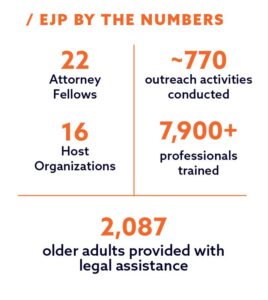
Elder abuse has been referred to as a “hidden epidemic” in the United States, with estimates that 1 out of every 10 people ages 60 and older are victims of abuse like caregiver neglect; financial fraud and exploitation; and psychological, physical, and sexual every year. Equal Justice Works created its Elder Justice Program to mobilize 22 attorney Fellows hosted at 16 legal services organizations nationally to provide trauma-informed civil legal services to victims of elder abuse, particularly in rural areas.

Clients served through the Elder Justice Program reported that they experienced a myriad of legal issues related to financial exploitation, housing, guardianship, domestic violence, identity theft, fraud, public benefits, and more. Many clients experienced multiple forms of victimization simultaneously, requiring trauma-informed and zealous advocacy that Fellows were trained to provide through the Elder Justice Program.
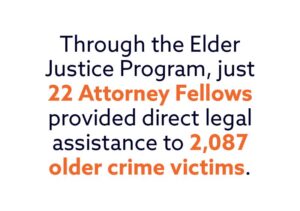 Fellows in the Elder Justice Program successfully increased the capacity of host organizations across the country to address elder abuse by developing a pipeline of lawyers committed to helping older adult crime victims; enhancing multidisciplinary responses to the victimization of older adults; developing community partnerships; and training allied professionals on crime victims’ rights and other topics. Through the Elder Justice Program, a total of 2,087 older crime victims received direct legal assistance from Fellows.
“The [Fellowship] exposed me to different areas of the law, allowed me to work with different kinds of professionals, and granted me the flexibility to design a program that catered to my client’s needs,” said 2020 Elder Justice Program Fellow Elvis Candelario.
To create a broader impact in their communities, Fellows engaged in extensive education and outreach; connected with community organizations to build referral networks; and trained potential victims, volunteers, and allied professionals on topics like elder abuse and crime victims’ rights. As a cohort, they trained over 7,900 individuals through 185 education activities, conducted approximately 770 outreach activities, and thereby increased their communities’ capacity to meet the needs of elder crime victims.
 Fellows additionally trained lawyers at their host organizations on how to respond to situations of elder abuse and detect when elder abuse was occurring within clientele. Their work on sustainable practices and resources will continue to benefit host organizations and communities even after the Fellowship conclusion. For example, a Fellow at Prairie State Legal Services helped create an Elder Abuse and Exploitation Interview Guide to help staff provide trauma-informed services to older adult crime victims. Another Fellow helped build capacity at their host organization by working to finalize an elder law manual, which helps staff identify signs of elder abuse, steps to help clients avoid further abuse, and external services and resources for victims in recovery.
“This experience has been a life-changing opportunity to make a real difference in the lives of individuals who might have otherwise gone unreached,” said 2020 Elder Justice Program Fellow Taylor Amstutz.
This experience has been a life-changing opportunity to make a real difference in the lives of individuals who might have otherwise gone unreached.
Taylor Amstutz /
2020 Elder Justice Program Fellow
Ultimately, an independent program evaluation found that the Fellows’ legal skills and knowledge related to victim legal services increased over the Fellowship program, and many Fellows committed to continue working in public interest law and elder law. In fact, more than half the Fellows accepted staff attorney positions at their host organizations and 21 of the Fellows remain in public interest roles.
We are grateful to all of the Fellows, Equal Justice Works staff members, host organizations, partner organizations, and financial supporters that made this program possible. To learn more about the work of individual Fellows in the Elder Justice Program, click here. To learn more about the current opportunities offered through Equal Justice Works, click here.
This program was supported by an award from the U.S. Department of Justice, Office of Justice Programs, Office for Victims of Crime, Award Number 2019-V3-GX-K033. The opinions, findings, conclusions or recommendations expressed are those of the author(s) and do not necessarily represent the official position or policies of the U.S. Department of Justice or Equal Justice Works.
Access to legal aid in rural communities across the United States has been a longstanding challenge. Low-income and under-resourced residents in rural communities are often forced to travel great distances to find much-needed legal services. In fact, a staggering 92% of low-income Americans are not getting any or enough legal help for their civil legal problems.
In response to this issue, Equal Justice Works first partnered with Legal Services Corporation (LSC) in 2016 to offer opportunities for law students to improve access to justice in rural communities through the Rural Summer Legal Corps (RSLC). The RSLC has provided opportunities for law students to respond to the shortage of legal aid in rural communities every summer since.
Last summer, RSLC Student Fellows spent eight to ten weeks providing direct legal services and engaging in community outreach and education. Selected from over 330 applications, the 2023 class of RSLC Student Fellows included 45 Student Fellows who served at 41 LSC-funded civil legal organizations across the country. During their summer of service, Student Fellows collectively contributed 13,129 hours to help rural communities attain access to legal aid, with 4,881 hours spent on direct legal services! Their efforts helped a total of 2,194 individuals, and they assisted on 1,030 legal cases.
The best part of this program was getting the support of a nationwide organization while getting to work on the ground locally with a focus on underserved areas. My host site was a great learning experience and everyone I met was so passionate and motivated.
Maria Catalano /
2023 RSLC Student Fellow
“The best part of this program was getting the support of a nationwide organization while getting to work on the ground locally with a focus on underserved areas. My host site was a great learning experience and everyone I met was so passionate and motivated,” said Maria Catalano, a second-year student at the University of Utah S.J. Quinney College of Law and 2023 RSLC Student Fellow. “I am leaving this summer with a lifelong commitment to rural populations and will always be grateful for this Fellowship.”
Student Fellows provided legal aid in a wide variety of issues, such as housing, responding to the opioid crisis, tribal law, domestic violence, farmworkers’ rights, and more. Of the 41 RSLC participants surveyed, 87% said that their experiences throughout the Student Fellowship increased their interest in working with similar client bases in the future.
The best part [of my Fellowship] was learning the tribal court system and native culture. The more I learned, the more invested I was in helping protect native culture and children.
Reilly O’Connor /
2023 RSLC Student Fellow
“The best part [of my Fellowship] was learning the tribal court system and native culture. I had the opportunity to participate in many cultural events and listen to different Native American perspectives. The more I learned, the more invested I was in helping protect native culture and children,” said Reilly O’Connor, a second-year student at Baylor University School of Law and 2023 RSLC Student Fellow.
Additionally, the 2023 RSLC class of Student Fellows participated in 139 outreach events and created 144 collaborations with community partnerships. Their efforts resulted in 1,763 individuals receiving informational legal services, such as resource materials, Know Your Rights trainings, and fact sheets.
The most exciting part of the program was that I was engaging in real legal practice and impacted real people in need, not corporations.
Anonymous /
2023 RSLC Student Fellow
“The most exciting part of the program was that I was engaging in real legal practice and impacted real people in need, not corporations,” said one 2023 RSLC Student Fellow. “Calling a client and telling them their issue is resolved was a rewarding feeling that trumps all others.”
The 2023 RSLC Student Fellows explored their passion for service and fostered positive outcomes for the clients they served. Following their summer of service, 95% of Student Fellows felt that their legal knowledge had increased from their Fellowships, and 83% said participating in the RSLC had increased their passion for public interest law. 97% of Student Fellows walked away from their summer of service feeling that their experience in the RSLC prepared them for post-graduate legal work.
“I know experience should be the most important part of any job, but for someone who needs to be able to earn money to get through law school, getting paid for this position was amazing,” said Carlie Marquez, a second-year student at Lewis & Clark Law School and 2023 RSLC Student Fellow. “I have to miss out on some opportunities of being able to do this kind of work because they do not pay. Here, I was able to do something I loved and still make a livable wage.”
Applications are open—apply to the Rural Summer Legal Corps by 11:59 p.m. ET on February 13, 2024. For more information about program eligibility and requirements, please visit here.

Tracie Johnson is the youth ombudsman for the City of Philadelphia and an Equal Justice Works Fellow Alum
WASHINGTON, D.C., February 6, 2024— Equal Justice Works, the nation’s largest facilitator of opportunities in public interest law, has added 2018 Equal Justice Works Fellow Tracie Johnson to the organization’s board of directors. Tracie is currently a youth ombudsperson with the City of Philadelphia.
“We are thrilled to welcome Tracie to our Board. Her experience as an Equal Justice Works Fellow aiding women of color who have criminal records will be a great asset to the board and our organization as we continue to make progress on our strategic plan,” said Verna Williams, CEO of Equal Justice Works. “Our alumni have a deep commitment to equal justice and public service, and I look forward to working with Tracie and the rest of the Board as we continue to advance our nation’s promise of equal justice for all.”
Our alumni have a deep commitment to equal justice and public service, and I look forward to working with Tracie and the rest of the Board as we continue to advance our nation’s promise of equal justice for all.
Verna Williams /
CEO, Equal Justice Works
As a 2018 Equal Justice Works Fellow, Tracie provided legal representation to more than 90 clients, conducted trainings for job developers, joined two reentry coalitions, and facilitated multiple continuing legal education events on record clearing support and employment advocacy. Following her Fellowsip, Tracie served as the primary staff attorney for Community Legal Services’ Youth Justice Project. In this role, she continued to meet the legal needs of girls with criminal records. Tracie is now the youth ombudsperson for the City of Philadelphia, where she works to improve the safety and quality of services for youth in residential placements.
“It is a great honor to join the Board as an Alumni Fellow,” said Tracie. “Equal Justice Works gave me the platform to carry out my life’s work of serving Philadelphia’s most vulnerable youth populations. I look forward to bringing my expertise as a public interest attorney, youth advocate, former journalist, and DEIB strategist to the Board.”
The Equal Justice Works Board of Directors is comprised of national leaders from every corner of the legal profession including judges, corporate counsel, law firm partners, law students, Fellow Alumni, academics, and public interest law leaders and advocates. Nominations for the Fellow Alumni board member are accepted from the Equal Justice Works community before being presented to the board of directors for final selection.
A full list of Equal Justice Works Board of Directors can be found here.
Equal Justice Works gave me the platform to carry out my life’s work of serving Philadelphia’s most vulnerable youth populations. I look forward to bringing my expertise as a public interest attorney, youth advocate, former journalist, and DEIB strategist to the Board.
Tracie Johnson /
Youth Ombudsman, The City of Philadelphia
Member of Equal Justice Works Board of Directors
About Equal Justice Works
Equal Justice Works is a 501(c)(3) nonprofit organization that creates opportunities for lawyers to transform their passion for equal justice into a lifelong commitment to public service. As the nation’s largest facilitator of opportunities in public interest law, Equal Justice Works brings together an extensive network of law students, lawyers, advocates, legal services organizations, and supporters to build a community committed to fulfilling our nation’s promise of equal justice for all.
Contact:
Sarah Lackritz
Vice President, Marketing & Communications
Email: [email protected]

This article was originally posted in January 2023. Samantha Beauchamp, a 2022 Student Fellow in our Rural Summer Legal Corps discusses how an Equal Justice Works Student Fellowship helped her build legal skills outside the classroom. Samantha was hosted by Legal Services of Northwest Minnesota Corporation and is currently a law clerk serving firms in Boston.
My 300 hours of service reaffirmed my belief that our country’s education platform is lacking topics that may protect young adults once they begin working. In some states, young adults begin working as young as 14 years old. I began working at 16 years old, and like many others, I did not have a clue about my rights or the rights of my employers. I was discriminatorily mistreated by employers and even ruined my own chances of obtaining assistance by not having practical knowledge about how to protect myself in the workplace. Seeing this injustice firsthand, I was determined to help people understand their rights and protections in the workplace.
As a Rural Summer Legal Corps Fellow with Legal Assistance of Western New York, Inc. (LawNY), I had the privilege of conducting research, doing hearing preparation, and counseling low-income clients at unemployment insurance benefits administrative hearings. By the end of my Student Fellowship, I represented a client against a government agency, and won the case for the client who received unemployment benefits.
By the end of my Student Fellowship, I represented a client against a government agency, and won the case for the client who received unemployment benefits.
Samantha Beauchamp /
2022 Rural Summer Legal Corps Student Fellow
The claimant had worked with the government agency for 10 years and quit in lieu of termination with good cause under non-disqualifying conditions. They were going to be discharged from service and lose their grade for poor work performance due to medical conditions. Despite doing everything in their power to keep their job, transfer, or find a job that is close in grade to their position, my client (like so many others) almost lost benefits they were entitled to because they didn’t fully understand their legal rights.
I believe if people understood the law before acting, they would be better able to advocate for themselves, and would avoid being taken advantage of by employers. People need to know that voluntary quitting for personal reasons or without first taking steps to try to resolve the issue with the employer is usually not considered good cause under New York State Department of Labor regulations, and that such actions may become a barrier to their receipt of unemployment benefits. What you don’t know can hurt you.
My Student Fellowship at LawNY challenged my ability to think on my feet, develop legal arguments, and directly engage with clients.
Samantha Beauchamp /
2022 Rural Summer Legal Corps Student Fellow
My Student Fellowship at LawNY challenged my ability to think on my feet, develop legal arguments, and directly engage with clients. Law school can teach you how to research and write, but the Rural Summer Legal Corps provided invaluable practical experience with the training wheels off.
If you are interested in embarking on a summer of service like Samantha, apply to the Rural Summer Legal Corps by 11:59 p.m. ET on February 13, 2024. For more information about program eligibility and requirements, please visit here.

This article was originally posted in January 2023. Brooke Trottier, a 2021 Student Fellow in our Rural Summer Legal Corps, discusses how her summer of service experience at Legal Aid Service of Northeastern Minnesota (LASNEM) helped her build legal skills outside the classroom. Brooke is currently an immigration attorney at Fredrickson.
I served in the Rural Summer Legal Corps with Legal Aid Service of Northeastern Minnesota (LASNEM), an organization that serves eleven counties in the Northeastern corner of the state, including the small town in which my family resides. I was drawn to this program due to its focus on providing access to justice through technology in rural communities.

The Reach Justice Minnesota is a project by the four regional legal aid providers of Minnesota. This project entails a series of initiatives, two of which I contributed to: the legal kiosk network and the Justice Buses.
The legal kiosk network consists of more than 200 computers located in community partner host sites. These kiosks provide access to a self-help legal database and the application for regional legal aid, with select kiosks outfitted for video conferencing. In alignment with the growing challenges the COVID-19 pandemic brought upon the community, the end of Minnesota’s eviction moratorium saw district courts requiring parties attend Zoom court by video.
While at LASNEM, I focused on maximizing host site experiences with the legal kiosks. As community partners opened their offices to the public again, it was important to ensure that the kiosks were functioning, each site had the tools it needed, and we were available for any questions or concerns that arose. This led to a fun field trip where I drove across LASNEM’s service area and visited five host sites!

Another part of my work involved The Justice Bus, a mobile legal aid office affiliated with each regional aid office. I was responsible for ensuring LASNEM was well-equipped for providing legal aid services out of the bus: drafting internal policies, defining expectations and procedures, and connecting with community partners. This project culminated at the end of July when the four Justice Buses met at the Minnesota State Capitol. It was quite the experience to see the project come to life, and to witness the Minnesota Attorney General and Minnesota Supreme Court Chief Justice’s support for the initiative.
The Justice Bus project required vast collaboration across the state: legal aid staff, attorneys and Executive Directors; community partners; technology support companies; and the Minnesota Judiciary. Although it could be difficult to coordinate involvement from each group, the value of collaboration was clear.
My Equal Justice Works Student Fellowship introduced me to the expansive reach of civil legal aid. I not only have a renewed energy towards providing equitable access to justice and legal aid, but see a future for myself as a civil legal attorney.
I not only have a renewed energy towards providing equitable access to justice and legal aid, but see a future for myself as a civil legal attorney.
Brooke Trottier /
2021 Rural Summer Legal Corps Student Fellow
I am immensely grateful for this experience and would recommend the Rural Summer Legal Corps to anyone who is considering a future in civil legal aid. This Student Fellowship was hands-on and allowed me to own my projects, while being supervised by experienced attorneys and legal staff.
If you are interested in embarking on a summer of service like Brooke, apply to the Rural Summer Legal Corps by 11:59 p.m. ET on February 13, 2024. For more information about program eligibility and requirements, please visit here.