Highlights from the Housing Justice Program Press Event
A Public-Private Partnership to Combat Housing Injustice in Virginia
Virginia is home to five of the top ten evicting large cities in the United States—a housing crisis affecting thousands of tenants across the state who need legal representation. Yet for too many, our justice system is inaccessible. Since 1993, Equal Justice Works has mobilized more than 250 lawyers and community organizers to combat housing instability. In 2021, JPMorgan Chase & Co. and The JPB Foundation invested a total of $3.75 million to provide Equal Justice Works with the resources to expand its Housing Justice Program from Richmond, Virginia, to other communities with high eviction rates, such as Hampton Roads.
In January, representatives from Equal Justice Works, The JPB Foundation, JPMorgan Chase & Co., and Virginia Poverty Law Center, came together to discuss how public-private partnerships can help increase capacity of the legal aid community in Virginia, provide legal assistance to low-income families facing eviction, and advocate for policies and practices that protect the rights of tenants.
Here’s what our speakers had to say about collaborating with Equal Justice Works on its Housing Justice Program:

“The Housing Justice Program Fellowship model is flexible. It’s responsive to the needs of communities and the host organizations that the Fellows serve. We feel that this has the advantage of making the project replicable in other cities and across the country.”
–Annie Greengard, Senior Program Officer at The JPB Foundation

“We’re proud to support Equal Justice Works and their innovative work bringing together Fellows and community organizations as part of the Housing Justice Program to increase access to legal services and tenant resources. It is a model that will truly make a difference.”
“It’s a comprehensive model that is bringing new partners and doing it in a place where there is an incredible need for that work. We are excited to see that model replicated in the greater Virginia area, especially Northern Virginia… and we hope is that this type of work informs a national conversation.”
–Abigail Suarez, Executive Director, Head of Neighborhood Development at JPMorgan Chase & Co.

“The wonderful thing about the Housing Justice Program is that it combines the traditional legal service model with community organizing, impact litigation and policy. Evictions aren’t an individual problem. Rather, they’re systemic. So why would we limit ourselves to individual solutions? Having that organizing component is essential to help build those connections and help connect tenants to legal aid attorneys.”
“It’s a model that puts communities first and allows attorneys to support the needs of those tenants, rather than attorneys acting as gatekeepers to this very complex legal system.”
–Laura Dobbs, Staff Attorney at Virginia Poverty Law Center, and 2019 Equal Justice Works Fellow
Visit here to learn more about the Housing Justice Program.

By Symone Wango, 2021 Equal Justice Works Fellow cosponsored by Davis Polk & Wardwell LLP and Morgan Stanley
In the Capital Region of New York—Albany, Schenectady, and Rensselaer counties—Black people make up 11% of the population but are disproportionately low-wage workers. The median income in these three counties for white families is approximately $96147, more than double the median income for Black families $43,323. Low-wage working class workers are the most vulnerable to workplace abuses, employment discrimination, wage theft, and poor working conditions.
The Worker Protection Program at my host organization The Legal Aid Society of Northeastern New York (LASNNY) is designed to provide low-income Black workers and other workers with free legal assistance for employment discrimination claims, wage and hours claims, and workplace safety issues. I grew up in a low-wage working-class household in the Capital Region and know too well that living paycheck to paycheck is not a far-away concept, it is a way of life. The economic impact of losing one’s income causes a ripple effect for everyone in the home. This threat to income can cause workers to endure workplace abuse, wage theft, discrimination, and unsafe conditions. This is one of the reasons that I am so passionate about helping low-wage workers of color.
I grew up in a low-wage working-class household in the Capital Region and know too well that living paycheck to paycheck is not a far-away concept, it is a way of life.
Symone Wango /
2021 Equal Justice Works Fellow
cosponsored by Davis Polk & Wardwell LLP and Morgan Stanley
At LASNNY, we provide free civil legal services to low-income people and families in the Capital Region and Northern New York. Prior to the inception of the Worker Protection Program, no legal services providers in the Capital Region offered free legal assistance to low-wage workers for employment related matters. This program was designed to fill a gap for low-income workers and their families and ensure that there is an advocate who will represent them if they have a legal issue with their employer. It also guarantees that workers are not left behind because they lack the resources to afford legal representation.
The Worker Protection Program guarantees that workers are not left behind because they lack the resources to afford legal representation.
Symone Wango /
2021 Equal Justice Works Fellow
cosponsored by Davis Polk & Wardwell LLP and Morgan Stanley

The Worker Protection Program’s clients are primarily Women of Color with various legal issues ranging from pay equity claims, to employment discrimination, to workplace retaliation. One of the biggest barriers to assisting workers in the Capital Region has been outreach. The COVID-19 pandemic has cut off many in-person community outreach opportunities that were previously available. However, we are working to overcome this barrier by offering virtual Know Your Rights in the Workplace presentations to our community partners. We’ve also been working with the Albany Damien Center, a community-based organization that assists individuals with an HIV or AIDS diagnosis. Recently, we teamed up with the Damien Center’s Employment Pathways program and gave a presentation on their weekly podcast.
The first few months of my Fellowship have been rewarding, the more I interact with workers and the more I learn about the issues that are affecting them in the workplace. Over the next year I plan to build upon these community relationships to develop a community engagement platform where workers can voice their concerns, access legal resources, and improve their working environment. I’m excited to continue leveraging these existing relationships and building new relationship throughout the community to increase awareness about the resources available to our most vulnerable workers.
At Equal Justice Works, we are proud of Symone and other Fellows for helping Black and brown communities fight back against employment discrimination and wage theft. To learn more about Symone’s Fellowship, visit her Fellow profile here.
Each year, disasters strike communities around the country, creating an ongoing cycle of impact and recovery. As a result of this cycle, inequality is further rooted in communities that are impacted by disaster. Moreover, disasters often disproportionately affect low-income communities and communities of color.
In 2020, Equal Justice Works launched the Disaster Resilience Program to respond to the critical need for legal assistance before, during, and after disasters. Through the Disaster Resilience Program, Equal Justice Works mobilizes cohorts of lawyers and law students to provide free civil legal aid in disaster-prone areas and work to rebuild lives, stabilize communities, and create resilience to future disasters.
Last summer, 6 law students spent eight to ten weeks working alongside Equal Justice Works Fellows in the Disaster Resilience Program, helping to provide legal aid, engage in community outreach and education in disaster resilience.
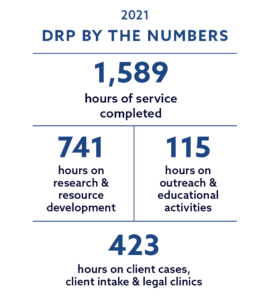
During their summer of service, Student Fellows in the Disaster Resilience Program collectively contributed 1,589 hours that included
- 741 hours on research and developing resources;
- 423 hours on client cases, client intake, and legal clinics; and
- 115 hours on outreach and educational activities.
“The best part of my experience at Community Legal Services of Mid-Florida was that I never felt like a day was wasted,” said Kyla Howard, a third-year law student at New England Law and a 2021 Disaster Resilience Program Student Fellow, “I could see how every project was effective for either the firm or the community. All my trainings and research came full circle when I got to use what I had learned to get into the community and help local tenants during the COVID-19 disaster.”
The best part of my experience at Community Legal Services of Mid-Florida was that I never felt like a day was wasted.
Kyla Howard /
2021 Student Fellow
Disaster Resilience Program
Among their many accomplishments this summer, Student Fellows assisted on research projects, contributed to a national disaster guidebook, prepped legal documents, drafted briefs for court, and developed tools to manage the COVID-19 eviction moratoriums. As a result of their efforts, 3,556 individuals received informal legal assistance!
One of the top highlights of the Disaster Resilience Program this summer occurred at Catholic Charities of Galveston-Houston, where Andra Lehotay de León, a second year student at Northeastern University School of Law and a 2021 Disaster Resilience Program Student Fellow worked alongside Equal Justice Works Fellow Maria Vazquez to help a young family facing deportation. The father of the family was faced with a 10-year ban from obtaining legal status in the United States due to his initial unlawful entry. Andra and Maria fought the ban with a waiver and were able to get the father approved for a visa petition through his marriage.
“Through this opportunity, I learned of the importance of disaster resilience-informed advocacy for immigrant clients,” said Andra. “…I am particularly interested in continuing my work in immigration law, specifically within communities frequently impacted by natural disasters.”
Through this opportunity, I learned of the importance of disaster resilience-informed advocacy for immigrant clients.
Andra Lehotay de León /
2021 Student Fellow
Disaster Resilience Program
Despite the challenge of several Student Fellows working remotely due to the COVID-19 pandemic, the 2021 Disaster Resilience Program were able to gain valuable legal experience and make meaningful contributions in the communities they served. Following their summer of service, all the Student Fellows felt that their legal knowledge and interest in serving communities affected by disasters had significantly increased due to their experience in the program.
If you are interested in helping communities prepare for and recover from disasters, apply to the Disaster Resilience Program by 11:59 p.m. ET on February 14, 2022. For more information about program eligibility and requirements, please visit here.
By Bailey Russell, 2020 Equal Justice Works Fellow hosted by the Mwalimu Center for Justice

Louisiana has one of the highest incarceration rates in the United States. It also convicts people of capital murder at an alarming rate. The people who are charged with capital crimes in Louisiana are almost exclusively poor and black. Many of them had their first interaction with the carceral system as children.
My Equal Justice Works Fellowship focuses on learning how to zealously fight Louisiana’s capital punishment system. It allows me to resist the system by learning how to directly advocate for clients on death row in post-conviction, as an attorney at the Mwalimu Center for Justice (formerly Capital Post-Conviction Project of Louisiana). I also aim to resist the school-to-capital-punishment pipeline that exists in Louisiana, by spreading legal resources with impacted communities.
Engaging with the community of New Orleans has been a highlight in my Fellowship. I became a board member of my neighborhood association, created professional relationships with leaders in the city, and forged bonds with people who were born and raised in New Orleans, to analyze how the prison system impacts Black and brown communities on a micro and macro level.
I have also found joy in representing clients in the post-conviction phase of their capital appeals. It has been an honor learning from people who are actively petitioning the State of Louisiana for their lives. Driving two and half hours to the infamous Louisiana State Penitentiary, also known as Angola, going through security, driving twenty minutes to Death Row, and sitting down face to face with my clients, has humbled me in a way I can’t even put into words.
However, humility comes from struggle. Capital defense work is the definition of struggle. The feeling that comes over me every time I exit Angola is one of deep sorrow, because I realize that my efforts, no matter how fruitful, can’t take away the trauma, the grief, and the anguish of my clients. I know that a winning brief can’t give back the time my clients have lost while sitting on Death Row. I know that while I can leave through the front gates of the prison, my clients cannot.
I know that a winning brief can’t give back the time my clients have lost while sitting on Death Row.
When I was growing up, I never understood why adults always told me to “stay a child as long as possible.” I couldn’t wait to grow up and change the world. But now I finally appreciate the advice. This work has forced me to see some of the darkest parts of humanity. It has required me to grapple with the reality that I can only act as a band aid to a wound that has existed for centuries.
This work has forced me to see some of the darkest parts of humanity. It has required me to grapple with the reality that I can only act as a band aid to a wound that has existed for centuries.
But it’s the bonds I’ve forged and the partnerships I’ve built with the people of this city that keep me energized to pick myself up and keep going. Looking ahead, I am excited to finally put together educational material to disperse within the community. Most of all, I am eager to keep learning from the work, and fighting for my clients’ right to life.
At Equal Justice Works, we are proud of Bailey and other Fellows for helping Black and brown communities fight back against capital convictions. To learn more about Bailey’s Fellowship, visit her Fellow profile here.
Rural areas in the United States have long been faced with a lack of accessible civil legal aid. Residents in rural communities are often forced to travel great distances to find much-needed legal assistance. Since 2016, Equal Justice Works has worked with Legal Services Corporation (LSC) to bring unique opportunities for law students to improve access to justice in rural areas through the Rural Summer Legal Corps (RSLC).
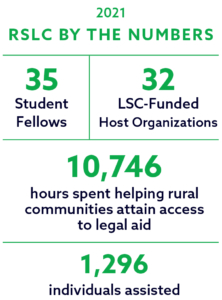 Last summer, Student Fellows in the RSLC spent eight to ten weeks helping to provide direct legal services and engaging in community outreach and education. Selected from 460 applications, the 2021 class of RSLC Student Fellows included 35 Student Fellows who served at 32 LSC-funded civil legal organizations across the country. During their summer of service, Student Fellows collectively contributed 10,746 hours to help rural communities attain access to legal aid, with 4,492 hours spent on direct legal services! Their efforts helped a total of 1,296 individuals, and they assisted on 795 legal cases.
“I felt like I was making a meaningful difference in the lives of my clients,” said Jessica Stipek, a second-year law student at the University of Oregon School of Law and 2021 RSLC Student Fellow. “I also appreciate that I got to work on a wide range of cases and with different attorneys.”
I felt like I was making a meaningful difference in the lives of my clients. I also appreciate that I got to work on a wide range of cases and with different attorneys.
Jessica Stipek /
2021 Student Fellow
Rural Summer Legal Corps
Student Fellows provided legal aid in a wide variety of issues, such as housing matters, COVID-19, economic matters, the opioid crisis, and disaster relief. They also served a diverse client base that included agricultural workers, victims of domestic violence, minors, veterans, military members, and elderly clients. Of the 34 RSLC participants surveyed, 80% said that their experiences throughout the Fellowship increased their interest in working with similar client bases in the future.
Additionally, the 2021 RSLC class of Student Fellows participated in 154 outreach events and created or expanded more than 170 collaborations with community partnerships. These efforts resulted in 944 individuals receiving informational legal services, such as resource materials, Know Your Rights trainings, and fact sheets.
“I was able to directly serve clients in filing various forms of post-conviction relief,” said Justin Small, a third-year student at Loyola Law School Los Angeles and 2021 RSLC Student Fellow. “It was actually being able to talk to clients and help them with their legal issues that I think was the most impactful. I also got to develop some of my ideas around client advocacy.”
Despite the challenge of several Student Fellows working remotely due to the COVID-19 pandemic, the 2021 RSLC Student Fellows were still about to explore their passion for service and foster positive outcomes for the clients they served. Following their summer of service, 97% of Student Fellows felt that their legal knowledge had increased from their Fellowships, and 85% said participating in the RSLC had increased their passion for public interest law.
“It afforded me the opportunity to get real legal aid experience and confirm that I am invested in pursuing a career in public interest law,” said Justin.
[RSLC] afforded me the opportunity to get real legal aid experience and confirm that I am invested in pursuing a career in public interest law.
Justin Small /
2021 Student Fellow
Rural Summer Legal Corps
For more information about the Rural Summer Legal Corps, such as program eligibility and requirements, please visit here. To become a 2022 Student Fellow, apply by 11:59 p.m. ET on February 14, 2022.
The need for legal services is especially critical for parts of the country hard hit by the pandemic and prone to natural disasters such as hurricanes, flooding, and wildfires. Our Disaster Resilience Program mobilizes full-time lawyers (Equal Justice Works Fellows) and law students (Student Fellows) to provide free civil legal aid in disaster-prone areas to ensure vital legal services are accessible to rebuild lives, stabilize communities, and create resilience.
Student Fellows have the unique opportunity to explore their passion for public service and equal justice by working alongside Disaster Resilience Program Fellows at their host legal services organizations (virtually and/or hybrid; see host site preferences and accommodations), serving some of the most marginalized communities in California, Louisiana, or New Mexico—all while working toward a $5,000 stipend.
Interested in joining this exciting program? Here’s what you need to know about applying.
Who is eligible?
The Disaster Resilience Program is open to current law students who have completed their first year of law school by the start of the program (summer 2022).
How do I submit a strong application?
A standout application should showcase a law student’s passion for public service and access-to-justice issues. Additionally, a strong display of interest for or prior experience in legal disaster preparedness, response, and recovery work will hold significant weight in the decision process. If you have a personal connection to disaster legal aid, highlighting that connection is another way to make a positive impression.
What type of training do Student Fellows receive?
All Disaster Resilience Program Student Fellows attend a virtual orientation meeting before their service begins, with opportunities for networking. In addition, throughout the summer, Student Fellows attend monthly Disaster Resilience Program Fellow meetings, which alternate between substantive topical discussion and professional development trainings. Equal Justice Works is also available for technical support throughout the summer. Student Fellows will receive additional training and support from their host organizations.
What type of work can I expect to complete during my Student Fellowship?
Student Fellows take on a wide range of responsibilities, regardless of the specific project focus area of their host site or Fellow. These assignments can include direct client services, client intake consultations/interviewing with supervising attorneys, legal writing opportunities, and court appearances. Projects may also include non-legal assignments such as community outreach, education, and pro bono coordination. You can find a list of host organizations and their position descriptions here.
Can the Disaster Resilience Program Summer lead to long-term opportunities following law school graduation?
Yes! Several Student Fellows from Equal Justice Works Summer Law Student opportunities have been hired by their previous host sites as full-time staff attorneys after graduation. For example, Ana Laurel, a 2019 Equal Justice Works Fellow in our Disaster Recovery Legal Corps, previously served in the Rural Summer Legal Corps.
What do I need to apply?
Applicants will be asked to provide a résumé and a summary of professional qualifications and interest in the program. An applicant may apply to more than one host organization; however, a full and separate application is required for each organization.
Applications are due at 11:59 p.m. ET on February 14, 2022.
For more information about program eligibility and requirements and to apply, please visit here. If you have any questions, email us at [email protected].
###
About Equal Justice Works
Equal Justice Works is a 501(c)(3) nonprofit organization that creates opportunities for lawyers to transform their passion for equal justice into a lifelong commitment to public service. As the nation’s largest facilitator of opportunities in public interest law, Equal Justice Works brings together an extensive network of law students, lawyers, nonprofit legal aid organizations, and supporters to promote public service and inspire a lifelong commitment to equal justice.
The Rural Summer Legal Corps (RSLC)—a partnership between Equal Justice Works and Legal Services Corporation (LSC)—supports 40 dedicated law students in serving rural communities each summer. Participants, called Student Fellows, have a one-of-a-kind opportunity to explore their public interest passions while gaining hands-on experience, all while earning a $5,000 stipend.
Interested in joining this incredible program? Here’s what you need to know about applying to be an RSLC Student Fellow this summer.
Who is eligible?
RSLC is open to current law students who have completed their first year of law school by the start of the program (summer 2022). For some placements, applicants must possess a valid driver’s license and/or access to adequate transportation or have proficiency in a second language.
How do I submit a strong RSLC application?
A standout application will showcase a law student’s passion for public service and access to justice issues. Additionally, a strong display of interest for the project focus area to which you apply also holds significant weight in the decision process. If you have a personal connection to rural communities, highlighting that connection is another way to make a positive impression.
What type of training do RSLC Student Fellows receive?
All RSLC Student Fellows attend an exciting three-day training before their service begins. This training is made up of a series of workshops and panels, networking opportunities, and the chance to connect with and ask questions of the LSC and Equal Justice Works staff. If the training is held in-person, Fellows receive travel accommodations and lodging for the training in Washington, D.C., as well as one-way travel arrangements from the training to each student’s host organization.
What type of work can I expect to complete during my Student Fellowship?
Student Fellows will take on a wide range of responsibilities regardless of the specific project focus area of their host site. These assignments can include direct client services, client intake consultations/interviewing with supervising attorneys, legal writing opportunities, and court appearances. Projects may also include non-legal assignments such as community outreach, education, and pro bono coordination. This summer, some projects are in-person, while others will be conducted remotely. You can find a list of host organizations and their position descriptions on the Equal Justice Works website here.
Can the RSLC lead to long-term opportunities following law school graduation?
Yes! Several Student Fellows have been hired by their previous host sites as full-time staff attorneys after graduation. For example, Ana Laurel, a 2018 Equal Justice Works Fellow in our Disaster Recovery Legal Corps, previously served in the Rural Summer Legal Corps, and Kevin Hempy, a 2020 Equal Justice Works Fellow, is now a Fellow who designed his own project at Prairie State Legal Services focused on improving employment prospects and financial stability through criminal records relief.
Are you ready to apply?
Applicants will be asked to provide a résumé, a personal statement describing their professional qualifications and interest in the program, and their top three host organization choices. For more information about program eligibility and requirements, visit our website or email us at [email protected].
Be sure to submit your application before the deadline on February 14, 2022 at 11:59 p.m. ET.
###
About Equal Justice Works
Equal Justice Works is a 501(c)(3) nonprofit organization that creates opportunities for lawyers to transform their passion for equal justice into a lifelong commitment to public service. As the nation’s largest facilitator of opportunities in public interest law, Equal Justice Works brings together an extensive network of law students, lawyers, nonprofit legal aid organizations, and supporters to promote public service and inspire a lifelong commitment to equal justice.

Andra Lehotay de León, a 2L at Northeastern University School of Law and a 2021 Student Fellow in our Disaster Resilience Program, shares her summer of service experience, and discusses how her Equal Justice Works Fellowship helped to build her legal skills outside the classroom.
This summer, I had the opportunity to serve as an Equal Justice Works Student Fellow in the Disaster Resilience Program while working at Catholic Charities of Galveston-Houston. As a Student Fellow, I worked under the supervision of Equal Justice Works Fellow Maria Vazquez. I supported Maria’s project by assisting immigrants impacted by natural disasters apply for legal status in the United States. Throughout the 10 weeks I spent at Catholic Charities, I had the opportunity to learn about and work on a variety of immigration cases, including family petitions, waivers of unlawful presence bars, U-visa applications, and briefs in support of asylum applications.
Through this opportunity, I learned of the importance of disaster resilience-informed advocacy for immigrant clients. Because natural disasters disproportionately impact marginalized communities, it is very important that marginalized communities have access to pro bono legal services in the wake of disasters. Additionally, the goals of public interest immigration advocacy—such as family unity and sanctuary for refugees—are an essential part of building immigrant communities’ disaster resilience. Immigration attorneys also play an important role in informing immigrant communities about steps to take to prepare for natural disasters and with spreading awareness about resources available after disasters.
Because natural disasters disproportionately impact marginalized communities, it is very important that marginalized communities have access to pro bono legal services in the wake of disasters.
Andra Lehotay de León /
2021 Student Fellow
Disaster Resilience Program
While hosted at Catholic Charities, I improved my legal research and writing skills and learned valuable techniques for trauma-informed client interviewing. Additionally, by working under a Fellow, I gained excellent insight into the practical work that an Equal Justice Works Fellowship entails. Most significantly, this Student Fellowship solidified my commitment to serving as a public interest attorney upon graduation from law school. I am particularly interested in continuing my work in immigration law, specifically within communities frequently impacted by natural disasters.
I would highly recommend the Disaster Resilience Program to other law students! Not only did I gain valuable legal experience in public interest law, but I also built connections within my host organization and within the network of Disaster Resilience Program Fellows and Student Fellows.
If you are interested in helping communities prepare for and recover from disasters like Andra, apply to the Disaster Resilience Program by 11:59 p.m. ET on February 14, 2022. For more information about program eligibility and requirements, please visit here.
This Student Fellowship solidified my commitment to serving as a public interest attorney upon graduation from law school. I am particularly interested in continuing my work in immigration law, specifically within communities frequently impacted by natural disasters.
Andra Lehotay de León /
2021 Student Fellow
Disaster Resilience Program
Dispatches from Fellows helping low-income tenants, small business-owners, and victims of elder abuse access justice.
In honor of Dr. Martin Luther King Jr.’s legacy, we celebrate the work of our Fellows who are bringing us closer to Dr. King’s vision of a “Beloved Community”—a society based on justice and equal opportunity.

“Service means trusting the community you serve to articulate their needs, and then uplifting and advocating for those needs,” said 2021 Equal Justice Works Fellow Madison Wiegand Brown, who is sponsored by the Rossotti Family Foundation. “Tenants acutely understand the need for safe and healthy housing, it is our job to try to get them there.”
Illinois has one of the highest rates of childhood lead poisoning in the country. At Legal Aid Chicago, Madison represents low-income Chicago families who have been exposed to lead due to unsafe housing conditions, in collaboration with personal injury attorneys and community partnerships. Although legal protections exist, there is little to no enforcement of lead law protections. For example, when a landlord receives a mitigation notice for lead hazards, and there is a child or pregnant person on the property, the landlord must mitigate the lead within 30 days. When there is neither a child nor pregnant person, the landlord has up to 90 days. When Legal Aid Chicago reviewed the records of the Chicago Department of Health, they found that on average, landlords take a whopping 394 days to mitigate lead hazards on a property.
Through Legal Aid Chicago’s medical-legal partnership, Madison seeks holistic outcomes for her clients and community-informed impactful legal solutions for those who have been exposed to lead. This means, “challenging and changing the conditions that people live in, so that they have the chance to lead healthy lives,” she said.
Service means trusting the community you serve to articulate their needs, and then uplifting and advocating for those needs.
Madison Wiegand Brown /
2021 Equal Justice Works Fellow

Growing up in a low-income household, 2021 Equal Justice Works Fellow Kevin Perry learned the importance of assistance programs and how they can help lift many people out of poverty. “For every helping hand my family received it was one less challenge we had to resolve ourselves,” he said. Kevin became a Fellow to have a positive impact in his community, and the very challenges that inspired him to go to law school are the issues he tackles in his work as a Fellow.
At Volunteers of Legal Services, Inc., Kevin, who is sponsored by Greenberg Traurig, LLP, focuses on leveraging civil and transactional legal resources to historically marginalized and underserved communities within the Northeast Brooklyn area. Many small business owners in this economically stagnant area are unable to allocate funds to stay afloat, defend themselves from legal challenges, and, often, recover. Through his Fellowship, Kevin connects with clients and community partners through virtual workshops and legal counsel, as well as facilitating small business ownership training.
“When we stand up for equality and justice, we empower others to do the same, and in time you are never alone,” explained Kevin, on why he is passionate about serving communities in need.
When we stand up for equality and justice, we empower others to do the same, and in time you are never alone.
Kevin Perry /
2021 Equal Justice Works Fellow

Elder abuse is a growing problem, with 1 out of 10 older Americans experiencing some form of elder abuse, neglect, or exploitation each year. At Indiana Legal Services, Inc., 2020 Fellow Cortney Sweat from the Elder Justice Program* provides legal assistance to elderly adult victims of crime for the northern half of Indiana.
Cortney was drawn to this work because as a prosecutor, she would often see defendants have their rights put above the rights of the victim. Now, as a Fellow, she is able to provide holistic services to clients and “help victims beyond what closure they receive from criminal prosecution.” Her case load consists of clients who have been victims of domestic violence and need advice or assistance with protection orders, individuals who are under abusive or overly restrictive guardianships and need termination or modification of the guardianship, and consumer issues where clients have been scammed.
“Standing up for equality and justice to me means to never become complacent in the status quo,” said Cortney. “…We are all not equal and we do not all have the same access to justice. We should always be striving for a more just world, and that cannot happen until we stop being complacent with the status quo.”
We should always be striving for a more just world, and that cannot happen until we stop being complacent with the status quo.
Cortney Sweat /
2020 Equal Justice Works Fellow
We are proud of all our Fellows for bringing lasting change to our communities. Learn more about their commitment to service here.
The Elder Justice Program is supported by an award from the U.S. Department of Justice, Office of Justice Programs, Office for Victims of Crime (OVC), Award Number 2019-V3-GX-K033. This federal funding is supplemented by funds from private donors. The opinions, findings, and conclusions or recommendations expressed in this product are those of the contributors and do not necessarily represent the official position or policies of the U.S. Department of Justice.
Brooke Trottier, a third year law student at the University of St. Thomas School of Law and a 2021 Student Fellow in the Rural Summer Legal Corps, shares her summer of service experience, and the challenges facing rural communities.
Last summer, I served in the Rural Summer Legal Corps with Legal Aid Service of Northeastern Minnesota (LASNEM), a legal services organization that serves eleven counties in the Northeastern corner of the state, including the small town in which my family resides. I was drawn to this program due to its focus on providing access to justice through technology in rural communities.

The Reach Justice Minnesota is a project by the four regional legal aid providers of Minnesota. This project entails a series of initiatives, two of which I contributed to: the legal kiosk network and the Justice Buses.
The legal kiosk network consists of more than 200 computers located in community partner host sites. These kiosks provide access to a self-help legal database and the application for regional legal aid, with select kiosks outfitted for video conferencing. In alignment with the growing challenges the COVID-19 pandemic brought upon the community, the end of Minnesota’s eviction moratorium saw district courts requiring parties attend Zoom court by video.
While at LASNEM, I focused on maximizing host site experiences with the legal kiosks. As community partners opened their offices to the public again, it was important to ensure that the kiosks were functioning, each site had the tools it needed, and we were available for any questions or concerns that arose. This led to a fun field trip where I drove across LASNEM’s service area and visited five host sites!

Another part of my work involved The Justice Bus, a mobile legal aid office affiliated with each regional aid office. I was responsible for ensuring LASNEM was well-equipped for providing legal aid services out of the bus: drafting internal policies, defining expectations and procedures, and connecting with community partners. This project culminated at the end of July when the four Justice Buses met at the Minnesota State Capitol. It was quite the experience to see the project come to life, and to witness the Minnesota Attorney General and Minnesota Supreme Court Chief Justice’s support for the initiative.
The Justice Bus project required vast collaboration across the state: legal aid staff, attorneys and Executive Directors, community partners, technology support companies, and the Minnesota Judiciary. Although it could be difficult to coordinate involvement from each group, the value of collaboration was clear.
My Equal Justice Works Student Fellowship introduced me to the expansive reach of civil legal aid. I not only have a renewed energy towards providing equitable access to justice and legal aid, but see a future for myself as a civil legal attorney.
I not only have a renewed energy towards providing equitable access to justice and legal aid, but see a future for myself as a civil legal attorney.
Brooke Trottier /
2021 Student Fellow
Rural Summer Legal Corps
I am immensely grateful for this experience and would recommend the Rural Summer Legal Corps to anyone who is considering a future in civil legal aid. This Student Fellowship was hands-on and allowed me to own my projects, while being supervised by experienced attorneys and legal staff.
If you are interested in embarking on a summer of service like Brooke, apply to the Rural Summer Legal Corps by 11:59 p.m. ET on February 14, 2022. For more information about program eligibility and requirements, please visit here.