Preventing Human Trafficking Through Systems Reformation

By Michaela Lovejoy, a 2020 Equal Justice Works Fellow sponsored by Crowell & Moring Foundation, and Ashleigh Pelto, a 2020 Equal Justice Works Fellow cosponsored by Jones Day Foundation and Procter & Gamble Co.
Broadly defined, trafficking is the exploitation of a human being through force, coercion, or fraud for the purpose of labor or commercial sex. In 2000, the United States Congress created a federal definition of trafficking with the passage of the Trafficking Victims Protection Act. Since that time, resources have been channeled to prosecuting traffickers and prevention campaigns educating the public to spot individual signs of trafficking.
While well intentioned, these campaigns miss a key point: the systemic economic and social inequalities that create the conditions under which trafficking can thrive. True prevention of human trafficking starts with correcting these inequities, which are fostered by harmful laws and policies that criminalize, restrict, or otherwise oppress survivors. As attorneys, we have the tools to advocate for tangible changes to laws and policies that foster exploitation. The following targeted recommendations in areas of housing, criminal record relief, immigration, and labor rights are tangible steps lawyers can take to meaningfully prevent human trafficking.
Through Immigration System Reform
Immigration policies that constrain freedom of choice and deprive migrants of the opportunity to earn legal status create a culture of fear that increases the risk of labor and sexual exploitation. Members of the legal community can advocate against increased detention and surveillance at the border and in immigrant communities. With increased rights, migrants are empowered against coercion by traffickers who take advantage of their lack of legal protections and vulnerability to deportation.
A second step is to push for more pathways to legal immigration by increasing the number of visas available to migrants. Only 10,000 U-Visas, which are available to survivors of certain crimes, and 5,000 T-Visas, which are specific to survivors of trafficking, are available to applicants each year. Not only can legal advocates lobby the government to expand these quotas for migrants who have already experienced crime, but they can prevent exploitation by pushing for legislation that would allow for adjustment of status for undocumented migrants who are already in the United States.
Finally, trafficking will look different depending on your community. In a migrant farmworker community, there may be a need to conduct know your rights presentations, while in an urban area, resources may best be channeled towards T-visa screenings at a community space for immigrant women. Legal advocates should form relationships with local immigrant rights organizations who are working directly with the community to gain this institutional knowledge. By taking a grassroots approach to advocacy, you can connect with activists who know firsthand where exploitation is taking place, and work together as partners to identify where resources need to be focused.
Through Increased Housing Rights
A lack of safe shelter is often a primary factor that pushes a survivor into commercial exploitation. In a 2018 Polaris survey, 64% of respondents “reported being homeless or experiencing unstable housing when they were recruited into their situation.” It is critical that survivors have access to emergency short term shelter, transitional housing, and stable permanent housing upon exiting a trafficking situation. Yet calls for emergency housing placements remain one of the largest crisis requests to the National Human Trafficking Hotline.
Homelessness is a crippling problem in the United States, but advocates for survivors of trafficking know that their clients face unique barriers to housing. For example, many emergency and transitional shelters for survivors impose faith-based requirements or are limited by age, gender, or familial status. Transitional programs are few and far between, and both private landlords and public housing programs have the discretion to discriminate against prospective tenants applying for permanent housing based on criminal history and financial status.
Facing these challenges, the legal community can advance systemic change first by lobbying local, state, and the federal government to pass budgets that increase funding for housing services, both emergency and long-term, for survivors of trafficking. Another area for reform is to advocate for an amendment to VAWA so that public housing leases contain protections specifically for survivors of trafficking, and not just for survivors of sexual assault, domestic violence, dating violence, or stalking. It is equally important to fight for state and local governments, residential management companies, and landlords to include the same protections on private leases. By focusing on housing reform in these targeted areas, advocates promote safety, stability, and dignity in a system that has few existing protections against exploitation.
Through Criminal Legal System Reform
In 2016, the National Survivor Network surveyed 130 trafficking survivors and found that over 90% of these survivors had been arrested at least once during the course of being trafficked. Over half of all respondents believed 100% of their arrests, charges, and convictions were directly related to their trafficking experience. The charges can vary widely in nature depending on how a trafficker is exploiting their victim, the law enforcement priorities in a given district, and the specific vulnerabilities of a given victim. Survivor Reentry Project.
If a person is not identified as a victim at the time of arrest or prosecution, their experience frequently ends with a criminal record on top of the myriad traumas they have endured. The resulting record of such arrests and convictions impacts survivors’ lives for years after they escape their traffickers and abusers. A survivor with a criminal record may face rejection from a job or housing application when a potential employer or landlord discovers the conviction in a background check, thus barring the survivor from finding gainful employment or affordable housing.[1]
With limited access to supports to help victims cope with and heal from the trauma of violence, victims may engage in behaviors to survive that can result in criminalization—from substance use or trade, crimes of theft, prostitution, to acts of self-defense. For young survivors, these behaviors may take the form of running away, substance use, and truancy. When these behaviors are criminalized instead of understood as a need for holistic, community-based, survivor-centered support, these young survivors are disproportionately funneled into the trauma-to-prison pipeline. The Sexual Abuse to Prison Pipeline.
Reform through expanded criminal record relief access, the decriminalizing of acts which trafficking survivors are often coerced into engaging in, and alternatives to incarceration are key ways to support survivors and combat trafficking in this area of law.
Through Labor Rights
Labor laws have the ability to remedy systemic inequities experienced by survivors of both sex and labor trafficking. Labor exploitation of many forms has existed in this country since its founding, beginning with slavery, going through the exploitation of child workers in the Industrial Revolution, up to the current exploitation of prison labor in the criminal legal system today. And while labor conditions have undeniably improved in the United States over the centuries, exploitation remains as do those willing to combat it.
Labor trafficking was first defined federally in 2000 through the Trafficking Victims Protection Act. As the trafficking movement progresses and begins looking to take on the systems that impact vulnerability to trafficking, the need for corporate accountability throughout supply chains and within workers’ rights has emerged. And it has become apparent that labor laws are being ignored or overlooked in many industries.
Corporate accountability is a key way to address labor trafficking in supply chains. Grass roots efforts such as the Worker-Driven Social Responsibility Network (WSR) have created reform in industries such as the Vermont dairy industry and the Florida tomato industry. WSR holds that: “Corporations bear responsibility for ensuring that human rights are respected in their suppliers’ operations” and works to bring that responsibility to bear by transforming labor conditions and corporate accountability within industries.
Red Canary Song is another organization aiding organizing efforts for migrant and self-identified sex trade workers, and they support workers through their Women’s Migrant Resource Network, mutual aid, and community partnerships.
As members of the legal community, we are able to come alongside the efforts to transform broken systems which fail to protect the most marginalized populations within our communities. Transformation of the immigration, housing, criminal legal, and labor law systems are key places to start when it comes to the prevention of human trafficking.
At Equal Justice Works, we are proud of the work that Michaela and Asleigh are doing to advocate for survivors of human trafficking. To learn more about their work, visit Michaela’s Fellow profile here and Ashleigh’s profile here.
Suggested Reading
Immigration:
- Freedom Collaborative, How Reform of Immigration Policies Would Significantly Improve Its Human Trafficking Situation
- National Immigration Law Center
- Julia O’Connell Davidson, The Making of Modern Slavery: Whose Interests are Served by the New Abolitionism?
- National Immigrant Women’s Advocacy Project, Promoting Access to Justice for Immigrant and Limited English Proficient Crime Victims in an Age of Increased Immigration Enforcement: Initial Report from a 2017 National Survey
Housing:
- Polaris, Housing & Homelessness Systems Report
- Freedom Network, Housing Options for Trafficking Survivors
- National Alliance to End Homelessness, The Intersection between Human Trafficking and Homelessness
- The Intersection of Human Trafficking and Housing Law – Advocating for Safe and Sustainable Housing for Survivors
Criminal Record Relief:
- National Survivor Network
- Survivor Reentry Project
- Polaris State Report Cards
- The Sexual Abuse to Prison Pipeline
Labor Rights:
- Worker-Driven Social Responsibility Network
- Red Canary Song
- Global Freedom Center, Labor Trafficking in Supply Chains
- Rainforest Alliance
- Freedom Fund
- Know the Chain
[1] The NSN survey found that of the 91% of survivors with criminal convictions on their records, 72.7% faced barriers with employment and 57.6% with housing. Survivors with criminal records or convictions may also be disqualified from financial aid and private loans if they seek to continue their education. They may lose or be unable to regain custody of their children. They may not be able to access government benefits. Or they may face removal from the country or be barred from re-entry because they are a foreign national with a criminal conviction.
Katy Harvey, a 2L at Louis D. Brandeis School of Law and a 2021 Student Fellow in our Rural Summer Legal Corps, shares her summer of service experience, and discusses how her Equal Justice Works Student Fellowship helped to build her legal skills outside the classroom.
I applied to Rural Summer Legal Corps because I grew up in a rural community myself, and the Beyond Opioids Project with Legal Aid of Arkansas (Legal Aid) interested me. I had never been to Arkansas before, but I knew that this project would be a great fit for me because of my interest in public health.
During my Student Fellowship at Legal Aid of Arkansas, I started a podcast for the Beyond Opioids Project, to help listeners understand the multifaceted impacts of substance use disorder and to destigmatize substance use disorder by sharing the stories of real people impacted. On the first episode, we highlighted how Legal Aid and the Center for Arkansas Legal Services help children and families affected by substance use disorder. I had the chance to interview a client whom Legal Aid had served, and the positive outcome of her case provided such a great example of the work that the Beyond Opioids attorneys do.
In addition to education and outreach activities, I also assisted with drafting legal documents, researching issues, interviewing clients to obtain more information, and helping attorneys prepare for court. Sometimes our opioid cases involved clients who had a history of substance use disorder themselves; other times the client’s legal problem stemmed from a family member’s substance use disorder. Many of these cases were family-based, but others contained legal problems pertaining to housing, employment, public benefits, and criminal record expungement. This Student Fellowship helped me understand how substance use disorder is a legal issue as well as a health issue, as substance use disorder can bring about so many different legal problems. When you solve those legal problems, you’re not just solving those specific problems; you’re making it easier for clients to get back on their feet and stay there, and I think that is very important work.
If you are interested in embarking on a summer of service like Katy, apply to the Rural Summer Legal Corps by 11:59 p.m. ET on February 14, 2022. For more information about program eligibility and requirements, please visit here.
Substance use disorder is a legal issue as well as a health issue, as substance use disorder can bring about so many different legal problems. When you solve those legal problems, you’re not just solving those specific problems; you’re making it easier for clients to get back on their feet and stay there, and I think that is very important work.
Katy Harvey /
2021 Student Fellow
Rural Summer Legal Corps
Interested in spending a summer of service gaining hands-on legal experience? If you’re a first or second-year law school student, apply for one of these exciting law student opportunities offered by Equal Justice Works:
- Rural Summer Legal Corps—a partnership between Equal Justice Works and Legal Services Corporation (LSC)—supports 40 law students in serving rural and isolated communities. Student Fellows take on challenging projects through LSC-funded civil legal aid organizations, addressing legal issues such as affordable housing and evictions, domestic violence, farmworkers’ rights, and family law matters.
- Disaster Resilience Program mobilizes 11 law students to work alongside Equal Justice Works Fellows as they provide civil legal aid to disaster-prone areas in California, Louisiana, and New Mexico. Student Fellows play a critical role in improving disaster preparedness and recovery for communities prone to natural disasters such as hurricanes, flooding, and wildfires.
“It afforded me the opportunity to get real legal aid experience and confirm that I am invested in pursuing a career in public interest,” said 2021 Rural Summer Legal Corps Student Fellow Justin Small.
Participants, called Student Fellows, will spend eight to ten weeks gaining valuable legal experience, expanding their network within the legal field, and serving communities in need this summer—all while working toward a $5,000 stipend! Student Fellows take on a wide range of responsibilities including providing direct client services, engaging in community outreach and advocacy efforts, and building capacity at the organization where they work.
Applications for these programs are being accepted until 11:59 p.m. ET on February 14, 2022. For more information about program eligibility and requirements and to apply, please visit here.
Each year on December 10, Human Rights Day gives us a chance to reflect on the work that needs to be done to ensure that every single person—regardless of race, sex, nationality, ethnicity, language, religion, or any other status—can access their unalienable rights and freedoms. It is also a chance to celebrate the work of Equal Justice Works Fellows who are advocating for underserved communities across our country.

Julia Mizutani, a 2020 Equal Justice Works Fellow hosted by American Civil Liberties Union (ACLU) of Washington, seeks to expand the rights of unhoused youth and decriminalize of activities that youth experiencing housing instability do to survive, such as miss school days or sleep outside. Although the United States and the state of Washington may not recognize housing as a right, numerous international legal documents affirm that everyone has a right to an adequate standard of living, including habitable, accessible, and stable housing.
At the ACLU of Washington, Julia has authored multiple amicus briefs to the Washington Supreme Court about the unconstitutional punishment of poverty and homelessness through vehicle home impoundments, camping bans, and disparate fare enforcement. Julia has also led statewide trainings on housing justice and participated in active litigation against the City of Seattle for their encampment sweeps practices and punishment of clients for engaging in life-sustaining conduct, such as sleeping in a tent to shelter from the rain.
“Housing is the foundation of many other rights and cannot be separated from the right to health, education, privacy, and the right to be secure and free from cruel punishment and inhumane treatment,” said Julia.
Housing is the foundation of many other rights and cannot be separated from the right to health, education, privacy, and the right to be secure and free from cruel punishment and inhumane treatment.
Julia Mizutani /
2020 Equal Justice Works Fellow

In accordance with international human rights standards, maternal health care must be available; physically, economically, and culturally accessible; medically and ethically acceptable; and of good quality. However, maternal health care is unacceptably poor in the United States, which has the highest rate of maternal mortality among developed nations, disproportionately impacting low-income people and people of color.
Sponsored by Covington & Burling LLP, Merck & Co., Inc., 2021 Equal Justice Works Fellow Ndome Essoka works to expand access to maternal health care for low-income pregnant people and people of color by addressing legal barriers to midwifery care. At her host organization, Center for Reproductive Rights, Ndome uses law and policy to advance sexual and reproductive rights as fundamental human rights that governments are obligated to respect, protect, and fulfill. This involves building relationships with impacted stakeholders, conducting legal research, developing impact litigation strategies, and creating policy advocacy tools and resources.
“Sexual and reproductive rights are fundamental human rights. These rights must be reflected in both law and practice, because all pregnant and birthing people have the right to safe and respectful maternal health care, free from discrimination, racial bias, coercion, and violence,” said Ndome.
Sexual and reproductive rights must be reflected in both law and practice, because all pregnant and birthing people have the right to safe and respectful maternal health care, free from discrimination, racial bias, coercion, and violence.
Ndome Essoka /
2021 Equal Justice Works Fellow

While the Supreme Court has yet to decide whether long-term solitary confinement alone constitutes cruel and unusual punishment, many advocates like Eliza McDuffie, a 2021 Equal Justice Works Fellow cosponsored by Eversheds Sutherland and The Home Depot, believe that the practice has devastating mental health effects and greatly increases the likelihood of recidivism.
Eliza works to end the use of solitary confinement for kids incarcerated in the Georgia Department of Corrections. At her host organization, Southern Center for Human Rights, she will carry out strategic litigation, collects data and track Georgia’s use of solitary confinement for kids, and conduct education and awareness activities and trainings.
“I am making sure that my service is responsive to what communities actually want and need, because in so many cases communities already know the solutions. So, listening to communities I’m serving and doing what I can to ensure that my work is directly responsive to what they’re asking for,” added Eliza, on what service means to her.
[To me, service means] listening to communities I'm serving and doing what I can to ensure that my work is directly responsive to what they're asking for.
Eliza McDuffie /
2021 Equal Justice Works Fellow
We are proud of how Julia, Ndome, and Eliza are working to reduce inequalities and advance human rights. To learn more about how our Fellows are uplifting lives and communities, click here.
By Hana Hausnerova, director of public programs at Equal Justice Works
Richmond, Virginia has been trapped in concentrated poverty and high employment rates for decades. In 2016, the Eviction Lab at Princeton University built the first nationwide database for evictions and found that Richmond had the second-highest eviction rate in the country, with 6,345 evictions reported that year.
To help advance housing justice in Richmond, Equal Justice Works designed the Housing Justice Program in 2019 with funding from The JPB Foundation. The program brought together its first cohort of eight Fellows (six lawyers and 2 community organizers) in partnership with three legal services organizations.
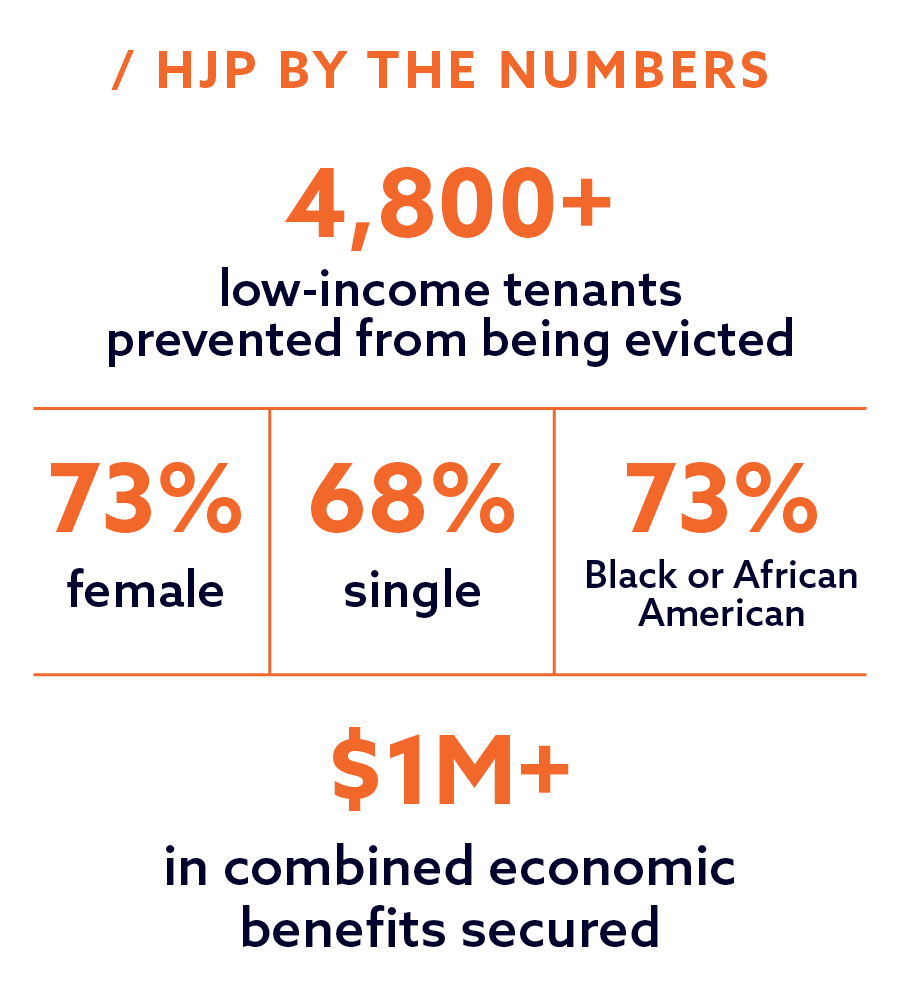 Between 2019 and 2021, the cohort worked on disrupting the cycle of evictions faced by low-income tenants, resulting in some impressive feats. The Fellows increased access to justice for low-income tenants by collectively assisting more than 4,800 low-income tenants through legal advice, brief service, and full-scope representation. Of the tenants served, 73% were female, 73% were Black, and 68% of clients were single. Many of the single clients identified themselves as single mothers. In helping tenants and families stay in their homes, Fellows were able to secure more than $1 million in combined economic benefits for their clients in rent relief, fee waivers, etc.
Additionally, the Fellows strengthened tenants’ capacity to advocate for their own interests by conducting more than 326 presentations (virtually and in person) for over 40,000 low-income tenants on an array of topics, such as “Know Your Rights,” addressing substandard housing conditions and repairs, challenging unfair and unlawful lease terms, eviction advice, as well as understanding changes to housing laws and Housing Choice (Section 8) vouchers. In one example, after seeing Fellows featured on the local news, residents at a Section 8 subsidized complex showed up to a presentation to share the problems they were having in their apartment building and schedule time with the Fellows to collect more information.
Empowering tenants by providing them with both representation and information is the most efficacious way of ensuring the eventual diminution of the constant imbalance of power between landlords and tenants.
HJP Participant
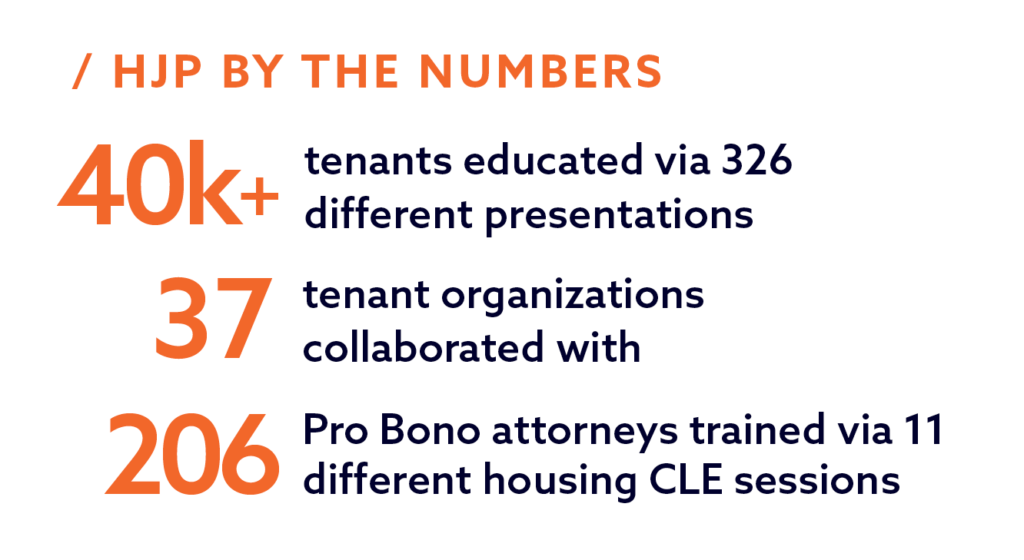 During their time in the program, Fellows were able to support the development and strengthening of tenant organizations. They assisted with the formation of seven new tenant associations, and strengthened six pre-existing groups and collaborated with 37 separate organizations focused on housing justice. The level of community outreach achieved by the Housing Justice Program is an excellent example of the strength in collaboration between Fellows. Organizers, familiar and well trusted in the community, helped recruit tenants and build trust for the attorney Fellows.
To help increase capacity of the legal aid community in the Greater Richmond Region, Fellows developed and conducted 11 housing law continuing legal education sessions attended by 206 pro bono attorneys. Fellows also developed tools for eviction lawsuits filed in violation of the CARES Act that were shared with legal aid attorneys throughout Virginia.
As a result of the Housing Justice Program, several of the legal services host organizations started to work together collaboratively on legislative reforms. This team of Fellows enhanced our understanding of how we can use our particular skill sets to enhance each other’s work.
HJP Supervisor
Perhaps most importantly, the Fellows supported systemic change to further empower tenants. Housing Justice Program Fellows collaborated with their host organization supervisors and Equal Justice Works, to yield at least 111 media placements and at least 36 meetings with policy makers at the local and state level. They also raised the voices of tenants during the legislative session. These combined efforts resulted in multiple changes to Virginia’s landlord tenant laws.
In the courtroom, Fellows provided “friend of the court” guidance for pro se litigants and, upon request from the bench, provided education to the judges to keep them abreast of the quickly changing laws affecting landlords and tenants during the COVID-19 pandemic. For example, Fellows succeeded in getting the Petersburg General District Court to include a resource sheet with all eviction lawsuits served on tenants in Petersburg that included information about how to access the Virginia rent relief program, the Virginia Poverty Law Center eviction hotline, and legal aid. Overall, their actions led to improvements in the administration of justice as more courtroom practices became aligned with intended eviction protection policies, and generated momentum towards tenants having the right to be represented by counsel in housing cases in Virginia.
The Housing Justice Program amplifies the success of Equal Justice Works Fellowship Programs, and shows that a team approach with dedicated lawyers and community organizers focused on a single issue with training and support produces far better and lasting results.
“This Equal Justice Works Fellowship provided an invaluable opportunity to build bridges across multiple organizations to accomplish meaningful work with a group of like-minded, committed attorneys,” 2021 Fellow Morgan Colonna.
Recently, Equal Justice Works successfully secured $3.75 million from national foundations to expand the Housing Justice Program into other jurisdictions with high eviction rates in Virginia and beyond, including Hampton Roads, Virginia, a region encompassing four of the top-ten evicting cities in the country. The second cohort of the Housing Justice Program will be in the field in 2022.
This Equal Justice Works Fellowship provided an invaluable opportunity to build bridges across multiple organizations to accomplish meaningful work with a group of like-minded, committed attorneys
Morgan Colonna /
2021 Equal Justice Works Fellow
Read more stories about the work of the first cohort of the Housing Justice Program:
- Tackling Housing Instability Through Medical-Legal Partnerships
- The Way Forward: Investing in Legal Representation for Tenants at Risk of Losing Their Home
- In the Spotlight: Housing Justice Program Community Organizer LaFonda Page on Helping Tenants Assert Their Rights
- Fighting for Fair Housing Practices in Richmond, Virginia
- Teaming Up to Address the Housing Crisis in Richmond
- Preventing Evictions and Increasing Protections for Tenants in Virginia: The Story of the Equal Justice Works Housing Justice Program
- Equal Justice Works Housing Justice Program Continues to Fight for Tenants as Mass Evictions Loom
- The Right to Safe, Decent, and Discrimination-Free Housing
- Standing Up for Tenants, Close to Home
- Fighting the Eviction Crisis in the Greater Richmond Region
By Scott A. Sloss, 2021 Equal Justice Works Fellow sponsored by Thomson Reuters and Shearman & Sterling LLP

Being a veteran and working with veterans allows me to connect with my clients in a different way than non-veterans. While my bond is one of a shared experience, non-veterans can also establish a close rapport with their veteran clients. Establishing that connection begins like it would with any other client: listening to their story and finding common interests. These commonalities should ultimately develop into a trusting relationship. From a veteran’s perspective, there are some common misperceptions on how to create this bond. Here are five things you should know when interacting with veterans.
1: Be You!
One of the building blocks of trust is being genuine in who you are. Stay away from comments such as “I almost signed up” or “I always wanted to serve, but never did.” Non-veterans, who may have thought about serving, may feel that they can make a connection by sharing such thoughts. Although we understand what people are trying to do, the truth is, the non-veteran did not serve so there is no connection to be made through these types of statements. Comments like these are often seen as someone trying to be something they are not. Don’t compromise who you are in an attempt to relate to your client. Be honest and genuine with who you are. Veterans will appreciate you for being you, and your willingness to help them.
2: Women are Veterans too
Don’t fall into the stereotypical trap that veterans are old men, who wear ball caps, and tell war stories. The fact is, women veterans exist—and there are a lot of them—and they are often not recognized for having served our nation. Beyond recognition, women experience similar struggles men have in receiving appropriate medical care through the VA system. The VA system was originally designed to serve men, and this has created unique issues for women veterans to navigate. Don’t allow your misconceptions to cost you a chance to connect.
3: Listen to their story
Every veteran has a story to tell. This is especially true when you are talking with a veteran looking for assistance. Actively listen to their story to understand why the veteran is there and where they need your help.
4: Served vs. Veteran
Not everyone who has served considers themselves a veteran. The reasons vary, but some individuals do not want to identify themselves as veterans. When trying to identify a veteran ask, “have you served in the military?” rather than “are you a veteran?”
5: Know your Veteran resources
Navigating through all the available veterans benefits and programs can be a daunting task for any individual. Fortunately, there are many local and national organizations that are available to assist. Locate and learn about each of these organizations, and make connections with your local resources to establish a working relationship with them.
Being a veteran has benefited me in serving the veteran population. It has allowed me to establish trust and build relationships with my clients. Non-veteran lawyers can have the same impact. These five tips can help any non-veteran lawyer connect with veterans. But, regardless of the population your serve, be true to who you are and know who the client is that you are serving.
At Equal Justice Works, we are proud of Scott and other Fellows for helping veterans with their unmet legal needs. To learn more about Scott’s Fellowship, visit his Fellow profile here.
Regardless of the population your serve, be true to who you are and know who the client is that you are serving.
Scott A. Sloss /
2021 Equal Justice Works Fellow

Rochelle McCain, executive director of the professional development office and co-director of the externship program at University of Pittsburgh School of Law, recently chatted with Equal Justice Works about becoming a member of the National Advisory Committee, and her work helping law students cultivate their public service passions.
Earlier this year, you were selected to serve on the Equal Justice Works National Advisory Committee (NAC). What motivated you to apply to join the NAC? How does your work as a law school professional inform your role on the committee?
In my life, I have always sought to do everything with intentionality to positively impact, and for the benefit of, others, not solely myself. To that end, I try to identify opportunities to advance and facilitate support of the public good, committing fully and actively. After years of working in my law school community, I resolved that the timing was right to give back to Equal Justice Works—an organization whose mission I share and that does so much nationally to support generations of public interest leaders.
I hope that my skills and experiences, coupled with the relationships I have developed as a law school professional, can support the organization’s efforts in serving the law school community and law students more broadly. In representing the Mid-Atlantic region, my work as a law school professional deeply informs my role on the NAC. I readily draw upon my expertise and experiences with colleagues, students, and alumni, to provide a perspective that is uniquely attuned to the challenges and opportunities the region encounters within the public interest space.
In your role at University of Pittsburgh School of Law (PittLaw), you counsel students and alumni on all aspects of job searching and career development. What are some of the biggest concerns that your students have expressed about pursuing their public service passions?
Some of the most pressing concerns raised by students stem from the job search process itself. Many often share concerns/uneasiness regarding the process itself of finding a public interest position. In particular, the constraints found inherent in the public interest hiring process versus that of the private sector’s recruiting process are often raised. What further complicates the job search process is that some may be geographically limited or focused on niche interest areas that may be challenging to break into at the onset of their careers, which many perceive as limiting their options. For some, pursuing a public interest career path may be one less taken among their peer group, so they express feelings of isolation, and some even question their ambitions.
In addition, students regularly worry about sustaining meaningful careers while navigating external financial pressures/considerations they face. Recognizing that public interest sector salaries are substantially lower than many private-sector options, many students are conflicted by their very real financial constraints, whether due to familial obligations or student loan debt. While many public interest employers can provide great substantive experiences, some contend with financial constraints that bear out in their ability to offer paid summer opportunities and competitive entry-level attorney salaries. This environment can often make those interested in pursuing the path restricted from doing so. In the wake of continued uncertainty surrounding the future public service loan forgiveness and economic challenges of our times, some contemplate whether their passions are enough to make the pathway a viable option.
What steps can law schools take to remedy those concerns?
Law schools are well-positioned to think creatively about how they can mitigate some of the “pain points” in the public interest job search process for law students. For many, it may simply start with identifying the public interest students and creating a support system/cohort to ensure they are supported to face the unique challenges of a public interest search. In my experience, I have found my students respond well to having information so they can make informed decisions and put a plan in place. To accomplish this, it may require law schools to create resources, seek innovative regional collaborations with other law schools and/or public interest employers, and broader amplification of existing public interest career resources (including PSJD.org and especially Equal Justice Works).
But, not every law school has the financial wherewithal to significantly reduce or eliminate the financial barriers its students face due to a broader operational budgetary concerns. So, law schools may want to think resourcefully about their fundraising strategies and how to include public interest giving, the establishment of summer funding resources, sponsorship of a post-graduate fellowship program, development of a loan repayment assistance program, etc.
Many law schools already strive to support their public interest students but some concerns and challenges may not be easily addressed by individual institutions and may require a concerted effort by the broader profession and industry.
You also manage the judicial clerkship program at Pitt Law. What advice do you share with students who are interested in securing judicial clerkships or exploring government (federal, state, and local) opportunities?
One of the biggest nuggets of advice I share with my students interested in pursuing clerkships and government opportunities is not to self-select out of the process. While students should think intentionally about whether a particular pathway is for them, due to the competitive nature of the process of both, coupled with the extensive applications, some students may be inclined to opt-out despite being highly credentialed and competitive for the role. Along the same lines, those that overcome the initial desire to opt-out may be discouraged by the process, especially if they experience rejection early on.
While law school is certainly competitive and grades are one of the objective factors by which employers evaluate candidates, many do not base their decisions solely on this factor. I urge students to try to do as well as they can during law school, but that is not limited to academic success. Students can also benefit as well by taking time to build relationships with others in the profession, take advantage of opportunities for experiential learning (clinics, externships, practicums, work experiences in the field, extracurricular activities such as student organizations and trial teams/competitions, pro bono) to round out applications and reflect practice readiness, and communicate with our office and faculty members as we may be in a position to support their aspirations and provide additional guidance.
I can attest to watching students shatter the “glass ceilings” placed upon them and their potential by themselves and others. With some savvy, support, hard work, connections, guidance, and understanding of their expectations and the profession, quite a bit is possible. The search can be a marathon with twists and turns so patience and perseverance is key along with a great support system.
Pitt Law has a pro bono recognition program for law students who engage in significant amounts of public service work, without academic credit or financial compensation. Why is it important for law students to take part in public service activities? What are some ways students can become involved in pro bono work on campus and in the community?
As members of the legal profession, we possess unique skills to advance and benefit the greater good. Pro bono is an obligation of our profession, as stewards of law. The duty is not just one solely owned by students and attorneys within the public interest sector to bear but for us all to share in regardless of our chosen practice pathways. By understanding and leaning into this duty early on, many reduce any apprehension around pro bono engagement and may increase the likelihood of continued pro bono engagement throughout practice.
Pro bono can also provide broader benefits to law students personally. Beyond fulfilling this call, many law students are able dabble and explore a variety of practice areas, gain practical experience and put the skills learned in law school to the test, and work collaboratively with practitioners. Students can see and be involved with “lawyering in action” with real problems, challenges, and consequences.
Students can find various ways to get involved in pro bono work on campus and in the community. Interested students should think about starting small by just committing to the idea. Once they have done so, they can often begin within their law school community. Many law school staff and faculty members are involved directly with pro bono efforts and welcome having students involved, especially if there is no dedicated office or point of contact at the institution to support pro bono. At Pitt Law, one of my colleagues works closely with students and the community to identify service opportunities. Students can also engage in pro bono by galvanizing around issues important to them and addressing areas of direct and immediate need. Organizations like Equal Justice Works can serve as a platform to engage. Additionally, law students can work within law student organizations to engage in established service projects. And broadly, some bar associations have pro bono coordinators or centers that support legal pro bono that may be willing to partner and serve as a nexus between community organizations and students.
To learn more about our National Advisory Committee, visit here.
Pro bono is an obligation of our profession, as stewards of law. The duty is not just one solely owned by students and attorneys within the public interest sector to bear but for us all to share in regardless of our chosen practice pathways.

By Samantha Osaki, a 2021 Equal Justice Works Fellow sponsored by The Lavan Harris Family. Samantha is hosted by the ACLU Voting Rights Project.
I fight for the representational rights of people who are incarcerated, because fair maps are at the heart of our democracy—and to move the needle on social justice, we must ensure that all voices carry equal weight.
I was inspired to work at the intersection between voting rights and criminal legal reform because as a Yonsei (fourth-generation) Japanese-American, I carry the legacy of a different form of incarceration: one that targeted Japanese Americans during World War II.
My grandfather and his family lost everything but what they could carry into the horse stalls and high-security desert camps where they were imprisoned for four years. After my grandfather was released, he struggled to find work due to the stigma of his race and for being a so-called “No-No Boy” (conscientious objector). The loss my family experienced has reverberated through the generations, and I work to help break cycles of systemic injustice for all families.

Prison gerrymandering is a complex issue, but at the heart of it, it’s about the right of people who are incarcerated to be counted like everyone else: as members of communities they call home and that represent their interests. When people are counted as “residents” of their prison cells, it results in a population skew that ensures the bodies of mostly Black, Indigenous, people of color in prison are used to bolster the voting strength of the largely white, rural districts where incarceration facilities are located. This process touches the lives of millions by diluting the voting strength of home communities. Because redistricting happens only once per decade, this unfair distribution of power continues long after the people who are incarcerated return home. The racial injustice of this practice is clear, leading many scholars to liken prison gerrymandering to the Three-Fifths Compromise.
The loss my family experienced has reverberated through the generations, and I work to help break cycles of systemic injustice for all families.
The most effective way to end prison gerrymandering would be through national legislation or a policy change at the U.S. Census Bureau mandating that people who are incarcerated be counted at their homes. Short of that, state legislatures and redistricting commissions may work with state departments of corrections to ensure that people who are incarcerated are fairly counted at their homes.
At the ACLU Voting Rights Project (VRP), I work with ACLU affiliates across the nation to advocate that redistricting commissioners and legislators end prison gerrymandering. Much of this work involves raising public awareness by speaking before coalitions and leveraging media outlets but may also include litigation. Most recently, my team submitted an amicus brief in Adkins v. Virginia Redistricting Commission, a lawsuit that attempted to overturn Virginia’s law ending prison gerrymandering. This case is a stark reminder that vigilance is necessary, even after laws ending the practice are passed.
Because redistricting happens only once per decade, this unfair distribution of power continues long after the people who are incarcerated return home.
In addition to my own project, I have had the opportunity to integrate myself fully within the incredible VRP family. Last November, I helped to ensure that lawfully cast votes were counted during the 2020 presidential election (Trump v. Boockvar, Hotze v. Hollins) and now I am working on active cases in Texas and Wisconsin challenging voter suppressive laws.
During my second year as a Fellow, I hope to continue my legislative advocacy to end prison gerrymandering in states including New Mexico, as well as continue to root myself more firmly at the intersection of criminal legal reform and voting rights by helping to expand my team’s rights restoration work.
To learn more about Samantha’s work to end prison gerrymandering, visit her Fellow profile here.
Equal Justice Works invites eligible organizations to submit proposals to participate as Host Organizations in Equal Justice Works’ second cohort (Cohort 2) of the Housing Justice Program.
The Equal Justice Works Housing Justice Program mobilizes a cohort of lawyers and community organizers working collaboratively as Fellows to serve low-income individuals residing in Virginia who are currently or at risk of experiencing housing instability and involuntary displacement, particularly due to eviction.
Cohort 2 will expand the efforts of Cohort 1 of the Housing Justice Program from the Greater Richmond Region to Northern and Eastern Virginia, and be comprised of 8 attorney Fellows and 4 community organizer Fellows. Host Organizations will participate in the Housing Justice Program by hosting one or more Fellows; organizations may apply to host attorney Fellows, organizer Fellows, or a combination of both. These 12 Fellows will work cooperatively to:
- Provide direct legal assistance including advice, referrals, and full representation for tenants in eviction proceedings;
- Build collaborative partnerships with community organizations and provide referrals for wraparound services;
- Engage in outreach including know-your-rights presentations and workshops, legal clinics, and intake events around housing issues; and
- Identify patterns, organize tenants, engage in impact litigation to challenge structural issues, and educate key stakeholders around the causes and consequences of housing instability.
Fellows will serve for two years, starting no earlier than February 21, 2022, and ending no later than 24 months after the Fellow’s start date.
The Housing Justice Program is funded by The JPB Foundation and JPMorgan Chase.
Please see links to the full Request for Proposals (RFP) and accompanying appendices below. Proposals must be submitted by Tuesday, November 30, 2021, 11:59 p.m. Eastern Standard Time via email to [email protected].
If you are interested in submitting a proposal, please complete this brief Intent to Apply Survey and specify how many Fellows (lawyers and/or organizers) you are interested in applying for by Monday, November 8, 2021.
Resources
Before applying, please review the following materials:
- Equal Justice Works Housing Justice Program RFP No. HJP-20A06
- Equal Justice Works Standard Grant Award Conditions for Non-Federal Grants
- Sample Fellow Position Description, Attorney Fellow
- Sample Fellow Position Description, Organizer Fellow
Templates & Forms
The following materials are required for submission:
- Applicant Information Form
- Proposal Narrative
- Budget Template
- Policy Certification
- Certification for Data Privacy
If you have any questions about the application process, please reach out to [email protected].
By Cesar Ruiz, a 2021 Equal Justice Works Fellow sponsored by The Lavan Harris Family. Cesar is hosted by LatinoJustice PRLDEF in New York.
My Equal Justice Works Fellowship project stems from the political and socio-economic reality of millions of Latinx individuals throughout our country. Particularly, in New York and Florida, where Latinx communities make up between 15% and 20% of each state’s voting age population, yet lack meaningful representation and engagement in key political processes.
As a result, Latinx voices go unheard and political actors and systems have been able to avoid accountability when it comes to issues that deeply impact the Latinx community. My works aims to help improve access through voting rights and redistricting education, engagement, and advocacy efforts.
The sad reality is that voter denial and voter dilution permeate voting policies and practices at the federal level and throughout the states of New York and Florida. These efforts exist to deprive Latinx communities access to political representation and crucial resources. Voter denial practices, such as recent restrictions on the ability to vote by mail in Florida, serve to curtail an individual’s right to vote. Voter dilution is the practice of reducing the effectiveness of racial and ethnic minority voting power through both voting practices and the drawing of federal congressional and state legislative district lines in the redistricting process. Voter dilution diminishes the ability of communities of color to elect candidates of their choice, reducing their agency to elect leaders that represent their collective interests. Taken together these actions distort political representation and disrupt the functioning of our democratic system.
Following the 2020 presidential election there have been concerted efforts to undermine a person’s right to vote. In the past year alone, hundreds of bills have been introduced under the guise of ensuring election integrity, even though most election security experts have concluded the 2020 election “was the most secure in American history” and that “there was no evidence” any voting systems had been compromised. Voting protections are crucial because they serve as safeguards to ensure that all eligible voters can participate in our democratic system. Without laws to protect the right to vote we leave communities of color vulnerable to unscrupulous actors who seek to silence the political voice of the marginalized.
Without laws to protect the right to vote we leave communities of color vulnerable to unscrupulous actors who seek to silence the political voice of the marginalized.
Through my work, I engage Latinx communities across New York and Florida, facilitating access by shining a light on complex voting and redistricting systems, policies, practices, and working to eliminate other barriers that prevent people in Latinx communities from voting.
In my first Fellowship year, I hope to expand access to knowledge within the Latinx community regarding redistricting and voting rights in both New York and Florida while building and enhancing current coalitions and networks. Through collective engagement, planning, and collaboration we can build upon existing advocacy efforts and promote renewed and continuing investment in Latinx political representation and community engagement. I’m confident that this work will make a huge difference in the fight for our democracy.
To learn more about Cesar’s Fellowship project and his work safeguarding the right to vote in Latinx communities, visit his Fellow profile.