Equal Justice Works Announces 2023-2025 National Advisory Committee Members
Equal Justice Works, the nation’s largest facilitator of opportunities in public interest law, today announced the newest members of its National Advisory Committee.
Formed in 2003, the National Advisory Committee (NAC) is a diverse group of law students and law school professionals who serve as Equal Justice Works ambassadors within the law school and legal services communities. NAC members extend the reach of Equal Justice Works initiatives by providing leadership, feedback, and outreach assistance to support the organization’s mission to create opportunities for lawyers to transform their passion for public service into a lifelong commitment to equal justice.
“These new National Advisory Committee members will provide insight to how Equal Justice Works can best serve law students and the communities supporting them,” said Aoife Delargy Lowe, vice president of law school engagement & advocacy at Equal Justice Works. “We are thrilled to welcome each of these new members to our NAC.”
NAC members serve two-year staggered terms, and each year we welcome new members to replace those who have completed their terms of service. This year, the Committee welcomes four law students and four law school professionals. The newest members of the 2023-2025 National Advisory Committee include:
Law Students:
- Christopher Kloth, Barry University Dwayne O. Andreas School of Law
- Kelsey Gunvalson, University of Wisconsin Law School
- Louis Lin, Harvard Law School
- Nick Weinrib, Elon University School of Law

Law School Professionals:
- April Giancola, Campbell University, Norman Adrian Wiggins School of Law
- Claire Abely, Boston University School of Law
- Elizabeth Boe, DePaul University College of Law
- Merce’de Savala, Washington University in St. Louis School of Law

“I joined the National Advisory Committee to share ways that students can impact the public interest sphere and serve underrepresented communities,” said new member, Kelsey Gunvalson. “I am honored to serve the NAC by communicating with law students about the range of public interest careers available to them through Equal Justice Works.”
I joined the National Advisory Committee to share ways that students can impact the public interest sphere and serve underrepresented communities.
Kelsey Gunvalson /
2023-2025 National Advisory Committee Member
Equal Justice Works National Advisory Committee
The NAC hosted its annual meeting on August 15, 2023. At the meeting, members brainstormed how to best expand access to justice and increase knowledge and understanding of public interest law in their respective regions.
For more information about the National Advisory Committee members and to see a current list of members, visit here.
Congratulations on graduating law school! It’s now time to prepare to pay back your student loans.
After you graduate, your federal student loan goes into repayment. If you hold a Direct Subsidized, Direct Unsubsidized, or Federal Family Education Loan, the standard grace period is six months. Other loan types may have differing grace periods (the promissory note you signed for your loan tells you the length of your grace period).
Before your grace period ends:
- Update your contact information on studentaid.gov and your loan servicer. If you are not sure which servicer your loans were transferred to, log into your Federal Student Aid dashboard and scroll down to the “My Loan Servicers” section. If you have trouble logging in, call 1-800-4-FED-AID (1-800-433-3243) for loan servicer information.
- Once you know who your loan servicer is, enroll in autopay. This can save you 0.25% on your interest rate.
- Don’t ignore messages you receive from your loan servicer. Missed payments do not count towards PSLF, unless you repay the amount due within 15 days of the due date.
When your loan enters repayment, your servicer will automatically place you on the Standard Repayment Plan unless you choose an Income-Driven Repayment plan (IDR)—the better option for you if you are planning to work in public interest law.
Generally, under the standard repayment plan, payments are fixed over 10 years. While you might usually pay less overtime than under other plans, this is not a good option if you plan to earn Public Service Loan Forgiveness (PSLF) while working in public interest law. In this case, it makes sense for you to enroll in an income-driven repayment plan (IDR). An IDR plan is based on your income, and your monthly payment amount will depend on what repayment plan you choose.
The Department of Education announced a new income-driven repayment plan called ‘SAVE.’ To date, 4 million borrowers have enrolled in this new plan that will replace REPAYE. The Department of Education believes, in total, 20 million more borrowers are eligible for SAVE, and would see significant relief by enrolling in it—you might be one of those borrowers. Read more about SAVE here.
Prepayments and PSLF:
If you ultimately want to earn PSLF, prepayments on your loan while you are in school or during your grace period will not count towards the 120 payments needed to earn forgiveness, so keep that in mind. If you have privately held debt, this might be worth prioritizing paying down during your grace period.
If you’re past your grace period, in repayment, and have accepted a job in public interest law, consider this:
Once you start your working in public service and are in repayment, get into the habit of certifying your employment for PSLF. It’s not required, but best practice, to fill out and submit the PSLF form annually or whenever you change employers. This can save you a lot of stress in the future by getting to this practice. We recommend using FSA’s PSLF Help Tool to do this.
At Equal Justice Works, we are committed to ensuring that no law student or lawyer is deterred from a public interest legal career by the burden of student debt. Through our work, we support aspiring and current public interest lawyers to understand the often-complex student debt landscape. We know minimizing the burden of student debt is crucial in supporting public interest legal careers, which in turn, are crucial to the benefit of our communities and justice system.
Earlier this summer, as part of the debt ceiling signed by the President, the payment pause that began at the start of the COVID-19 pandemic will end with no further extensions offered. As a result, interest on student loans will accrue starting on September 1, 2023, and payments will be due starting in October.
If you graduated from law school during the payment pause and are about to make student loan payments for the first time, now is the time to ensure you are in the best payment plan and are ready to make your first payment. Your first payment will be due in October 2023, unless you graduated recently (within the last 6-9 months) and will still be in your automatic grace period (usually six months).
If you are working in public interest law, these steps should set you on the right path to eventually earn Public Service Loan Forgiveness (PSLF).
- Update your contact information on studentaid.gov and your loan servicer
Wrong contact information with either could make you miss important updates regarding your student loans. If you are not sure which servicer your loans were transferred to, log into your Federal Student Aid dashboard and scroll down to the “My Loan Servicers” section. If you have trouble logging in, call 1-800-4-FED-AID (1-800-433-3243) for loan servicer information. For more help in identifying your loan servicer, click here.
- Enroll in or recertify your income driven repayment (IDR) plan
As its name suggests, an IDR plan is based on your income. To earn PSLF, it is critical to choose a qualifying repayment plan. Qualifying repayment plans include all of the income-driven repayment (IDR) plans (plans that base your monthly payment on your income and household size) and the 10-year Standard Repayment Plan. Your monthly payment amount will depend on what repayment plan you choose. If you don’t choose a plan, you’ll be put on the Standard Plan (not an income-driven plan). Keep in mind the Standard Repayment Plan for Direct Consolidation Loans, Graduated Repayment Plan, and Extended Repayment Plan do not qualify for PSLF. You can use FSA’s Loan Simulator to explore your repayment options to see how much your payments will be on the plans.
The Department of Education announced a new income-driven repayment plan called ‘SAVE.’ If you are already enrolled in the REPAYE Plan or sign up for the REPAYE plan now, you will automatically be transferred to the SAVE plan. Under SAVE, your monthly payments will drop by at least $1,000 annually and any unpaid interest will be erased on a monthly basis. Read more about SAVE here.
- Consider enrolling in autopay
With your loan servicer, enrolling in autopay can save you 0.25% on your interest rate. You’ll get a reminder before every payment is made and get your monthly payment amount at least 30 days before your first due date. You should get your first bill at least 21 days before your due date. If you were enrolled in autopay before the payment pause, you’ll most likely need to re-enroll in autopay.
- Pay attention to messages you receive from your loan servicer
The Department of Education has promised that for the next year, any missed, partial, or late payments will not result in default or loans being sent to collection agencies. In addition, missed payments will not be reported to credit reporting agencies. However, missed payments do not count towards PSLF, unless you repay the amount due within 15 days of the due date.
- If you still can’t afford to make student loan payments, you can consider temporary relief options, such as forbearance and deferment.
You may need to apply for forbearance or deferment, which temporarily lower or pause your payments. Keep in mind these affect loan forgiveness options, such as Public Service Loan Forgiveness or IDR plan forgiveness.
- Use the PSLF Help Tool to certify for qualifying employer
If you are working in public interest law, it is not required, but good practice, to fill out and submit the PSLF form annually or whenever you change employers. This can save you a lot of heartache down the line when you’d have to submit PSLF forms for each employer you worked for all at once. It could become difficult to contact those employers after such a long time or you could discover that some of your employers do not qualify. You can use the PSLF Help Tool to complete your PSLF form, send your form to your employers for their digital signature (certifying your employment), and finally, electronically submit your form to the PSLF servicer for processing.
At Equal Justice Works, we are committed to ensuring that no law student or lawyer is deterred from a public interest legal career by the burden of student debt. Through our work, we support aspiring and current public interest lawyers to understand the often-complex student debt landscape. We know minimizing the burden of student debt is crucial in supporting public interest legal careers, which in turn, are crucial to the benefit of our communities and justice system.
The expiration of pandemic-era tenant protections and rising rents have yielded an increase in eviction filing rates and the number of tenants in need of legal representation. The Equal Justice Works Housing Justice Program conducted a nationwide community needs assessment in May 2023 to understand how organizations are meeting the increasing need for housing legal services. Equal Justice Works distributed this needs assessment to more than 300 partners nationally and received 92 responses from across 29 states and the District of Columbia. The responses confirmed that there is a significant gap between community need and the capacity of legal aid organizations to provide housing-related legal services. The results of the needs assessment illustrated that:
- 93% of legal services respondents indicated that their organization does not have the capacity to serve all eligible individuals seeking services for housing and eviction related issues.
- 76% of respondents indicated that their service area does not have adequate access to free or affordable legal services related to housing stability.
- 45% of respondents reported receiving a large increase in requests for housing-related services in 2023 (21-50% increase from normal intake), and 12% reported a massive increase in requests for services (51%-100%+ increase from normal intake).
Respondents noted several internal challenges related to meeting legal needs, including difficulty with staffing, retention, and increased caseloads. Despite 70% of respondents employing dedicated housing attorneys, only 5% are fully staffed to handle all eligible clients seeking housing services. To increase capacity, organizations have sought to grow the number of housing attorneys on staff. Seventy-five percent of respondents have increased the number of full-time housing attorney positions at their organizations since 2020; however, filling the positions is not always easy. Thirty-five percent of respondents reported that it typically takes 4-6 months to recruit a housing attorney and 10% reported that the process takes 7-9 months. Once hired, respondents indicated housing attorneys typically only stay for 1-3 years. Since most organizations do not have the staff capacity to serve all eligible individuals, they often must refer them to other providers, pro se materials, or provide limited scope service to try to address needs in their service areas.
Equal Justice Works enhances the capacity of legal aid to provide housing services by attracting and training talent through our Housing Justice Program. The needs assessment results indicate that 93% of respondents are interested in hosting an Equal Justice Works Housing Justice Program Attorney Fellow to increase their service capacity. Several organizations elaborated on their desire to partner with the Housing Justice Program:
- “We could really use help with hiring an EPP attorney in Columbia, SC. An Equal Justice Works Fellow would be a revelation!”
- “We are in dire need of capacity building strategies and support, and would welcome conversations to build this in NYC.”
- “The housing issue in L.A. is dire and our clients, specifically transition-age youth and nonminor dependents, often slip through the advocacy cracks… We are excited to expand our advocacy efforts to include housing and hopeful that we can take these steps to build our program soon.”
Respondents to the needs assessment explained that, in addition to hiring more attorneys, they hope to improve housing stability in their communities through organizing and encouraging legislative change.
- 33% of organizations currently engage in tenant and community organizing.
- 67% of organizations participate in policy advocacy. The most common policies advocated for are right to counsel, just cause protections, and emergency rental assistance.
- Of the organizations that participate in policy advocacy and tenant organizing, 80% are interested in hosting an Equal Justice Works Housing Justice Program Organizer Fellow.
Housing Justice Program Organizer Fellows assist their host organization and service area by advocating for reforms, conducting outreach and education on tenants’ rights, and helping form tenants’ associations. They also bolster the work of the Attorney Fellows by building trust between community members and legal service organizations and emphasizing the importance of having representation in court. Current Housing Justice Program Organizer Fellow DeAnna Smith recently wrote about the importance of community outreach and how it can help remove barriers to accessing legal counsel.
The results of the needs assessment underscore how the Housing Justice Program can continue to enhance the capacity of legal aid organizations across the country to meet the needs of low-income renters. As the nation’s largest facilitator of public interest fellowships, Equal Justice Works attracts top talent to our programs and provides tailored training to support the work of our Fellows. Our Housing Justice Program Fellows have helped nearly 4,000 households avoid eviction, secured $2.3 million in economic relief for tenants, and helped to pass tenant protections such as rent control. The program currently operates in Maryland, South Carolina, and Virginia, and aims to expand into new states in 2024.
Learn more about the key findings of the Housing Justice Program Needs Assessment by reading the report here.
If you or your organization are interested in lending support to expand the Housing Justice Program to meet the community needs highlighted in this report, please contact us at [email protected].
The Housing Justice Program includes Fellows hosted across Maryland, South Carolina, and Virginia. The Housing Justice Program is made possible thanks to the generosity of The JPB Foundation, JPMorgan Chase & Co., Abell Foundation, Maryland Legal Services Corporation, and Sisters of Charity Foundation of South Carolina, and the Community Foundation for a Greater Richmond.
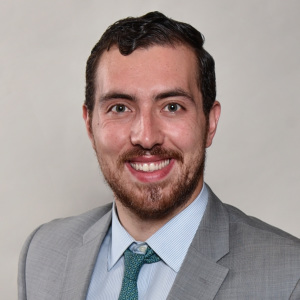
By Zach Outzen, 2022 Equal Justice Works Fellow. Zach is hosted by National Veterans Legal Services Program and sponsored by the Lavan-Harris Charitable Fund.
Growing up in a family with six Army veterans, I have had a lifetime to become familiar with military and veterans’ culture without being a veteran myself. Luckily, you don’t need that background to connect with veteran clients and successfully advocate on their behalf. When building rapport with veteran clients, the following fundamentals of an attorney-client relationship apply: be empathetic, friendly, competent, and trustworthy. Understanding the nuances specific to the military and veterans’ community is also important. Here are five tips to help you connect with military and veteran clients:
- Understand that there is a distinct military and veteran culture and understand how you fit into it. Cultural competency is crucial when working with any population, including servicemembers and veterans. That does not mean that you should attempt to force a connection with your client, but it does mean that you should be authentic, understanding, and aware of how your client’s background may differ from your own.
- Understand intersectionality in veterans. As America continues to become increasingly diverse, our military has begun to reflect our broader society. Although veterans share a common bond through their service, the lived experience of Black veterans, women veterans, LGBTQIA+ veterans, Indigenous veterans, and immigrant veterans will be different from those who do not share those identities. Understanding intersectionality is crucial to being an effective advocate. For example, seeking a discharge upgrade for a LGBTQIA+ veteran discharged under “Don’t Ask Don’t Tell” will look different from a discharge upgrade for a non-LGBTQIA+ veteran.
- Practice trauma-informed advocacy. Not all veterans identify as having experienced trauma, but many veterans seeking legal assistance do. To build an effective rapport with a veteran with traumatic experiences, ensure that you are comfortable with trauma-informed advocacy and client interviewing skills. In some cases, this will require an empathetic, gentle approach to discussing a traumatic experience that lies at the heart of your client’s legal matter. In other cases, this may entail knowing when a traumatic event—although deeply relevant to the veteran’s personal experience—is not relevant to their legal matter, allowing you to avoid unnecessarily reopening difficult subjects. Understanding how to navigate these dynamics requires a baseline understanding of trauma and the stressors from which it arises.
- Be aware of what resources are available to the veteran. There is a vast network of military and veterans’ benefits programs, as well as national and local resources that can assist veterans with these areas. Sometimes, clients may need help with matters outside of the scope of your representation. If you familiarize yourself with the veterans’ advocacy landscape, you can provide timely referrals to ensure that your client’s needs are met.
- Be aware of resources available to you. Veterans’ law can be a challenging practice area. Cases often involve both legal and medical issues, and the law itself is fast-changing. Fortunately, there is a tight-knit veterans’ law bar with many eager and willing mentors, and many veterans’ advocacy groups are happy to lend their expertise. Never be afraid to seek out help or mentorship, as it is abundantly available and can make a huge difference.
In every case I handle, I apply the five tips above, which I have drawn from my own experience as both an Army family member and second-generation American. I have found that this approach helps me effectively build relationships with my clients. Other non-veteran lawyers can take this approach, as well, to connect with their veteran clients.
To learn more about Zach’s Equal Justice Works Fellowship, visit his profile here.
An Equal Justice Works Design-Your-Own Fellowship presents a one-of-a-kind opportunity to create your dream job. This Fellowship opportunity allows you to leverage your law degree in service of a community or cause of your choice.
Interested in joining this incredible program? Here’s what you need to know about applying for a Fellowship.
How can an Equal Justice Works Design-Your-Own Fellowship jumpstart my legal career?
85% of Equal Justice Works Fellows remain in public service positions and continue to pursue equal justice for underserved communities across the country following their Fellowships. There are more than 2,400 alumni across all Equal Justice Works Fellowship programs. Fellow alums like Casey Trupin have started organizations that now host Equal Justice Works Fellows, while others like Cynthia Cornelius and Michael Pope now serve in leadership positions at the organizations where they were hosted as Fellows.
Who is eligible?
Our Design-Your-Own Fellowship is open to individuals who have graduated from an Equal Justice Works Member Law School before September 2024 with a J.D. or LLM. Applicants may not have previously held a full time (more than 30 hours/week), permanent, public interest lawyer position, though applicants coming from bridge/gap fellowships or clerkships are eligible. For more specifics about eligibility requirements, check out page five of our applicant guide.
What type of training do Equal Justice Works Design-Your-Own Fellows receive?
Each fall, Equal Justice Works provides Fellows with three days of Leadership Development Training with experts in the field. The training equips Fellows with necessary practical leadership and management skills to help them succeed in their Fellowships and beyond. It also provides Fellows with opportunities to learn more about working in specific fields of public interest law and to network with peer Fellows and Fellowship alumni. For more information on the Leadership Development Training, click here.
Throughout the two-year program, Equal Justice Works also provides Fellows with virtual and in-person networking and learning sessions; optional, periodic training opportunities; and tools, resources, and other assistance to support their work.
What type of work can I do during my Equal Justice Works Design-Your-Own Fellowship?
You get to decide what type of work best suits your project! Projects may include direct representation, legal education, legal training, community organizing, transactional work, policy work, litigation, administrative representation, or a combination of these strategies. Many successful Fellowship project applications are multi-faceted in their approach while also avoiding utilizing every type of approach available. For more information about eligible projects, check out page five of our applicant guide.
Please visit the Fellow Archive to see what kinds of projects Fellows have done and are doing at nonprofit Host Organizations across the U.S./U.S. territories. We recommend that applicants collaborate closely with their potential future Host Organization to design their project proposal. Equal Justice Works Design-Your-Own Fellowships may be fully remote, fully in-person or hybrid in nature.
How do I find a Host Organization for a Fellowship?
Fellows work at Host Organizations for the two-year duration of their Design-Your-Own Fellowship. Applicants and Host Organization staff work closely to design the Fellowship, though the prospective Fellow is ultimately responsible for submitting the application. Host Organizations must be a nonprofit legal services organization—or an organization able to provide legal supervision—in the United States. More details on eligibility requirements may be found on page five of the applicant guide.
Applicants may search on popular job platforms or social media for organizations who are actively recruiting an Equal Justice Works Fellow. We also recommend reaching out via email or phone to organizations that are already doing the kind of work you are interested in. This could include organizations where you have interned/volunteered, become familiar with during your studies, or which are active in your community or neighborhood. Check out the Fellow Archive and search by Host Organizations for inspiration. However, please note that there is no need for an organization to have hosted a Fellow previously in order to host a Fellow in the future! More information is available in the recording of the “How to Apply and Tips to Succeed” webinar (in English hereand in English and Spanish here).
How do I submit a strong Design-Your-Own Fellowship application?
A Design-Your-Own Fellowship project addresses an unmet legal need for an underserved community. A project proposal should paint a picture of the particular problem you want to solve, in the specific community you wish to serve. Standout applications weave in data, client stories, and personal narratives to demonstrate the potential impact of the project, while underscoring the applicant’s strong connection to the issue area and target community. This can include lived experience; what you have seen or experienced as a pressing, under-addressed legal need in your community or neighborhood; academic studies; or volunteerism/internship experience.
Strong applications demonstrate a clear alignment between the applicant and the Host Organization’s mission and work, as well as a strong fit between the applicant and the legal issue the project addresses and/or the community (people, geographical area) that the project serves. As noted above, competitive applications use multiple approaches without employing every approach available. They also present a menu of creative, varied options for potential sponsor involvement.
Competitive applications are also easy to follow and understand from an external reader’s point of view. We recommend assembling a review team of a Host Organization staffer, law school professor, and law school career services staff member to read through your application for clarity, concision, and the extent to which the answers respond to the questions asked.
Our “How to Apply and Tips to Succeed” webinar (available as a recording in English here and in English and Spanish here) includes a deep dive into crafting a competitive application.
We also strongly recommend you register here to attend a “last minute tips” webinar in August or September.
What kind of applications are sponsors likely to support?
Sponsors are the law firms, corporations, foundations, or individuals that fund Fellowships and support Fellows during the two years of their Design-Your-Own Fellowship. While sponsors often specify which issue areas and geographic preferences they will fund, plenty of sponsors have no such preferences and are interested in supporting impactful projects.
Here you will find the current sponsor preference list, which is periodically updated. It shows where sponsors have expressed dedicated interest in the geographic and issue areas; it is neither exhaustive nor final.
Check out webinar recordings with more information on applying for funding by region, and sponsor preferences, here.
Equal Justice Works encourages projects and applications in all geographic and issue areas from applicants who have a passion for pursuing our nation’s promise of equal justice for all.
Are you ready to apply?
The application is divided into three distinct expository sections: the project description, candidate background, and host organization background. Additionally, applicants will also need to provide a personal statement, résumé, professional reference, and two letters of recommendation. To get a sense of what the application entails without logging in to the submission platform, check out this reference application.
For more information about the application process, review page 15 of our applicant guide. Also check out a recording of the “How to Apply and Tips to Succeed” webinar (in English here and in English and Spanish here).
Have more questions?
In addition to the resources linked above, please see the Frequently Asked Questions document.
Technical Questions?
This application cycle, Equal Justice Works is using the Submittable platform for Design-Your-Own Fellowship applications.
Check out the Submitter Resource Center or contact Submittable Customer Support for additional information and with questions/issues. Please note that all technical or Submittable questions should be directed to Submittable Customer Support rather than Equal Justice Works. You can even submit such questions while completing your application!
Be sure to submit your application online here before the deadline on September 12, 2023 at midnight ET. For more information about the Design-Your-Own Fellowship, check out our website!
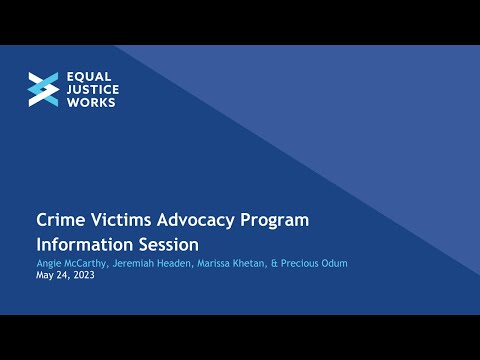
Equal Justice Works recently held an information session about the Crime Victims Advocacy Program (CVAP) highlighting what applicants need to know before applying. At the session, staff members Angie McCarthy, Senior Program Manager, and Jeremiah Headen, Program Manager, chatted with former fellows Precious Odum and Melissa Khetan about their experiences serving victims of crime, and how participation in the program has shaped their careers.
“There is something really cool about feeling like part of a team that’s addressing an issue nationwide and feeling like you’re really making an impact.” said Melissa Khetan, Portfolio Manager at Equal Justice Works and 2018 Equal Justice Works Fellow.
“Having this Fellowship helped make my dreams [of working with trafficking survivors] come true,” said Precious Odum, 2018 Equal Justice Works Fellow. “[This Fellowship gave me] a group of individuals who [shared] the same passions and values I did…and also someone I could go to, to ask questions and receive expert advice and technical assistance.”
The Equal Justice Works Crime Victims Advocacy Program is mobilizing a cohort of Attorney Fellows to increase access to legal aid for survivors of crime, especially in underserved black, Indigenous, and people of color (BIPOC) communities.
Applications to become a Fellow in the Crime Victims Advocacy Program at Equal Justice Works are open! The application deadline is July 14, 2023. Applications are being reviewed on a rolling basis, so apply today!
For answers to frequently asked questions, please visit the Crime Victims Advocacy Program webpage.
Email [email protected] with any questions concerning the application process.
This program is supported by an award under 15POVC-22-GK-01116-NONF, awarded by the Office for Victims of Crime, Office of Justice Programs, U.S. Department of Justice. The opinions, findings, and conclusions or recommendations expressed in this document are those of the contributors and do not necessarily represent the official position or policies of the U.S. Department of Justice.
On May 10, we announced the 76 new Fellows in our 2023 class who will launch their public interest careers through an Equal Justice Works Fellowship of their own design later this year.
In honor of Pride month, we are highlighting some 2023 Equal Justice Works Fellows—Jack Pellicano, Henry MacDonald, and Ellie Rutkey—and their LGBTQ+ rights-focused projects.

At Brooklyn Legal Services, Jack Pellicano (he/they/theirs) will provide tailored civil legal services to support the economic stability and mobility of Transgender and Gender Non-Conforming Non-Binary (TGNCNB) young people living in New York City.
State legislators across the country are expressing intense hostility toward TGNCNB young people, dramatically increasing administrative violence against them. Although New York City has long been a beacon for LGBTQ+ people, there remains a wide gap between the content of New York City and State anti-discrimination laws and the lived experience of TGNCNB young people. The TGNCNB community continues to face rampant discrimination in public accommodations, the workplace, school, and housing—which contributes to cycles of poverty, criminalization, and homelessness faced by many. Jack’s project is designed to address these barriers, with the goal of maximizing the opportunities for TGNCNB young people to live a life filled with joy—beyond mere survival.

At Justice Resource Institute, Henry McDonald (he/him/his) will provide low-barrier, trauma-informed legal services to young Boston-area queer and transgender people of color by establishing a community-based HIV prevention medical-legal partnership.
In Massachusetts, sharp racial disparities persist in measures of HIV risk: Hispanic/Latino individuals face nearly four times the risk of HIV infection compared to white individuals, while Black individuals face nearly eight times the risk of white individuals. By extending HLI’s legal services to the clients at Boston GLASS, Henry will work in tandem with GLASS professionals to address the health-harming legal needs that tend to place the GLASS client population at heightened risk of HIV infection.

At The Door’s Legal Services Center, Ellie Rutkey (she/her/hers) will work at the intersection of housing justice and LGBTQ+ rights to help meet the fundamental needs of unhoused people living in New York City.
In New York City, there are over 7,000 unhoused young people. Despite the broad range of unmet needs that unhoused youth are likely to have, they are chronically underserved by legal providers and may not realize that some of the hardships they face have legal solutions. In response to this, Ellie will seek name change orders and orders of protection to advance the safety of youth who have experienced abuse; represent young people who have been denied public benefits in the fair hearing process; help unhoused youth access education by advocating with secondary schools and post-secondary institutions; and challenge gender-, ability-, or income-based discrimination by houseless shelters and by landlords.
To learn more about Equal Justice Works Fellows and alums supporting the LGBTQ+ community, visit here.
Equal Justice Works is proud to introduce the 2023 class of Disaster Resilience Program Student Fellows. These 14 law students will spend their summer working alongside Disaster Resilience Program Fellows as they help communities prepare for, respond to, and recover from disasters.
“Disasters bring about complex legal issues that require specific expertise in disaster law to solve,” said Linda Anderson Stanley, associate director at Equal Justice Works and special advisor to the American Bar Association Young Lawyers Division Disaster Legal Services Program. “We are proud to support these Student Fellows in their work to expand critical legal resources for communities affected by disasters and their efforts to build more resilient communities.”
Through the Disaster Resilience Program, Student Fellows will gain exposure to disaster preparedness, response, and recovery legal work. They will help to provide civil legal services, engage in community education and advocacy efforts, and build capacity at their host organization.
Meet our Disaster Resilience Program Student Fellows and learn more about how they will be supporting a wide range of disaster-related legal issues, including housing, employment, immigration, accessibility, and health care needs.

Ben Beckman, Lewis and Clark Law School
Ben, hosted at Neighborhood Legal Services of Los Angeles County, will spend the summer representing wildfire survivors in administrative hearings and court cases throughout Los Angeles County. Ben will also conduct client outreach to natural disaster survivors by distributing resources and attending community events.

Cadence Ciesielski, William S. Boyd School of Law, University of Nevada
At New Mexico Immigrant Law Center Cadence will work to address the economic mobility of immigrants impacted by the pandemic through direct services, education, and advocacy with administrative agencies and licensing bodies.

Colton Cronin, Vanderbilt Law School
Colton will work with a newly formed disaster legal team at West Tennessee Legal Services to provide civil legal aid and develop disaster resiliency to West Tennesseans affected by the December 2021 tornado. Colton will also assist with community outreach and the development of disaster legal forms and resiliency tools.

Molly Giguiere, University of San Francisco School of Law (she/her/hers)
At Disability Rights California, Molly will assist in responding to the legal needs of Californians with disabilities before, during, and after wildfire disasters. She will help in partnering with grassroots community groups to strengthen existing disaster resource centers and coalitions and provide accessible clinics, trainings, and direct legal services to people with disabilities.

Drew Hoffman, University of Missouri School of Law
Hosted at Legal Aid of Arkansas, Drew will spend the summer providing direct legal services to people with opioid use disorder, developing educational materials, and conducting community outreach. Drew will engage at an opioid clinic to do eligibility screening and legal interviews for patients with opioid use disorder.
 Julissa Juarez, North Carolina Central University School of Law
At Migrant and Immigrant Community Action Project, Julissa will work with survivors of the 2021 Missouri tornadoes to help prepare immigration cases for affirmative filings and Immigration Court. Julissa will also assist in planning community outreach activities for disaster preparedness.

Jesse Leaneagh, The University of Tulsa College of Law
At New Mexico Immigrant Law Center Jesse will work to address the economic mobility of immigrants impacted by the pandemic through direct services, education, and advocacy with administrative agencies and licensing bodies.

Megna Murali, Vermont Law School
Megna, hosted at Kentucky Legal Aid, will spend the summer attending outreach events organized to perform work required in order to prepare and assist the community in disaster relief. Megna will also assist with legal filing, drafting, and multiple forms of communication.

Tiana Pham, Texas A&M University School of Law
At Disability Rights Louisiana, Tiana will work to eliminate or mitigate barriers to critical programs, services, and housing for people with disabilities in Louisiana who have been impacted by disasters. Tiana will also help expand stakeholder relationships, conduct training and outreach, and share information and resources for disaster survivors.
Michel Ramirez, University of New Mexico School of Law
Hosted at New Mexico Immigrant Law Center, Michel will assist in addressing the legal needs of asylum seekers, unaccompanied minors, and incarcerated immigrants in the New Mexico border region who have been impacted by policies related to COVID 19, human rights, and other disasters. Michel will work on a wide-range of legal issues including asylum and work-permit applications, navigating the detention and removal process, and seeking bond and release.

Taylor Rappeport, University of Colorado Law School (she/her/hers)
Taylor, hosted at Disability Rights Louisiana, will work to eliminate or mitigate barriers to critical programs, services, and housing for people with disabilities in Louisiana who have been impacted by disasters. She will also help expand stakeholder relationships, conduct training and outreach, and share information and resources for disaster survivors.

Kaylee Sheppard, University of Georgia School of Law (she/her/hers)
Hosted at Tennessee Alliance for Legal Services, Kaylee will spend the summer assisting with work on legal issues for individuals and families impacted by the 2021 tornadoes. She will conduct education and outreach, as well as complete other work related to disaster recovery and resilience.
Bella, Bjornstad, University of New Mexico School of Law
At New Mexico Immigrant Law Center, Bella will assist in addressing the legal needs of asylum seekers, unaccompanied minors, and incarcerated immigrants in the New Mexico border region who have been impacted by policies related to COVID 19, human rights, and other disasters. Bella will work on a wide-range of legal issues including asylum and work-permit applications, navigating the detention and removal process, and seeking bond and release.
Visit here for more information about Disaster Resilience Program.
The Disaster Resilience Program is currently funded American Red Cross, Carnegie Corporation of New York, the Center for Disaster Philanthropy and the California Wildfires Recovery, W.K. Kellogg Foundation, and the Danaher Foundation.
"We are proud to support these Student Fellows in their work to expand critical legal resources for communities affected by disasters and their efforts to build more resilient communities.”
Linda Anderson Stanley /
Associate Director, Equal Justice Works Disaster Resilience Program
Special Advisor, American Bar Association Young Lawyers Division Disaster Legal Services Program
Equal Justice Works is proud to introduce the 2023 class of Housing Justice Program Student Fellows. These four law students will spend their summer working alongside Housing Justice Program Fellows to increase access to housing justice in South Carolina. This inaugural class of Housing Justice Program summer law student Fellows is made possible through a partnership with the Charleston School of Law.
“Housing crises continue to affect communities across the country, and navigating eviction and landlord-tenant law is incredibly difficult without access to a legal advocate” said Laura Roach, Housing Justice Program at Equal Justice Works. “We are excited to support these four Student Fellows as they expand critical civil legal services in their communities and advocate for tenants’ rights to fair housing.”
Through the Housing Justice Program, Student Fellows will provide educational resources to communities, gain experience working with clients, and learn about the processes of representing tenants in housing court.
Meet our Housing Justice Program Student Fellows and learn more about how they will advocate for tenants’ rights and provide civil legal aid for tenants in South Carolina.
Austin Morgan, Charleston Law School
At South Carolina Legal Services, Austin Morgan will help address housing instability for low-income clients in the Charleston area. Austin will also work collaboratively with housing attorneys by assisting with case management, which includes the intake process, interviewing witnesses, and trial preparation.

Casey Popowski, Charleston Law School
At Charleston Pro Bono, Casey Popowski will work alongside 2022 Fellow Mary Templeton to prevent evictions and improve housing stability for low-income households. Casey will assist Mary by conducting outreach, client intake, and participating in courtroom observations.

Alyssa Munger, Charleston Law School
At Charleston Legal Access, Alyssa Munger will assist 2022 Fellow Taylor Rumble with implementing Housing Courts in Berkeley and Dorchester Counties. Alyssa will work with the court clerks’ office to coordinate dockets, conduct intakes with tenants, case management, and obtain pleadings. She will also provide administrative support and conduct community outreach.

Lindsay Barton, Charleston Law School
At Charleston Legal Access, Lindsay Barton will assist 2022 Fellow Taylor Rumble with implementing Housing Courts in Berkeley and Dorchester Counties. Lindsay will work with the court clerks’ office to coordinate dockets, conduct intakes with tenants, case management, and obtain pleadings. She will also provide administrative support and conduct community outreach.
Visit here to learn about the work of our Housing Justice Program Fellows and how they are advocating for policies and practices that protect the rights of all tenants.
The Housing Justice Program includes Fellows hosted across Maryland, South Carolina, and Virginia. The Housing Justice Program is made possible thanks to the generosity of The JPB Foundation, JPMorgan Chase & Co., Abell Foundation, Maryland Legal Services Corporation, and Sisters of Charity Foundation of South Carolina.
We are excited to support these four Student Fellows as they expand critical civil legal services in their communities and advocate for tenants’ rights to fair housing.
Laura Roach /
Equal Justice Works Senior Program Manager