Service, Sacrifice, But No Citizenship: How an EJW Alum Supports Immigrant Veterans
During internships in immigration services, Danicole Ramos encountered something that surprised him: veterans who weren’t U.S. citizens. “It really struck me that I never thought this was an issue. I thought once you’re a veteran, you automatically become a U.S. citizen.”
That realization and the gap it revealed became the foundation for his Equal Justice Works Fellowship.
A member of the Hawaii Air National Guard and a child of immigrants, Danicole saw firsthand how immigration and military service intersect in ways that leave veterans without the support they need. Through an Equal Justice Works Design-Your-Own Fellowship, he set out to change that.
Supporting Those Who Serve
While military service can create a pathway to citizenship, the process is not automatic. About 4.5% of the country’s 16.2 million veterans are noncitizens. 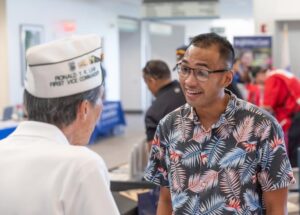
Through his Fellowship, Danicole worked directly with these veterans and began to see patterns emerge. Many had tried to navigate the system but were given incorrect information or lacked the support to follow through.
“We ask these people to serve, we ask these people to sacrifice themselves—but we don’t give them the right support,” Danicole said.
We ask these people to serve, we ask these people to sacrifice themselves—but we don’t give them the right support."
Danicole Ramos
Danicole sees the need for legal support partly as a matter of readiness: “Quality legal services play a role because we can’t expect those in service to sacrifice for our country, to put their lives on the line for their country, if other aspects of their life are not going well.”
Beyond readiness, the consequences of not having immigration paperwork in order can be severe. Veterans returning from combat frequently face PTSD and substance use disorder. For noncitizen veterans, these challenges can trigger immigration consequences, even leading to deportation and removal proceedings.
Designing a Solution
Danicole designed his own Fellowship, partnering with William S. Richardson School of Law’s Refugee & Immigration Law Clinic (RILC) to build a project focused on noncitizen veterans and their families. 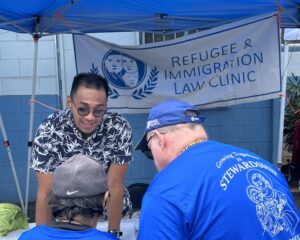
Over the course of his two-year Fellowship, he provided 170 legal consultations on naturalization, adjustment of status, and removal defense. He helped 15 veterans become U.S. citizens and assisted six others in obtaining replacement certificates of citizenship.
The Fellowship allowed him to deliver direct impact legal services and gave him the flexibility to respond to a need that had long gone unaddressed.
A Fellowship Case That Went National
One case brought national attention to the issue.
Sae Joon Park had lived in the United States for nearly 50 years after immigrating from South Korea as a child. He served in the U.S. Army, was wounded in combat in Panama in 1989, and received a Purple Heart. But after returning home, he struggled with severe, undiagnosed PTSD and later faced legal challenges that cost him his green card. 
For years, Park rebuilt his life, raising two children and maintaining stability. But in June 2025, he was told his deferred action status had ended. He had to leave the country or face detention.
He self-deported to South Korea, leaving behind his children and his elderly mother with dementia.
Danicole became Park’s attorney and has been fighting for a path home, but it hasn’t been easy.
“Especially for noncitizen veterans who go through the criminal justice system, there’s so many different parts of systems that they have to deal with that are broken, that take a long time, that need to be fixed.” He’s now pursuing a pardon from New York’s governor for the decades-old convictions—a step toward potentially restoring Park’s ability to return.
The case drew national media attention and congressional interest. For Danicole, it reinforced that while attorneys are often focused on how their case will play out in court, the court of public opinion matters too. “When cases have really compelling stories, it can change people’s perceptions and public opinion or open their minds up to different perspectives.”
The Fellowship’s Lasting Impact
Beyond the impact for his clients, Danicole is grateful for what his Fellowship gave him, too. “It really has helped me grow, not just as a lawyer, but as a professional in general,” he said. That included skills beyond the law: community outreach, coalition building, media relations, managing relationships across multiple agencies and stakeholders. 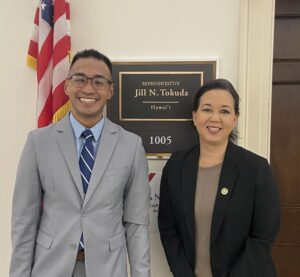
“It’s made me more grounded in this work, but also helped me realize the bigger picture of what we do as public interest lawyers,” Danicole said. “We’re not just fighting for our client. We’re fighting to address bigger systemic issues in our country, and hopefully reform them, little by little, every day.”
We’re not just fighting for our client. We’re fighting to address bigger systemic issues in our country, and hopefully reform them, little by little, every day.”
Danicole Ramos
Following his Fellowship, Danicole was hired by RILC, where he continues to build on the project he launched during his Fellowship, providing legal services to noncitizen veterans and their families, running naturalization clinics, and overseeing day-to-day clinic operations.
His work reflects the lasting impact of Equal Justice Works Fellowships.
“What Equal Justice Works Fellowships do is they solve problems,” he said. “They give us the opportunity to go on the ground, work directly with the community, build relationships with them, help address their issues—but also use those stories and experiences from the trenches to advocate for bigger systemic changes in the future.”
What Equal Justice Works Fellowships do is they solve problems. They give us the opportunity to go on the ground, work directly with the community, build relationships with them, help address their issues—but also use those stories and experiences from the trenches to advocate for bigger systemic changes in the future.”
Danicole Ramos
By Linda Anderson Stanley, Senior Director of Programs at Equal Justice Works
Disasters reshape communities overnight — and the legal system helps determine what happens next.
In the aftermath of a disaster, families must figure out how to replace lost documents, apply for federal disaster benefits, deal with insurance companies, or avoid eviction—often while displaced and in crisis.
These are legal problems. Lawyers play a critical role not only in helping communities rebuild, but in ensuring that disaster recovery systems operate fairly and effectively. That is where disaster law comes in.
What Is Disaster Law?
Disaster law addresses the wave of civil legal needs that arise before, during, and after disasters.
After a disaster, people may need help with:
- Applying for federal disaster assistance
- Appealing a denied FEMA application
- Fighting wrongful eviction or foreclosure
- Resolving insurance disputes
- Replacing important legal documents
- Protecting themselves from contractor fraud
- Addressing language or documentation barriers that may affect immigrant families
- Ensuring equal access to disaster recovery resources for people living with disabilities
Many attorneys who do this work are public interest lawyers—attorneys who provide free civil legal aid to help people who cannot afford a lawyer. Some private-sector attorneys also volunteer their time to assist disaster survivors through “pro bono” (volunteer) legal work.
Navigating disaster recovery programs, including assistance from FEMA, is a complex process. Applications are frequently denied for technical reasons,and having a lawyer can significantly improve a survivor’s ability to navigate these systems and secure help.
Lawyers are instrumental in ensuring that recovery happens fairly and that communities are able to rebuild with stability.
Why Is Disaster Law Important?
 While disasters may strike broadly, recovery systems often produce inequitable outcomes. Without legal intervention, disasters can deepen existing poverty and inequality. People with lower incomes, renters, older adults, people living with disabilities, and immigrant communities often face additionalbarriers when trying to access recovery resources. Left unaddressed, these barriers can lead to long-term housing instability, debt, or displacement.
In many communities, access to a lawyer determines whether a family receives disaster benefits or keeps their home. Disaster law is not just about paperwork. It is about civil rights, economic stability, and the ability of communities to recover with dignity.
What Is Disaster Resilience?
Disaster resilience means being prepared not only to respond to disaster, but to recover in a way that strengthens communities over time. It goes beyond emergency readiness and short-term recovery. Resilience requires building the legal infrastructure, relationships, and community knowledge that allow individuals and communities to withstand and recover from future disasters.
Resilience is built before the next disaster strikes. True resilience requires sustained investment in training advocates in disaster-related legal issues, strong partnerships between legal aid organizations and emergency management systems, and proactive identification of service gaps.
When legal services are integrated into disaster planning, communities can respond more quickly and equitably when disaster occurs.
How Can Lawyers Support Disaster Resilience?
 Resilience is built during blue-sky times—by forging partnerships, conducting community education and outreach, and identifying gaps before disaster strikes.
Lawyers are uniquely positioned to serve as connectors between disaster response agencies, legal aid organizations, local government officials, and community members. By building these relationships during blue-sky times, the network can mobilize quickly to support the community and handle the surge of legal needs that follow a disaster.
Lawyers can get involved in disaster preparedness and response efforts in their communities by:
- Participating in local disaster response planning efforts
- Partnering with local legal aid organizations
- Collaborating with housing advocates and community-based organizations
- Learning about and educating communities about disaster benefits and documentation needs
- Volunteering to provide legal support after disasters
When legal systems are integrated into broader emergency response frameworks, communities recover faster and more equitably.
To support this work, Equal Justice Works developed a Disaster Attorney Guidebook designed to help attorneys and organizations build disaster legal capacity.
Whether someone is new to disaster response or looking to expand existing efforts, these resources can help translate interest into action.
Join Us During Disaster Resilience Awareness Month
Each March, Equal Justice Works leads Disaster Resilience Awareness Month (DRAM), bringing together partners from across the country to highlight the important role legal services play in disaster response, recovery, and preparedness.
During DRAM, we share educational resources, host programming, and spotlight the work of attorneys and advocates helping communities prepare for and recover from disasters. We invite attorneys, advocates, and community leaders to deepen their understanding of disaster law, explore partnership opportunities, and consider how they can contribute to building more resilient legal systems.
Download this Explainer in a PDF

Avery Shivers spoke to us about how he supported tenants in asserting their rights to safe and habitable housing as an organizer Fellow in the Housing Justice Program. Hosted by Maryland Legal Aid, Avery advocates alongside low-income tenants to combat involuntary displacement, increase access to Maryland Legal Aid’s eviction defense attorneys, and support collective tenant action.
On August 12, 2025, Maryland Legal Aid filed a lawsuit against Sharp Leadenhall Apartments seeking redress for systemic substandard and dangerous conditions that violated residents’ rights under Maryland law. The following day, the Historic Sharp Leadenhall Tenant Council – the tenant association that represents the 192-unit affordable housing complex – organized a press conference that helped garner public and political support for these low-income renters.
How did the case against Sharp Leadenhall’s property management company come your way?
Our legal partnership with renters from Sharp Leadenhall Apartments began in 2024 when previous Equal Justice Works fellows, Caroline Tripp and Amanda Wisniewski, helped the property’s residents create a tenant council. With the creation of this union, renters at the property now had the infrastructure to negotiate with the landlord and assert their demands collectively. With Maryland Legal Aid as their counsel, the Historic Sharp Leadenhall Tenant Council had the ability to enforce their rights through legal action if necessary.
Caroline and I also provided technical support to the tenant council, planned Know Your Rights training in the community, and met with property management to address property-wide conditions issues. When the landlord did not change its practices, Historic Sharp Leadenhall Tenant Council decided that taking collective legal action was necessary. They began consulting with Caroline and me to learn more about their options.
What have these cases (both individual and the group lawsuit) taught you so far?
My first takeaway from this multi-plaintiff lawsuit is that the success of collective legal action relies on organized renters. It would have been nearly impossible to successfully bring this lawsuit without the engagement and determination of tenant leadership. From door-knocking efforts to one-on-one conversations with their neighbors, tenant leaders ignited their fellow residents with a belief that participating in this lawsuit would be a worthwhile endeavor in ways that our team was restricted from doing.
I have also learned that legal action is only one approach to advocate for renters. While legal action advances the rights of tenants, it does not make them leaders in this effort. In contrast, tenant leadership came to the fore when they organized the press conference. By creating a space to tell their story, apart from the courtroom, they enhanced renters’ engagement and belief in themselves as leaders. Tenants also invited local representatives in order to influence lawmakers’ perspectives on the need for greater enforcement action against negligent landlords. Not only did five publications cover the press conference, but several city council members have also connected with the Historic Sharp Leadenhall Tenant Council to address the issues they face.

How has working with four former Fellows (Caroline Tripp, Natali Collazos, DiNesha “Dee” Rucker, and Annie Toborg) influenced you?
These former Fellows have altered my perspective on the role that attorneys can and should play in any legal partnership. Before working with these fellows, I believed that attorneys primarily supported their clients through courtroom advocacy and individualized support. What Caroline, Natali, Dee, and Annie have demonstrated is a far more expansive model of legal advocacy, often referred to as Community Lawyering. Community Lawyering fosters systemic change through community-integrated problem solving, partnerships, and client empowerment. The Fellow alums that I work with greatly exemplify the framework’s openness to community-driven solutions. By playing an advisory role in the organization’s decision-making process, they ensure that tenant leaders feel empowered to solve problems on their own and only consult them when necessary. This collaborative approach to lawyering is unique to the former Fellows and it only makes me more excited to continue working with them on these transformative projects.
What are your next steps with this case?
Last month, the judge presiding over the case permitted the opening of an escrow account, asked all plaintiffs to pay $0into the account every month, and ordered that the owner and management company immediately abate all dangerous and life-threatening conditions at the property. This result in our first hearing has energized other residents at Sharp Leadenhall. The next court hearing is in December 2025. While our legal staff intends to continue monitoring repairs on the property, I will support the resident council in their efforts to educate their community about their options to enforce their legal rights.
What do you wish more tenants knew when it comes to asserting their rights?
When asserting your rights, there is strength in numbers. It is far easier for landlords, media, and political representatives to ignore the complaints of one tenant than it is to ignore the complaints of dozens. This collective approach to justicerelies on renters meaningfully engaging with those who live in their building. By building relationships with their neighbors – through offering a helping hand to bring in groceries, inviting them over for dinner, or something else –tenants can cultivate the community trust that is foundational to the success of any campaign against bad-faith landlords. As the adage goes, organized people beat organized money; and to be organized, we need to live up to the values of a strong community.
To learn more about the Housing Justice Program, click here. To learn more about Avery’s work, click here.
When asserting your rights, there is strength in numbers. It is far easier for landlords, media, and political representatives to ignore the complaints of one tenant than it is to ignore the complaints of dozens.
Avery Shivers /
2024 Fellow
Housing Justice Program

By Levi Colonna-Bevis, 2024 Rural Summer Legal Corps (RSLC) Fellow and 2025 Fellow in the Design-Your-Own Fellowship Program. Levi shares how his Student Fellowship inspired him to continue his work at his host organization and helped him identify needs in the communities he serves to create and tailor a Fellowship project that addresses them. Levi’s Fellowship is sponsored by Fenwick & West LLP.
From a young age, I knew I wanted to work in the legal field to support my community. I grew up in rural Alabama, and I quickly learned that access to legal services was more challenging for rural communities. These experiences sparked a passion for public service that guided my academic and professional career, and this passion led me to law school. While in law school, I had the great privilege and opportunity to serve as a Rural Summer Legal Corps (RSLC) fellow with Inland Counties Legal Services (ICLS) in Southern California. The RSLC program pairs law students with legal aid organizations serving rural communities nationwide to improve access to legal services in what many call “legal deserts,” or rural communities that don’t have adequate or any nearby legal service organizations. Now, I am grateful to build on my experience by serving rural communities across San Bernardino and Riverside counties in Southern California as an Equal Justice Works fellow.
Growing up in a blue-collar family on a cattle farm in rural northwest Alabama, I knew firsthand the challenges rural communities face in accessing robust and affordable legal services. My experiences in Alabama, and my college years in rural northern Mississippi, strengthened my passion for enhancing rural communities’ access to essential legal services and encouraged me to become a first-generation lawyer who could speak to these challenges. I attended law school at the Sandra Day O’Connor College of Law at Arizona State University to pursue a career in public interest law, so RSLC was a great fit for both my career goals and my passion for public service.
Growing up in a blue-collar family on a cattle farm in rural northwest Alabama, I knew firsthand the challenges rural communities face in accessing robust and affordable legal services.
Levi Colonna-Bevis /
2024 Rural Summer Legal Corps Student Fellow
2025 Equal Justice Works Fellow
In law school, I became more familiar with legal aid work and realized it was the right career path for me. I have long been interested in constitutional law, administrative law, and housing law. Likewise, as an openly gay man, I wanted to support LGBTQ+ community work throughout my career. When exploring legal aid organizations, ICLS was a perfect match for me because their wide array of legal service teams includes housing, systemic impact litigation, and LGBTQ+ teams among others, which allowed me to explore my legal areas of interest while also engaging in hands-on work to support local communities.
During my RSLC Student Fellowship at ICLS, my team sought to challenge unlawful practices impeding communities’ access to public benefits, housing, and other essential services. I had the opportunity to work with and learn from top-notch attorneys to address systemic regional challenges in areas such as housing, healthcare access, and LGBTQ+ matters. I received training for trauma-informed lawyering and community lawyering practices—both areas which are usually not taught in law school yet are crucial for public interest work.
Through our team’s work, I recognized that, while there were several organizations in the region providing housing and healthcare services for people living with HIV, there were no local legal aid organizations specifically working with people living with HIV. I also knew that Equal Justice Works has opportunities allowing graduating law students and attorneys to create their own Fellowships to address specific challenges in their communities because of the RSLC Student Fellowship, so there were opportunities for me to help fill the gap.
I was deeply influenced by my time at ICLS to return after graduation because attorneys and staff alike were fiercely committed to our communities and clients, and every person I met truly cared for the well-being of those around them. After further research and discussions with ICLS, I pursued and was deeply honored to be selected for Equal Justice Works’ Design-Your-Own Fellowship program.
Through my experience as an RSLC Student Fellow with ICLS, I found a true calling in legal aid and saw firsthand the issues faced by both rural residents and members of the LGBTQ+ community — two communities that are close to my heart. I also gained the connections, confidence, and expertise to pursue a highly competitive Equal Justice Works Fellowship made possible by ICLS and my sponsor, Fenwick & West.
Through my experience as an RSLC Student Fellow with ICLS, I found a true calling in legal aid and saw firsthand the issues faced by both rural residents and members of the LGBTQ+ community — two communities that are close to my heart.
Levi Colonna-Bevis /
2024 Rural Summer Legal Corps Student Fellow
2025 Equal Justice Works Fellow
As I continue my work from my Student Fellowship in the project that I have built at ICLS, I am proud to be moving the needle on access to legal assistance for people living with HIV as an Equal Justice Works Fellow, thanks to both ICLS and RSLC.
Our multi-pronged project seeks to connect people living with HIV to the medical services they need while addressing any discrimination they may experience in accessing these services, engage a community lawyering model to inform people living with HIV of their rights under federal and California law, and build capacity for future work to address discrimination in housing, employment, and other challenges in Southern California. Through this project, I hope to raise awareness of the challenges people living with HIV face in communities across the nation, provide legal services and resources to meet those challenges, and build out a program that can continue to address these challenges for many years to come. I am also incredibly excited to return to ICLS to deepen my community relationships and learn from some of the region’s most dedicated community advocates.
It is an honor to be able to serve low-income and rural communities in Inland Southern California through this fellowship, and I am deeply grateful to Equal Justice Works, ICLS, and Fenwick & West for making this opportunity possible.
Through this project, I hope to raise awareness of the challenges people living with HIV face in communities across the nation, provide legal services and resources to meet those challenges, and build out a program that can continue to address these challenges for many years to come. I am also incredibly excited to return to ICLS to deepen my community relationships and learn from some of the region’s most dedicated community advocates.
Levi Colonna-Bevis /
2024 Rural Summer Legal Corps Student Fellow
2025 Equal Justice Works Fellow
To learn more about Levi’s Fellowship, click here. If you are a law student looking for opportunities in public interest law, click here.
How Individuals and Communities Can Prepare for Disasters
After a disaster like a wildfire or severe storm, communities must navigate a complex range of legal challenges from FEMA applications to wrongful evictions. Preparedness is crucial to building resilience and ensuring communities can withstand and recover from these challenges. Equal Justice Works’ Disaster Resilience Program places Fellows with host organizations in disaster-prone areas across the country to ensure free legal services are equitably accessible not only during and after disasters, but before they strike. Our Fellows and their host organizations see firsthand how legal preparation – or lack thereof – shapes a community’s ability to recover.
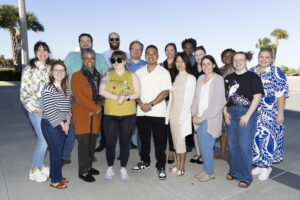
This National Preparedness Month, we asked those host organizations what steps individuals and communities can take to better prepare for disasters. The below guidance comes from: Catholic Charities of Galveston-Houston, Florida Rural Legal Services, Inc., Houston Volunteer Lawyers (HVL), LatinoJustice PRDLF, Legal Aid Society of Hawaii, and United Policyholders.
Disaster preparedness can seem overwhelming, but there are many small steps that can be taken in order to prepare a client and the community as a whole.
Catholic Charities of Galveston-Houston /
Equal Justice Works Host Organization
How Individuals Can Prepare for Disasters
Stay informed. Follow local alerts about both weather-related and humanitarian disasters in your area.
Prepare safety plans. Plan for urgent evacuation scenarios and ensure all family members know their roles.
Review your insurance coverage thoroughly. Call your insurer to confirm adequate coverage and explore additional options like flood and earthquake insurance. Don’t overlook renters insurance – it provides essential protection for evacuation and property loss.
Secure your important documents. Store identification, medical records, and legal documents (divorce decrees, parenting plans, deeds, titles) somewhere safe from disaster but easily accessible for evacuation. Use a waterproof and fireproof box and/or or upload digital copies to cloud storage.
Resolve legal matters in advance. Clear title and custody issues now to prevent delays and complications during recovery.
Consider naturalization if eligible. Some disaster relief programs are only available to U.S. citizens and lawful permanent residents. Store a photo or electronic copy of important documents like naturalization certificates in secure locations to expedite replacement processes.
Create a home inventory. Take a video of belongings inside and outside your home to support future insurance claims and recovery efforts.
Write down five important phone numbers. You can’t always rely on phone chargers or cell reception during emergencies.
Harden your home. Take steps against regional threats, such as wildfires if you’re a homeowner in fire-prone areas.
Think locally when planning. Beyond FEMA, know your county’s Emergency Management department, local American Red Cross branch, and community shelters – including whether they accommodate medical needs or pets. Disasters are local, so disaster preparedness should be local too.
How Communities Can Prepare
Foster communication and collaboration. People cannot prepare for disasters they don’t know about, and working together is often the most effective approach to community preparedness. Strong organization, proactive planning, and community-wide awareness are key.
Build trusted networks. Partnerships with local organizations, including those serving vulnerable and immigrant populations, are essential to ensuring access to legal rights, citizenship resources, and disaster assistance.
Plan beyond the immediate crisis. While national attention and resources often surge immediately following a disaster, sustainable recovery depends on trusted local organizations and informed long-term decisions. Be wary of outside contractors or temporary resources that may not be able to fulfill their promises.
[This guidance] not only reduces delays in recovery but also helps individuals and families regain stability more quickly after a disaster
Legal Aid Society of Hawaii /
Equal Justice Works Host Organization
Preparedness is both a personal and legal responsibility, and community resilience depends on collaboration. As our host organizations remind us, resilience is built step by step – by securing documents, resolving legal issues in advance, strengthening networks, and ensuring every community member knows where to turn when disaster strikes.
Building on insights shared at our 2025 Disaster Resilience Symposium in Gulfport, Florida, we are reminded that preparedness is never an isolated step. It is an ongoing commitment to equity, access, and collaboration that helps communities withstand crisis and recover more quickly.
To learn more about how the Disaster Resilience Program strengthens communities before, during, and after disasters, visit here.
By Karen A. Lash, former Equal Justice Works Vice President of Programs, board member, Leadership Development Training speaker, consultant, and student organizer
Hurricane Katrina’s landfall on August 29, 2005, brought not only physical devastation but also an avalanche of legal needs, exposing a critical gap: Who helps survivors navigate the complex legal challenges that follow disaster?
In the aftermath of the storm, I supported efforts to deliver legal help to the people who needed it most and to push for a more equitable recovery. These combined efforts jumpstarted Equal Justice Works’ disaster resilience work, which continues today, and helped lay the foundation for what is now known as disaster law.
Action after the storm

Katrina devastated the southern half of Mississippi, destroying or rendering uninhabitable most of its housing stock. A staggering number of legal needs emerged. First came the immediate issues related to Federal Emergency Management Agency (FEMA) benefits, insurance claims, and housing. Then came secondary challenges: contractor fraud, custody disputes when families were displaced across state lines, and more.
The legal infrastructure was overwhelmed. Roughly half of Louisiana Bar Association members were displaced, with some attorneys working out of tents or cars after their offices were destroyed.
Equal Justice Works heard these legal horror stories and mobilized to get a squadron of lawyers to the region. At the time, I was working for the Mississippi Center for Justice, and Equal Justice Works enlisted my help in finding legal aid offices where Fellows could assist.
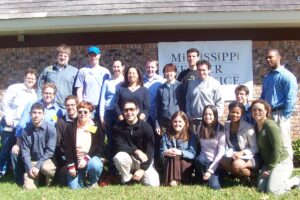
Within six months of the storm, 19 Equal Justice Works Katrina Fellows were on the ground!
The Katrina Legal Initiative soon expanded into three components, all hosted by nonprofit legal aid organizations across the Gulf Coast:
- Katrina Legal Fellowships — two-year placements for experienced attorneys,
- AmeriCorps Legal Fellowships — nine- to eleven-month placements, and.
- Summer Corps — internships for first- and second-year law students.
Together, these programs served more than 17,000 individuals, mobilized over 5,000 volunteer attorneys and law students, and forged hundreds of collaborative partnerships among organizations.
Systemic wins
But numbers tell only part of the story. The Fellows didn’t just represent individual clients — they fought for systemic reforms that affected hundreds of thousands more.
One such effort was led by Reilly Morse, a 2006 Equal Justice Works Katrina Fellow at the Mississippi Center for Justice, where I was also working. I witnessed firsthand his masterful advocacy in the battle to restore housing to Katrina’s most vulnerable survivors.
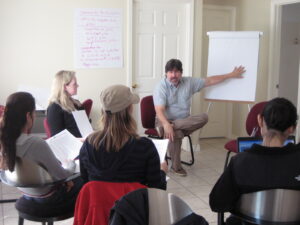
When Mississippi secured $5.4 billion in federal housing recovery aid, the initial joy gave way to despair as so many elderly, low-income, and minority communities were systematically deprived of the rebuilding funds available to disproportionately white and middle-class victims. When the state declared the recovery “over” and moved to divert nearly $600 million of disaster grants to expand the Port of Gulfport, we at the Mississippi Center for Justice took the fight to Washington.
Once Mercedes Márquez, the newly confirmed U.S. Department of Housing and Urban Development (HUD) Assistant Secretary for Community Planning and Development, got involved, things began to change. Reilly, working with her and her team, led negotiations that ultimately required Mississippi to set aside $132 million — later growing to more than $210 million — for low-income households who needed it most.
This was just one win among many. Through individual representation, class action litigation, and policy advocacy, the Katrina Fellows stopped FEMA from clawing back survivor benefits, secured accessible housing for disabled victims, and reformed federal disaster assistance programs.
Building on Katrina’s lessons
What began as an emergency response evolved into a regional and national collaboration among legal aid organizations, law schools, and law firms providing pro bono aid, leaving a legacy that reshaped how the legal profession approaches disaster relief.
The Katrina Legal Initiative not only created a more equitable recovery from the hurricane — it also informed the first guidebook for delivering legal services in disaster-affected communities and established a replicable model.

Today, the Equal Justice Works Disaster Resilience Program places Fellows and Student Fellows in disaster-prone areas throughout the country, building capacity for both preparation and response.
As natural disasters grow more frequent and severe, Katrina’s legacy reminds us that disaster law is not just history but a living practice. Through the Disaster Resilience Program, the audacious goals born in the storm continue to guide Equal Justice Works and its legal aid and pro bono partners in creating real change for real people when it is needed most.

By Cecilia Ballinger , 2024 Equal Justice Works Fellow with the Alabama Disabilities Advocacy Program. Cecilia works to provide educational and medical advocacy to children with complex medical conditions across Alabama and is sponsored by Faber Daeufer & Itrato.
This July marks the 35th anniversary of the Americans with Disabilities Act (ADA), a landmark piece of legislation that prohibits many forms of disability discrimination. As we work towards making the guarantees of the ADA into something to be exceeded, rather than hard-fought, I reflected on the work of self-advocates like Judy Heumann , who staged the 26-day “504 sit-in” to demand the long-awaited federal regulations for Section 504 of the Rehabilitation Act of 1973, and Jennifer Keelan-Chaffins, who was only eight years old when she left her wheelchair behind and crawled up the Capitol steps during the “Capitol Crawl” to call for passage of the ADA. These activists fought for inclusion and access to be standard, something that we continue to fight for. I have been overwhelmed at times during my Fellowship with the progress we have not yet made. On a national level, individuals with disabilities continue to face barriers in employment, education, healthcare, and housing, among other things. The Department of Justice, the Department of Education, and Health and Human Services have historically fought for the enforcement of federal anti-discrimination statutes, like the ADA, though this role moving forward is in question.
Within my home state of Alabama, access to care and services are extremely challenging. Lack of transportation and internet access, as well as patterns of rural hospital closures have worsened this issue, leaving individuals across the state scrambling to find providers in their area. These issues will only worsen in Alabama and other states if federal program cuts on the horizon are passed. As it is now, the medically complex children I serve through my Fellowship frequently cannot find nurses to care for them for years at a time. Knowledge of home and community-based services available through Medicaid programs is scarce among families and providers alike. Some of my clients have been restrained and secluded in school, while others have been brushed to the side and put on homebound programs with minimal services. Services that families can access are largely funded with federal dollars, and, in many cases, are all that stand between individuals and institutional care, where they’d live in a clinical setting without the comfort of their homes and families. Concerns have been raised about the quality of care in such institutions.
With looming cuts to programs that offer services to individuals with disabilities, my host organization included, it is all too easy to focus on what could be lost. While it is important to understand what is at stake, I have been reflecting on the ways in which we can advocate and make a difference for each other, however small our advocacy may seem. Through local advocacy, glimmers of hope for the future shine through and give me something to hold onto through days that feel hopeless.
Through local advocacy, glimmers of hope for the future shine through and give me something to hold onto through days that feel hopeless. This Disability Pride Month, and beyond, I challenge all of you to find something you can do to advocate for disability rights. You can do this by starting with your community and the places where you have influence.
Cecilia Ballinger /
2024 Equal Justice Works Fellow
This Disability Pride Month, and beyond, I challenge all of you to find something you can do to advocate for disability rights. You can do this by starting with your community and the places where you have influence. You can:
- Look for accessible features in your community, like accessible parking spaces, curb cuts, push buttons for doors, and accessible routes. If what you find is lacking, bring it to the attention of the city or business owner.
- Support fundraisers and events that support individuals with disabilities and contact local disability rights groups to ask for ways to get involved on a local level.
- Consider whether your workplace could partner with vocational rehabilitation programs to provide meaningful employment opportunities.
- Use plain language as a default when communicating with clients or the public.
- While voting, check your polling site for accessibility and request poll workers to bring out an accessible booth. Report inaccessibility to voting rights hotlines and organizations.
- Work with organizations serving blind individuals to have Braille materials available.
- Educate yourself on the intersection of disability and your profession and offer services to individuals with disabilities if you are able.
Most of all, engage with the disability community with humility and a willingness to learn. Ask questions and take time to listen to the answers without trying to immediately solve the issues you find.
Some of my most impactful work is not done across from opposing counsel. Rather, it is done in the community where I build relationships, share plain language resources, and train people to be their own advocates.
Cecilia Ballinger /
2024 Equal Justice Works Fellow
Some of my most impactful work is not done across from opposing counsel. Rather, it is done in the community where I build relationships, share plain language resources, and train people to be their own advocates. It is done by listening to the lived experiences of people and considering how I can empower them, rather than just “fix” their problems. It is done by giving clients honest evaluations of their situation, even when my answer is not ideal, and taking the time to ensure that they understand why their case may not be successful and what a successful case may look like in the future.
Your small actions have the potential to make waves, and advocates of all kinds are needed. Whether you are providing services, creating policy, organizing local events, advocating in the courts and administrative processes, creating and distributing informational resources, providing financial backing to others, or creating places where all people can be recognized for their strengths and have their differences not only accepted but embraced, you have a role to play in this movement. Local action can create national change, and each action moves us a bit closer to not only meeting, but exceeding, the ideals of the ADA and creating a nation in which all individuals, regardless of disability, are able to contribute and find meaning.
To learn more about the Fellows working to advance disability rights, click here. To learn more about Cecilia’s project, click here.
By Richard Luong, senior director of development at Equal Justice Works
I recently joined Equal Justice Works CEO Verna Williams, Network Manager Leeja Patel, and other Equal Justice Works staff in the privilege of visiting two remarkable host organizations in Chicago: Uptown People’s Law Center (UPLC) and Legal Aid Chicago. Both expand access to justice through frontline legal work—and both reminded us why our collective efforts matter now more than ever.
Uptown People’s Law Center: Meeting the Evolving Needs of the Uptown Community
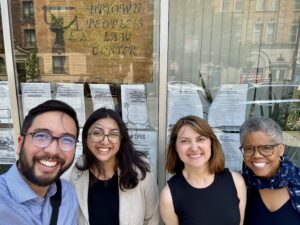
Nestled in one of Chicago’s most diverse neighborhoods, UPLC has been a cornerstone of community-based legal advocacy since its founding in 1975. Originally established to help disabled coal miners secure black lung benefits, it has evolved into a legal clinic with deep expertise in prisoners’ rights, tenants’ rights, and a Social Security disability practice.
During our visit, we head from Executive Director, Kate Walz, about their class-action work challenging solitary confinement in Illinois prisons. For years they’ve litigated cases like Davis v. Jeffreys, advocating for incarcerated individuals confined in isolation for months – even years – as part of a broader national campaign. Their legal team, supported by pro bono partners, amplifies systemic reform through their work on these cases.
In addition to impact litigation, UPLC prioritizes deep community connections—organizing bus trips for families to visit incarcerated loved ones, hosting community trainings on tenant and disability rights, and engaging deeply in grassroots advocacy.
UPLC’s incoming Equal Justice Works Fellow will focus on investigating instances of custodial sexual assault & harassment reported by incarcerated women at Logan Correctional Center and coordinate pro bono lawyers to eliminate the pervasive culture of sexual abuse in Illinois’s main women’s prison.
Legal Aid Chicago: Expanding Equal Justice Across Cook County
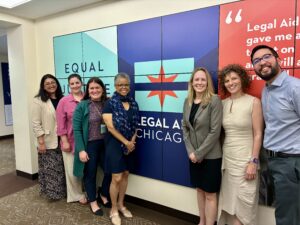
Next, we journeyed downtown to Legal Aid Chicago—a powerhouse legal aid provider that champions civil justice for low-income individuals across Cook County. As they note in their mission statement, “equal justice under law… must be the same in substance and availability, without regard to economic status.”
We met with Katherine Shank, the CEO and Executive Director of Legal Aid Chicago; Deputy Director and General Counsel, Teresa Sullivan; and Barbara Bertini, the Director, Pro Bono and Community Partnerships. The staff showed us how Legal Aid Chicago takes a comprehensive approach to tackling the most pressing issues facing its communities, including: preventing evictions and homelessness, aiding survivors of domestic violence and human trafficking, securing benefits for veterans and seniors, combating consumer fraud, and advocating for children’s education rights.
Legal Aid Chicago’s 32 legal clinics and court-based help desks serve as entry points for individuals confronting injustice. Their pro bono initiative enlists more than 1,000 volunteers, logging over 10,000 hours in 2023—showing how community partnership strengthens legal access.
Legal Aid Chicago’s current and incoming Fellows have projects that focus on removing future barriers to education, employment and housing for Students; working with low-income families on tangled title and estate planning matters; family defense services to parents in or formerly in foster care; and eviction prevention.
A Shared Vision for Chicago
Though their practices differ, UPLC and Legal Aid Chicago share a vision to bridge the justice gap through community-grounded advocacy, strategic lawyering, and systemic change. At UPLC, that can look like fighting solitary confinement and defending tenants in Uptown. At Legal Aid Chicago, that can mean supporting survivors, seniors, families, and workers across Cook County. Whether recruiting volunteers for pro se clinics or mobilizing families to support incarcerated loved ones—these host organizations demonstrate thoughtful, strategic approaches to closing the access to justice gap.
Our site visits left us inspired and energized. The work at UPLC and Legal Aid Chicago underscores the potential of the design-your-own fellowship, where early-career attorneys create innovative and meaningful impact in underserved communities. We look forward to deepening our partnerships, supporting fellowships that embed attorneys in their groundbreaking work, and amplifying their success stories in the years ahead.
To view a comprehensive list of Equal Justice Works host organizations, click here.
Though their practices differ, UPLC and Legal Aid Chicago share a vision to bridge the justice gap through community-grounded advocacy, strategic lawyering, and systemic change.
Richard Luong /
Senior Director of Development,
Equal Justice Works
We sat down with 2020 Fellow Dana Bolger and 2023 Fellow Samantha Hunt to learn more about both their work at A Better Balance, where they advocated for accommodations and care for pregnant students and teachers, and what mentorship means to them. Read more from their conversation about how their collaboration has inspired results below.
Q: To start, can tell us a bit more about the crisis pregnant students and workers face in this country?
A: Across the country, thousands of pregnant students and workers are pushed out of their schools and their jobs. This pushout occurs when schools and workplaces fail to grant modest accommodations to help students and workers care for their pregnancies while at school or at work.
Q: And what role does your host organization play in combating this crisis?
A: A Better Balance (ABB) has over a decade of experience advocating for pregnant workers. Our work, which stems from two separate but complementary Equal Justice Works projects, means we get to serve as steadfast advocates for pregnant and postpartum workers and students across the nation. The heart of our collaborative efforts is rooted in one shared vision: No person should have to lose their education or their job because they’re pregnant.
Q: Dana, you were a Fellow at ABB first back in 2020. Can you tell us a bit more about your project and what you’re doing now?
A: As part of my Equal Justice Works project, I created a legal clinic at a Women, Infants, and Children (“WIC”) program in the Bronx. There, I saw firsthand the barriers pregnant workers were facing as they tried to access the reasonable accommodations they needed to stay healthy on the job during pregnancy. For instance, employers often required workers requesting modest pregnancy accommodations to provide rigorous medical documentation, which tended to impede workers’ ability to access accommodations at all.
Employers frequently rejected doctor’s notes over minor technicalities, forcing them to return to their health provider over and over for small clarifications—a frustrating, expensive, and time-consuming process that low-wage workers often could not afford. That experience directly informed the work to pass strong regulations through the federal Pregnant Workers Fairness Act (“PWFA”). Because of our awareness of the problem, we were able to tackle it head on, successfully persuading the Equal Employment Opportunity Commission to adopt final PWFA regulations limiting the circumstances in which employers can require medical documentation.
So to sum it up, my project provided direct legal assistance to workers, and now Samantha’s to students, so they can learn and work without compromising the health of their pregnancies. We also implement federal and state policies to make it easier for pregnant students and workers to access the accommodations they need.
Q: Sounds like this project really paved the way for future Fellows to get involved and make a difference. Samantha, how has your work expanded upon the foundation Dana has built through her Fellowship?
A: My project expands ABB’s services to cover pregnant and postpartum students, a natural extension of our experience advocating for pregnant workers. Many helpline callers carry intersecting identities as both workers and students, and my project allows ABB to more holistically meet our clients’ needs.
I hear from pregnant and postpartum students who face strikingly similar issues as those in the workforce: They need modest classroom accommodations so they can learn safely and comfortably while pregnant, excused absences for prenatal appointments so they can care for the health of their pregnancies, and support as they recover from childbirth and return to school. Our student-facing work aims to remove barriers to educational access and help students feel supported at school so they can learn in an environment free from discrimination and harassment. This work, in turn, helps students meet their educational goals and pursue more opportunities once they enter the workforce.
To learn more about Dana’s work, click here. Dana is now senior associate at Katz Banks Kumi. To learn more about Samantha’s project, click here.
The heart of our collaborative efforts is rooted in one shared vision: No person should have to lose their education or their job because they’re pregnant.
Dana Bolger and Samantha Hunt /
2020 and 2023 Equal Justice Works Fellows
Richard Luong the senior director of development at Equal Justice Works, recently joined our CEO, Verna Williams, on a site visit to learn more about 2023 Fellow Justin McCarroll’s work and shared his experience below. Justin is sponsored by Greenberg Traurig.
During a recent trip to Atlanta, Georgia, I found my feet planted next to Justice Thurgood Marshall’s at the International Civil Rights Walk of Fame. I reflected on his wisdom in the landmark case Furman vs. Georgia, where Justice Marshall advocated in his concurring opinion that the death penalty is unconstitutional under any circumstances, stating “in recognizing the humanity of our fellow beings, we pay ourselves the highest tribute.”
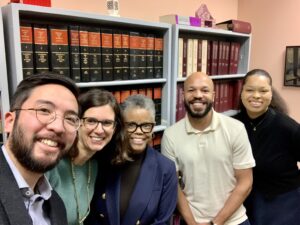
The Georgia Resource Center (GRC) is a nonprofit organization that embodies the virtues of Justice Marshall’s opinion. Its staff work to ensure fair treatment for those sentenced to death or life without the possibility of parole, advocate for justice, and push for systemic change in Georgia’s criminal justice system. I was fortunate enough to visit the GRC during this trip with Equal Justice Works CEO, Verna Williams, and Network Engagement Manager, Domonique Hamilton, to learn more about the project of 2024 Fellow Justin McCarroll.
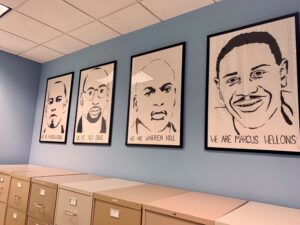
Justin and GRC Executive Director, Anna Arceneaux, led us through the hallways of their offices, where I felt the weight of their critical work. The GRC primarily provides legal defense, vital legal resources, and advocacy to individuals who have been sentenced to death, especially those who are in the post-conviction phase who have already exhausted their initial rounds of appeals. Within steps of the front door, visitors are met with powerful portraits of Marcus Wellons, Andrew Cook, Warren Hill, and Troy Davis – individuals executed by the state of Georgia. Their portraits watch over a row of file cabinets filled to the brim with records from death row cases taken on by the GRC.
The organization’s efforts are aimed at creating a more informed and compassionate society that recognizes the importance of fair trials and the need to address racial and economic disparities in the system. For many on death row, GRC is their last line of defense, working to uncover flaws in their convictions and to ensure that their cases are reviewed with the attention they deserve.
Justin McCarroll’s project expands upon the GRC’s foundational death penalty case work, extending its arms to provide direct legal representation, outreach, and advocacy to individuals sentenced to life without parole (LWOP) in Georgia. The LWOP prison population in Georgia has quintupled over the last 20 years, with Black prisoners making up 75%.
What’s even more staggering is Justin is likely the only attorney in the entire state to dedicate himself full-time to providing representation to this population. Word quickly spread about Justin’s work through the extensive network of 183 jails and 34 prisons across 159 counties in Georgia. His office is lined with letters, pictures, and artwork from current and prospective clients. Justin’s efforts are bolstered by his fellowship sponsor, Greenberg Traurig, and attorneys at the firm dedicating pro bono services. From maintaining regular contact with clients to offering emotional support to their families, it’s clear that Justin and his team’s work is driven by a deep sense of humanity.
What’s even more staggering is Justin is likely the only attorney in the entire state to dedicate himself full-time to providing representation to this population.
Richard Luong /
Senior Director of Development
Equal Justice Works
In one instance, Justin shared the story of one LWOP client who was convicted of felony murder at the age of 16 – a conviction that has now been called into question by the examination of critically overlooked circumstances. At sentencing, the client was referred to as “permanently incorrigible” or incapable of reform, a powerful reflection of how so many involved in the justice system are stripped of their humanity in the United States – the only country in the world that permits youth to be sentenced to life without parole. Thanks to Justin’s efforts, his client’s sentence has been changed to reflect that the client will have the possibility of parole, and he will continue to advocate for additional sentencing relief.
In another, Justin shared with us his work to advocate for and secure a kitchen detail for one of his LWOP clients. Being able to prepare and cook food is a privilege that is not extended to many LWOP individuals in the Georgia system, and it was a dream of his client to be able to participate. Thanks to Justin’s compassion and care, his client’s life is enriched by joining the kitchen brigade, doing tasks so many of us take for granted.
I’m grateful for Justin, Anna and the GRC staff for their compassionate pursuit of justice, even in the face of seemingly insurmountable odds. The work they do is not only about defending lives; it’s about challenging a system that too often fails to live up to its own ideals. I’m excited to see Justin continue to make an impact in the lives of his clients, their families, and the justice system through his fellowship and beyond.
Thanks to Justin’s efforts, his client’s sentence has been changed to reflect that the client will have the possibility of parole, and he will continue to advocate for additional sentencing relief.
Richard Luong /
Senior Director of Development
Equal Justice Works