Bringing Justice to Communities in Need
Dispatches from Fellows pursuing water affordability and housing policy changes
In honor of Dr. Martin Luther King Jr.’s legacy, we celebrate the work of our Fellows who are bringing us closer to Dr. King’s vision of a “Beloved Community”—a society based on justice and equal opportunity.

“This fight for water has been going on for decades. And it’s a quiet war that has been waged against my community—Black people, poor people. These are my roots, where I come from; these are my people in Flint and Detroit,” said 2022 Equal Justice Works Fellow Norrel Hemphill, who is sponsored by American Tire Distributors. “If I don’t use my talents and abilities to help my people—my community—what will become of us?”
If I don’t use my talents and abilities to help my people—my community—what will become of us?”
Norrel Hemphill /
2022 Equal Justice Works Fellow
At Great Lakes Environmental Law Center, Norrel works alongside grassroots water warriors and lawyers to advocate for low-income residents in Detroit, the state of Michigan, and throughout the Great Lakes region to ensure they have access to clean, safe, and affordable drinking water.
No laws—at the local or state level—currently safeguard the human right to water. A 2021 report published by the University of Michigan found that between 2010 and 2019, an estimated 175,000 households out of the approximately 300,000 housing units in Detroit experienced at least one shutoff. Residents of Detroit are not afforded procedural due process before their water is shut off, and residents will often have their water shut off due to administrative or human errors within the Detroit Water and Sewerage Department (DWSD).
Norrel’s Equal Justice Works Fellowship is focused on working toward water affordability through coalition-building with local nonprofit organizations, attorneys, and residents, as well as improving the Detroit Lifeline Plan, a pilot program launched by DWSD. “When DWSD initially launched the program it lacked procedural transparency, accountability, consumer advocacy protections… and it still focuses on water rationing rather than setting an affordable and sustainable rate based on income,” she explained. “I have worked with a team of attorneys and grassroot activists organized by We the People of Detroit to negotiate and support a more equitable policy. Through this work, we engaged the City of Detroit’s Ombudsman to advocate for residents and provide them with consumer protections, extended the public comment period, and I’ve gone on record at public meetings advocating for a true Water Affordability Plan based on the ability to pay.”
With the inflation-adjusted average cost of water across Michigan increasing 188% since 1980, Norrel also collaborates with organizations in the state to provide suggestions on how the Department of Environment, Great Lakes, and Energy can disperse money from the clean water state revolving fund and drinking water state revolving fund.
“It’s not easy—community lawyering, fighting for human rights, fighting for the right to be human and to be able to live,” said Norrel. “There are long nights and a lot of behind-the-scenes coordination. I also provided recommendations for a permanent solution to water affordability working with international water lawyers at the Center for Water Security and Cooperation on their national Community Taskforce.”
“I’m blessed to have been granted the opportunity to use my talents and abilities to serve my community. As Dr. Martin Luther King, Jr. said, ‘Now is the time for justice to roll down like water and righteousness like a mighty stream. Now is the time.’”

At Tenants and Workers United (TWU), 2022 Equal Justice Works Fellow Marianela Funes from the Housing Justice Program engages in community outreach, relationship building, and organizing to advance housing policy changes in Fairfax County, Virginia.
“It is unacceptable that in a jurisdiction as wealthy as Fairfax County, we have kids that go to bed hungry, parents that cannot sleep because of the high cost of rent, landlords that take advantage of tenants, and communities that cannot afford legal services,” explained Marianela, on why her work is important.
In 2021, TWU and the Northern Virginia Affordable Housing Alliance conducted the first ever survey of a mobile home community in Northern Virginia and found that more than 70% of surveyed residents reported an inability to pay for other necessities due to housing costs. This included being unable to pay their phone bills (66%), for medicine (65%), and for doctor’s appointments (65%). “These residents have to decide whether to use their money for these basic and essential needs, or pay the rent,” Marianela stated.
Residents have to decide whether to use their money for basic and essential needs or pay the rent.
Marianela Funes /
2022 Equal Justice Works Fellow
As an Equal Justice Works Fellow, Marianela organizes mobile home communities along the Route One corridor, aiming to prevent displacement of these communities and ensure that local governments help protect these communities by supporting opportunities for residents to purchase and own land. “There are solutions to these problems. We just have to keep pushing our leaders to take action,” she declared.
The Housing Justice Program includes Fellows hosted across Maryland, South Carolina, and Virginia. The Housing Justice Program is made possible thanks to the generosity of The JPB Foundation, JPMorgan Chase & Co., Abell Foundation, Maryland Legal Services Corporation, and Sisters of Charity Foundation of South Carolina.
We are proud of all our Fellows for bringing lasting change to our communities. Learn more about their commitment to service here.

Samantha Beauchamp, a 2L at Suffolk University Law School and 2022 Student Fellow in our Rural Summer Legal Corps, shares her summer of service experience, and discusses how an Equal Justice Works Student Fellowship helped her to build legal skills outside the classroom.
My 300 hours of service reaffirmed my belief that our country’s education platform is lacking topics that may protect young adults once they begin working. In some states, young adults begin working as young as 14 years old. I began working at 16 years old, and like many others, I did not have a clue about my rights or the rights of my employers. I was discriminatorily mistreated by employers and even ruined my own chances of obtaining assistance by not having practical knowledge about how to protect myself in the workplace. Seeing this injustice firsthand, I was determined to help people understand their rights and protections in the workplace.
As a Rural Summer Legal Corp Fellow with Legal Assistance of Western New York, Inc. (LawNY), I had the privilege of conducting research, hearing preparation, and counseling low-income clients at unemployment insurance benefits administrative hearings. By the end of my Student Fellowship, I represented a client against a government agency, and won the case for the client who received unemployment benefits.
The claimant had worked with the government agency for 10 years and quit in lieu of termination with good cause under non-disqualifying conditions. They were going to be discharged from service and lose their grade for poor work performance due to medical conditions. Despite doing everything in their power to keep their job, transfer, or find a job that is close in grade to their position, my client (like so many others) almost lost benefits they were entitled to because they didn’t fully understand their legal rights.
I believe if people understood the law before taking action, they would be better able to advocate for themselves, and would avoid being taken advantage of by employers. People need to know that voluntary quitting for personal reasons or without first taking steps to try to resolve the issue with the employer is usually not considered good cause under New York State Department of Labor regulations, and that such actions may become a barrier to their receipt of unemployment benefits. What you don’t know can hurt you.
My Student Fellowship at LawNY challenged my ability to think on my feet, develop legal arguments, and directly engage with clients.
Samantha Beauchamp /
2022 RSLC Student Fellow
My Student Fellowship at LawNY challenged my ability to think on my feet, develop legal arguments, and directly engage with clients. Law school can teach you how to research and write, but the Rural Summer Legal Corps provided invaluable practical experience with the training wheels off.
If you are interested in embarking on a summer of service like Samantha, apply to the Rural Summer Legal Corps by 11:59 p.m. ET on February 14, 2023. For more information about program eligibility and requirements, please visit here.
Interested in spending a summer of service gaining hands-on legal experience? If you’re a first or second-year law school student, apply for one of these law student opportunities offered by Equal Justice Works:
- Rural Summer Legal Corps (RSLC)—a partnership between Equal Justice Works and Legal Services Corporation (LSC)—supports 45 law students in serving rural communities. Student Fellows take on challenging projects through LSC-funded civil legal aid organizations, addressing legal issues such as affordable housing and evictions, domestic violence, education, farmworkers’ rights, and family law matters in Native American communities and tribes.
- Disaster Resilience Program (DRP) mobilizes thirteen law students to work alongside Equal Justice Works Fellows as they provide critical legal assistance to disaster-prone areas. Student Fellows support efforts to improve disaster preparedness and recovery for communities prone to climate-related and human-made disasters such as flooding, hurricanes, tornados, wildfires, COVID-19, and humanitarian crises.
“My host organization entrusted me with complex, interesting, and meaningful work,” said Aaron Schaffer-Neitz, a third-year law student at Stanford Law School and a 2022 RSLC Student Fellow. “At no point did I feel like I was given busy work. I’m hopeful that the work I performed this summer will meaningfully improve the lives of farmworkers.”
Participants, called Student Fellows, will spend eight to ten weeks gaining valuable legal experience, expanding their network within the legal field, and serving communities in need this summer—all while working toward a $7,000 stipend! Student Fellows take on a wide range of responsibilities, such as providing direct client services, engaging in community outreach and advocacy efforts, and building capacity at their host organization. Additionally, Student Fellows will have access to trainings and the opportunity to participate in networking events throughout their time in the program.
“The best part of my experience at Community Legal Services of Mid-Florida was that I never felt like a day was wasted,” said Kyla Howard, a third-year law student at New England Law and a 2021 Disaster Resilience Program Student Fellow. “I could see how every project was effective for either the firm or the community. All my trainings and research came full circle when I got to use what I had learned to get into the community and help local tenants during the COVID-19 disaster.”
Applications for these programs are being accepted until February 14, 2023. For more information about eligibility and requirements and to apply, please visit here.
On October 11th, 2022, Equal Justice Works gathered hundreds of leaders and supporters from the legal community for the first in-person Scales of Justice since 2019. This year’s event gathered our community of Fellows, Alumni, and supporters in Washington, D.C., to support our mission and to honor Teresa Wynn Roseborough, Executive Vice President, General Counsel, and Corporate Secretary at The Home Depot.
Thanks to generous event sponsors and donors, we raised more than $2.9 million to support our efforts to mobilize a community of lawyers committed to public service and equal justice!
This was a landmark year for Equal Justice Works and the Scales of Justice event, as we introduced our new CEO, Verna Williams, to our community for the first time in person. During her remarks, Verna touched on what drew her to Equal Justice Works and the recent successes of the organization. She also shared her vision for the future of Equal Justice Works: “Looking forward, I see great opportunity ahead for this organization and the communities we serve.”
During the program, we highlighted the incredible work of our Fellows, including 2021 Fellow Joey Carrillo’s work, which provides identity-affirming legal services, outreach, and education for low-income LGBTQ+ survivors of domestic violence in Chicago. Joey also spoke at the event, and shared stories from his clients who benefit directly from the services that he provides through his Fellowship. Joey’s project is sponsored by Greenberg Traurig, and he invited Ernest LaMont Greer, the co-president of Greenberg Traurig and Equal Justice Works board member, to the stage to share that as of this spring, Greenberg Traurig will have sponsored 200 Fellows with Equal Justice Works!

Our 2022 Text-to-Give Fellow, Alexandra Zaretsky, took the stage to discuss her project reuniting refugee families by exposing and challenging anti-Muslim immigration policies. In response, attendees texted in donations totaling more than $76,000 to fund one more 2023 Fellow who will pursue their passion to help individuals and communities in need.
We also shared a video in conversation 2012 Fellow alumni Hillary Schneller and 2021 Fellow Ndome Essoka, who discussed their important work advocating for reproductive justice and maternal health care. In this fireside chat, Hillary and Ndome spoke to the recent developments challenging reproductive rights and other intersecting issues, such as maternal healthcare.

During the award presentation, Teresa was introduced by her long-time colleague from Eversheds Sutherland, Mark Wasserman. She then took the stage to speak about the importance of public interest work in achieving justice. During her remarks, she touched on some of the incredible work that our Fellows do to advocate for their causes. She cited projects that focus on youth with behavioral and mental needs; aim to stop the solitary confinement of children in Georgia’s prisons; and help people navigate complicated property laws, such as Heirs’ law, to ensure that generational wealth is passed down. She also discussed the importance of using the law as a tool of empowerment to create equal access to justice for all.
Teresa stated in her remarks that, “No single person… can fix the tremendous problems before us. None of us alone can do the great things that need to be done to make our country and our world what they were intended to be. But if each of us will simply bite off what we can chew, I believe we can achieve equal justice for all.”
The program was rounded out with special appearances from General Counsel and Secretary, Medtronic, Inc., Ivan Fong; Managing Partner and Co-Chief Executive Officer of Eversheds Sutherland LLP, Mark Wasserman; and co-president of Greenberg Traurig, LLP Ernest LaMont Greer. The 2022 Scales of Justice event was co-hosted by emcees Michel Martin, Weekend Host of All Things Considered and Consider This from NPR, and Billy Martin, Partner at Barnes & Thornburg.
Huge thanks to everyone who made this program possible: Champion of Justice sponsors The Home Depot and Greenberg Traurig, LLP, our other incredible event sponsors, the 2022 Steering Committee, and all who attended and supported The Scales of Justice!
The generosity and dedication of our community is greatly appreciated and will help to bring us closer to fulfilling our nation’s promise of equal justice for all.
If each of us will simply bite off what we can chew, I believe we can achieve equal justice for all.”
Teresa Wynn Roseborough /
2022 Scales of Justice Honoree
To register for the 2023 Scales of Justice event, click here.

By Ameil Kenkare, a 2021 Fellow in the sponsored by AbbVie Inc. and Kirkland & Ellis. Ameil is hosted by the Chicago Lawyers’ Committee for Civil Rights.
Prior to attending law school, I taught at a public charter high school in Chicago for four years. There, I worked with students across all grade levels: I taught U.S. history, co-advised a cohort from freshman through senior year, and coached the boys’ soccer team. As a teacher, I witnessed moments of curiosity, achievement, and joy that will stay with me for a long time. I also witnessed and took part in systems of punishment and oppression that cut my homeroom group of two dozen freshmen in half by their graduation, created perverse incentive structures, and placed even the ‘non-disciplined’ students in constant states of anxiety and discomfort. Under the guise of ‘high expectations,’ explicit and tacit exclusions of students who did not conform to gendered, racialized, and paternalistic expectations formed an undercurrent of fear and anxiety in the school, with the remaining kids wondering who was next.
My Equal Justice Works Fellowship project combats exclusionary discipline practices in education through direct representation in expulsion defenses and through collaboration with grassroots organizations that advocate against the school-to-prison pipeline. Two factors animate my work: my aforementioned experience in a school system that practiced exclusionary disciplinary policies, and my desire to change policy around systemic racism.
I know that not all schools are organized with such carceral rules. Schools with resources do not turn to exclusionary discipline as a first resort—students are allowed to learn and grow from their mistakes in material-rich environments. The high school I attended was like this. Schools with silent hallways and belt checks emerge from deeply segregated systems, where Black and Brown students, disproportionately from under-resourced and intentionally-disadvantaged neighborhoods, have already been separated out to places that receive specifically punitive treatment as a rule. These practices come from policy effectuated against Black and Brown people at the institutional level, policies that directly impact Brown and Black children in their daily lives at school.
Data and academic research demonstrate that high school students who are suspended are more than twice as likely to become involved in the criminal legal system. With expulsions, students removed from their learning environments can move even more quickly towards systems of youth and adult incarceration. While the excluded students have the most to lose in the literal sense, their former classmates, hallways, and communities can feel disruption from even a single student’s absence. Many of the students I work with first and foremost miss their friends, and their friends also suffer the consequences of ‘zero tolerance’ policies, overreactions, and racist discipline philosophies.
My Fellowship is one of many efforts to both reduce the harm of exclusionary school discipline and locate and address the source policies causing it. Along with others who are working to improve school policies, I represent students who are unfairly and improperly excluded from their home schools and identify patterns of exclusion that center on specific laws, loopholes, and indiscretions. I attend discipline hearings, negotiate, and engage in formal and informal legal advocacy to directly address client needs.
Like all lawyers, my central goal is to ensure the best possible outcome for my clients. It is often not as simple as making sure that a student who has been expelled, or who could be expelled, returns to that school. As a core principle, I do not apply prescriptive approaches to complex needs and situations, and instead listen to my clients, community partners, and people being disserved to shape and guide our advocacy. This means working with each student and the important adults in their life to determine what continuing their education and achieving their goals looks like.
I am very grateful to be starting my legal career with an Equal Justice Works Fellowship, and specifically to be working at Chicago Lawyers’ Committee for Civil Rights. In this role, I can reflect openly on lawyering and its relationship with education equity, what it means to support students and their families, and the extent to which the privilege of the profession can cause a school district to do what it should have done from the beginning.
I hope to continue the work of advocating with Black and Brown families disproportionately impacted by excessive discipline practices for the rest of my career. All students should have the right to decide and fulfill their potential. I want to grow long-term bonds of trust with community partners and work together to end discriminatory policies for all students, especially for the kids most negatively impacted by exclusionary discipline.
To learn more about Ameil’s project, visit his profile.
By Ariele Dashow, 3L law student at Stetson University College of law, and disaster law extern for Equal Justice Works’ Disaster Resilience Program.
Throughout adolescence, parents spend a great deal of time teaching their children who to call in case of an emergency. By age six, most children know how to call the police, the fire department, or even animal control. With age, our need for information may expand, depending on location: hurricane evacuation routes to take, where the closest protective shelter is located, and how to respond during any kind of disaster. This information may be common sense to the average individual living in high-risk areas, but for members of federally recognized tribes living on reservations, accessing aid for disasters isn’t so simple.
Under the United States Constitution, federally recognized tribes are considered “domestic dependent nations,” holding a type of “tribal sovereignty” within their own courts systems and governing bodies. These internal governments and councils dictate tribes’ relationships with local, state, and federal governments and their corresponding agencies and disaster response services. The most important agency recognized by the tribes is the Bureau of Indian Affairs (BIA), which has acted as the mediator, negotiator, and representative for the tribes within the government for the past 185 years.
This long-standing relationship with the government and the ability of tribes to create their own government has left disaster response surprisingly more complicated for tribes than for others. The title of “domestic dependent nation” has wedged tribes in a position with more sovereignty over their land and people than states have, but less than the federal government. Since tribes possess their own government, disaster response and preparedness starts from within the tribe, with aide coming from tribal police and resources. These resources are very limited in funding and manpower, which occasionally forces tribes to leave disasters unattended. Despite representation by the BIA, the tribes do not have as concrete of a relationship with other federal response agencies as States do.
This long-standing relationship with the government and the ability of tribes to create their own government has left disaster response surprisingly more complicated for tribes than for others.
Ariele Dashow /
Extern for Equal Justice Works' Disaster Resilience Program
When internal responses fail, the tribes do have access to and are encouraged to use response measures and preparedness resources put in place by federal agencies. Many of these resources, such as pre-disaster mitigation plans, emergency operation plans, and other training modules are readily available for the tribes to engage in. The Center for Disaster Preparedness (CDP) under the Federal Emergency Management Agency (FEMA) recently reported on trainings they provide to tribes and their members on disaster preparedness. A recent seminar provided basic medical training for mass casualty incidents. Ronald Spang, the Disaster and Emergency Service Coordinator for the Northern Cheyenne Indian Reservation, attended this seminar and spoke about how the rurality of his tribe and many others impacts their ability to respond to emergencies:
“The majority of Native American communities are small and located in rural areas. We do not have access to this type of training, and I know all of the tribes here will benefit. I rarely see emergency simulations that reinforce the importance of practicing our plans or implementing new plans if they are needed.”
I rarely see emergency simulations that reinforce the importance of practicing our plans or implementing new plans if they are needed.
Ronald Spang /
Disaster and Emergency Service Coordinator for the Northern Cheyenne Indian Reservation
It is also important for Native American communities to have access to legal services in the aftermath of a disaster. All indigenous peoples and federally recognized tribes have access to the Indian Law Resource Center (ILRC); with offices in Montana and Washington, D.C., this non-profit organization centralizes all legal and non-legal resources and news for American Indians and indigenous groups. Through this organization, everyone is encouraged to learn and support their indigenous friends and neighbors, as well as take action in the legal battles and disasters tribes face. Additionally, the National Indian Law Library (NILL) offers direct links to sources, guides, and lawyer directories for tribes to use in times of disaster. NILL is a great academic resource for those looking to learn more about the history and current practice of Native American Law. For those interested in Native Indian Law or in need of legal aid, their website can be found here. The ILRC and NILL are regularly updated with new projects, resources, law news, and ways to show support to different tribes being affected by disaster. Attorneys who are interested in offering legal aid to native tribes should also brush up on the laws and contacts of local tribes. Visiting a tribe’s tribe website is another great way to get involved—these websites will guide individuals towards tribal leaders, employment opportunities, important historical facts, and laws.
As recognized citizens of the United States, tribes can seek aide from federal agencies and organizations, such as FEMA, the Environmental Protection Agency (EPA), the American Red Cross, as well as other state and local response teams. The CDP offers more than 40 free courses in disaster response and preparedness to tribal nation members, at no extended cost to their members and globally-accessible preparedness training via their YouTube Channel. FEMA seeks to bridge the gaps between tribal nations and federal agency aide to make response and preparedness more accessible for tribes and their members. Additionally, online trainings are meant to encourage communication and relationships between tribes and local resources that would be able to provide aide during disasters.
When in the face of a disaster, it is important to know who you can turn to in your time of need. The Equal Justice Works Disaster Resilience Program is committed to ensuring that all disaster survivors have equal access to recovery, legal services, and information to help communities prepare for and withstand future disasters.
For more information about the Disaster Resilience Program, please visit here.
My Impact is a conversation series from Equal Justice Works, using interviews with alumni to shine a light on what’s possible with an Equal Justice Works Fellowship. Marketing and Communications Assistant Miranda Sullivan spoke with Robert Flores, a 2018 Fellow in the Disaster Recovery Legal Corps and a 2020 Fellow in the Disaster Resilience Program. As a Fellow, Robert was hosted by YMCA International Services.
For Robert Flores, working in public interest law is a commitment to the entire public interest community. His focus on immigrant communities affected by disasters is a testament to his philosophy. “There’s one fundamental truth to disasters,” said Robert. “[They] can make an already bad situation worse. So, for people who are already disadvantaged or are already struggling in one way, being affected by a disaster just exponentially makes things unbearable.”
When Hurricane Harvey hit Houston, Texas in 2017, Robert was practicing immigration law at YMCA International Services. The office closed for a week due to flooding and when he returned, he noticed how members of the community were impacted by the hurricane. “It led to them not being able to afford the fee for the immigration office… so I began to do more and more fee waivers for our clients due to applying for temporary needs-based benefits or due to effects on their income or other financial hardships.”
Robert had the unique experience of serving in two Equal Justice Works Fellowship programs. From 2018 to 2020, he participated in the Disaster Recovery Legal Corps, a program that placed lawyers throughout Texas and Florida to deliver critical legal services to underserved communities affected by recent hurricanes and tropical storms. Following this Fellowship, Robert joined the Disaster Resilience Program from 2020 to 2021, where he helped to fulfill the need for equitable legal services before, during, and after a disaster occurs.
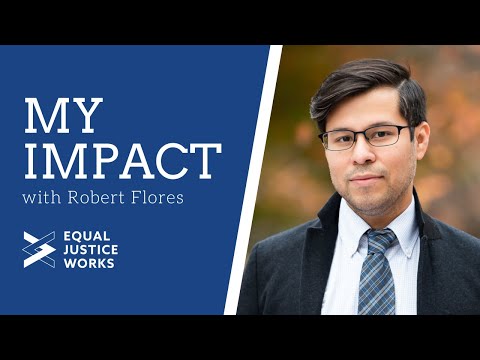
Throughout these two Fellowships, Robert remained at his host organization, YMCA International Services, continuing to expand disaster resiliency within the immigrant and refugee communities and build stronger client relationships. “It has made me more cognizant of people’s situation outside of the service that I am providing them,” he noted. “I had the opportunity to go to the immigration courts and actually speak to people in removal proceedings on a rotating basis… and [this allowed me to be] able to see trends, identify gaps, and identify things that were working and things that were not working… My immigration knowledge experience increased exponentially.”
Serving in these programs also allowed Robert to gain experience in other areas of law. “I was able to see civil law in a way that I hadn’t been able to see before [and] I was able to see how disaster effectiveness affects other legal processes,” he said. “I was able to understand the importance of title clearance, of FEMA appeals, and of insurance. I was able to see how people with disabilities are affected or systemically cut off from services and I would not have had that exposure without the Fellowship.”
I was able to see civil law in a way that I hadn't been able to see before [and] I was able to see how disaster effectiveness affects other legal processes.
Robert Flores /
2020 Equal Justice Works Fellow
In his conversation with Miranda, Robert also shared the following advice for those looking to go into public interest law: “Start off with looking at what causes an emotional reaction from you right now. Whether that is good or bad, look at something that is exciting to you… and see if there is any way that you can get involved.”
“Public interest is an incredibly wide net. It can be anything from immigration to education rights, rights for people with disabilities, accessibility, reproductive rights. It’s a field that almost has no limits,” he added.
To learn more about Robert’s work helping immigrants and refugees prepare and recover from disasters, watch the full interview here.
Interested in kickstarting your own public interest law career? Visit here to apply for a 2023 Design-Your-Own Fellowship before the September 13, 2022 deadline!

By 2022 Disaster Resilience Program Student Fellow Emily Bruell, who works alongside 2022 Fellows Sophia Genovese, Taylor Noya, and Anna Trillo at the New Mexico Immigrant Law Center (NMILC) to provide legal aid to non-detained asylum seekers and noncitizens in immigration detention facilities experiencing COVID-19 outbreaks. In honor of National Preparedness Month, this blog was written to raise awareness about the importance of being prepared for disasters in order to respond to them adequately and efficiently.
COVID-19 has intensified the chronic issues within immigration detention facilities, which are wrought with medical neglect, government misconduct, and due process violations. The pandemic has made these facilities even more dangerous, particularly for those with medical vulnerabilities.
I work alongside my colleagues at the New Mexico Immigrant Law Center (NMILC) to respond to issues exacerbated by COVID-19 in two of New Mexico’s private immigration detention facilities: the Cibola County Correctional Center and the Torrance County Detention Facility.
Over the past several months, we have spoken with ill and disabled migrants and asylum seekers whose basic needs go woefully unmet while in immigration custody. We also observed that when there is a COVID-19 outbreak in a detention facility, Immigration and Customs Enforcement (ICE) and the facilities do not respond adequately nor appropriately, jeopardizing the health and safety of incarcerated immigrants, particularly those with medical vulnerabilities.
In response to this mismanagement, we filed a Civil Rights and Civil Liberties (CRCL) complaint with the Department of Homeland Security on behalf of Edgar, a Nicaraguan asylum seeker, against the ICE El Paso Field Office and the Cibola County Correctional Center. Edgar suffered physical abuse at the hands of government officials, which resulted in his ankle being broken, and he experienced first-hand how ICE’s COVID-19 policies were negligent to the detainees in Cibola. In addition to detailing the physical abuse Edgar suffered at the hands of government officials, causing a broken ankle, we also exposed the inadequate response to the COVID-19 outbreak.
The COVID-19 outbreak at Cibola began when another incarcerated immigrant in Edgar’s unit reported symptoms on Friday, August 5. Edgar reported symptoms the next day. Neither Edgar nor the other man received a COVID-19 test until the following Monday, August 8. At that time, Edgar’s entire unit was tested, then sent back to their usual dorms before learning the results of their test. The next morning, Edgar was given another COVID-19 test and informed that he tested positive.
He was then moved to quarantine—three days after initially reporting symptoms, which allowed the disease to spread in Cibola. Edgar was originally quarantined with four other men, and the number ultimately increased to seven. The total number of those who tested positive for COVID-19 is still unknown because ICE refuses to report these positive tests.
While in quarantine, Edgar experienced trouble breathing, shortness of breath, severe lung pain, and nausea in addition to intense body aches, headache, sore throat, and congestion. He was not provided any medication for over 24 hours, at which point he was given a pill for his sore throat and another for his congestion. Every evening, the men were placed in separate cells with a radio to contact the officers; however, the officers did not respond to any communication from the radio.
One of the men in quarantine became extremely ill and was struggling to breathe. Edgar and the other quarantined men pleaded for medical help over the radio but received no response. Though the man’s condition improved somewhat the next morning, the lack of response left no doubt in Edgar’s mind that he could not expect help from the officers if he needed urgent medical care.
The lack of response left no doubt in Edgar’s mind that he could not expect help from the officers if he needed urgent medical care.
In response, we escalated our concerns to ICE, and those complaints went ignored until the filing of the CRCL complaint the following week. To this day, ICE has not reported the positive COVID-19 cases at Cibola County.
Despite having ties to the United States and a sister who is deeply committed to supporting him upon release from detention, Edgar remains detained at Cibola, where he continues to experience horrific and unsafe living conditions. In light of his prolonged detention, Edgar contemplated giving up and accepting deportation; however, he remains committed to fighting his complaint and ensuring no one else suffers the way he and so many others have in Cibola County.
I work alongside my colleagues at NMILC to help people like Edgar every day. We hold on-site bimonthly legal presentations for migrants and asylum seekers that provide an overview of asylum law, their rights, how to request to be released from detention, and more. Since April of 2022 we have provided valuable legal presentations and know-your-rights information to nearly 300 incarcerated migrants and asylum seekers.
I work alongside my colleagues at NMILC to help people like Edgar every day.
We have also conducted consultations for these 300 individuals, providing them with individualized case information. After conducting consultations, NMILC—in partnership with Innovation Law Lab, Justice for Our Neighbors—El Paso, and Las Americas Immigrant Advocacy Center—coordinates legal services for individuals seeking representation in their requests for release from detention and other legal support. So far, we have helped release nearly 20 people from immigration detention. In addition, we have engaged in systemic advocacy to combat the cruelties of immigration enforcement, removal, and detention.
At NMLIC, we are constantly fighting for transparency in ICE operations, fighting for the rights of incarcerated migrants and asylum seekers impacted by the COVID-19 disaster, and demanding the release of all immigrants from deadly detention facilities in New Mexico. COVID-19 has exacerbated the cruelties of immigration detention, and no amount of oversight or medical response can prevent another tragedy from occurring. In the end, I believe the only way to overcome, and be resilient to, the COVID-19 crisis in New Mexico’s immigration detention facilities is to abolish detention itself.
To learn more about the Disaster Resilience Program, visit here.
By Sarah Jasper, program specialist at Equal Justice Works
Interested in working in public service after law school? Want to transform your passion for equal justice into a career? Becoming an Equal Justice Works postgraduate Fellow is a great way to get started!
Equal Justice Works postgraduate Fellowships offer two different avenues for new public interest lawyers to jumpstart their careers while serving their community. Through the Design-Your-Own Fellowship, applicants identify a particular area of unmet legal need and propose strategies to address it. Through our issue-specific Fellowship Programs, participants join a corps of Fellows addressing a particular area of need, such as housing or disaster recovery.
No matter how you choose to serve, being an Equal Justice Works Fellow helps jumpstart participants’ careers in public service law and fosters long-term success. On average, 85% of Equal Justice Works Fellows remain in public service following their Fellowship, and many continue to use the connections and the skills they attained during their Fellowship to help them throughout their careers. Additionally, once you have completed your Fellowship, you are invited to join the Equal Justice Works Alumni Network, with over 2,000 passionate public interest lawyers who support one another throughout their legal careers!
To learn more about the different ways you can become an Equal Justice Works postgraduate Fellow, check out the recording of the “Mobilizing the Next Generation of Public Interest Lawyers: EJW Postgraduate Fellowships”conference session from the 2021 Conference and Career Fair. In this session, you will hear from Sherene Thomas and Laura Roach about the two different Fellowship models Equal Justice Works provides. You will also get to learn about the project that 2020 Design-Your-Own Fellow, Clarence Okoh, is working on in collaboration with his host organization, the NAACP Legal Defense and Educational Fund, Inc.

This fall, the annual Equal Justice Works Conference and Career Fair will be held virtually, with the conference taking place on a separate weekend from the career fair portion of the event. The Equal Justice Works Conference will take place on Thursday, September 22 and Friday, September 23, and the Equal Justice Works Career Fair will be held on October Thursday, October 20 through Saturday, October 22. It is the largest national public service legal career fair in the country, bringing together hundreds of public interest employers, law school professionals, law students, and recent graduates from across the United States and its territories to network, participate in interviews, and attend substantive conference sessions and workshops.
Attending the Conference and Career Fair is a great way to build your network and secure either summer or full-time opportunities. Even if you are not ready to apply for interviews just yet, we encourage anyone who wants to get involved in public interest law to attend the fair and see the myriad ways you can work in public service within the legal community!
Visit here for more information about the 2022 Conference and Career Fair.
My Impact is a conversation series from Equal Justice Works, using interviews with alumni to shine a light on what’s possible with an Equal Justice Works Fellowship. Program Specialist Sarah Jasper spoke with Annie Lee, a 2014 Fellow in the Design-Your-Own Fellowship Program and chair of the Alumni Advisory Council. As a Fellow, Annie was hosted by the National Center for Youth Law.
Annie Lee began her professional career as a history teacher in the Bronx—a role that gave her firsthand insight into the obstacles facing her students, which inspired her pivot to public interest lawyering on behalf of underserved students. “What I realized in my time teaching is that [students] faced so many barriers outside of our classroom and our school,” Annie explained. “I was really interested in trying to address some of those, and so that’s why I went to law school.”
Early in her legal career, Annie learned to leverage resources, her network, and the experiences available to her to become a strong advocate. These skills proved useful when she chose to pursue an Equal Justice Works Design-Your-Own Fellowship. Throughout the application process, Annie relied on her public interest peers, who helped her navigate the complexities of law school, define her Fellowship, and clarify what she wanted her long-term public interest career to look like. She highly recommends that potential Fellows do the same and lean on their networks to maintain strong connections in the public interest community.
In 2014, Annie began her Equal Justice Works Fellowship, where she worked with the National Center for Youth Law to improve educational outcomes for foster youth. “People view foster youth as a child welfare issue [without acknowledging] the other aspects of [a] child’s life,” explained Annie, “including schooling.” Her Fellowship also advocated for increased transparency in how school districts utilized their funding, and directly represented students in special education and in school disciplinary matters.
Throughout the conversation, Annie emphasized the value of collaboration. She recommends reaching out to others in the public interest community for help, citing the work she did with her host organization to define the focus of her Fellowship during the application stage. “It’s not just on you to figure out this new idea,” Annie stated. “You can work with other people to… take that pressure off yourself.”

Annie was able to have a smooth transition from her Fellowship into the next step of her career by having a conversation about new opportunities with her supervisor at her host organization. For those who are not sure what next steps to take after their Fellowship, Annie advised: “life is not linear… there is no right next step—it is whatever step you choose. Choosing one thing for the immediate future does not necessarily foreclose other things.”
Through her extensive public interest experience in varying roles, Annie has developed a lot of advice for those who are starting out in public interest, including what steps were most helpful to get her to where she is today. One important step is setting boundaries and remembering to care for yourself, as well as your clients, to avoid burnout. To set helpful boundaries, Annie recommended reaching out to people you trust at your place of employment and asking them about their experience. Having this conversation with your employer will give you a good idea of what to expect as an employee.
Annie also advised current law students who are looking for inspiration for their project to join clinics related to their interests. “It is the best learning experience… far better than any doctrinal class you can [take],” said Annie. She so highly recommends clinics to young professionals because her experience in a clinic clarified her path forward in two ways: it showed her what content area of law she wanted to focus on, and it let her test out which kinds of legal tasks she found to be the most engaging.
Annie’s last bit of advice for anyone looking into a career in public interest was to leverage the experiences available to you in law school. “Clinics, externships, summer internships… [use these] to figure out the content that you’d like to work in, the skills you’d like to build, and the geographical region that you want to be in.” One of the most helpful tools along the way, besides her Fellowship experience, was her network, which she began building through experiences like internships. Her connections in the public interest field helped her land her Fellowship at the National Center for Youth Law and continue to help her in her current job as the Director of Policy at Chinese for Affirmative Action (CAA) and in her advocacy as a co-founder of the national Stop AAPI Hate coalition.
In addition to an extensive professional career, Annie stayed involved with Equal Justice Works after her Fellowship through the Alumni Advisory Council. She now uses her networking skills to foster connections within the Equal Justice Works alumni community. “One of the best parts of being on the Alumni Advisory Council is the diversity… we’ve got folks from all across the country, but also [from] different fields, different types of Fellowships and different parts of their career,” Annie explained. “I really like when we come together and leverage our skills and experiences to give back to the Equal Justice Works community.”
To learn more about Annie’s work advocating for educational rights, watch the full interview here.
Interested in kickstarting your own public interest law career? Visit here to apply for a 2023 Design-Your-Own Fellowship before the September 13, 2022, deadline!