Support Equal Justice Works
Your tax-deductible gift brings us closer to fulfilling our nation’s promise of equal justice for all.
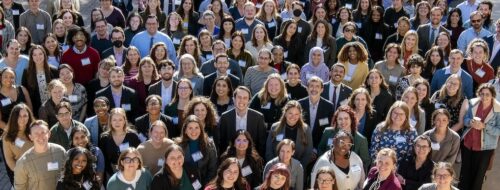
Our recent national survey found that 79% of Americans don’t believe the justice system is fair. This new class of 60 Fellows have designed projects to bridge that gap and bring legal aid to those who need it most. Each project is targeted to an identified need within communities. Over the course of two years, each of these Fellows will serve clients, provide advocacy, and build relationships with their community.
This class of Fellows will be working across 21 states in issue areas ranging from affordable housing and disability rights to legal issues arising in tech. Each Fellow will help expand access to justice in their communities.
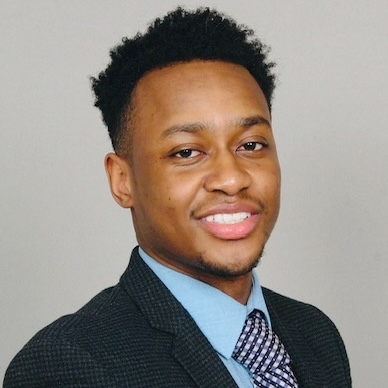
Kofi Agyepong's project will expand post-conviction access to justice for those who were wrongfully convicted due to limited resources while piloting artificial intelligence–assisted screening tools. To accomplish this, he will work with the Ohio Innocence Project.
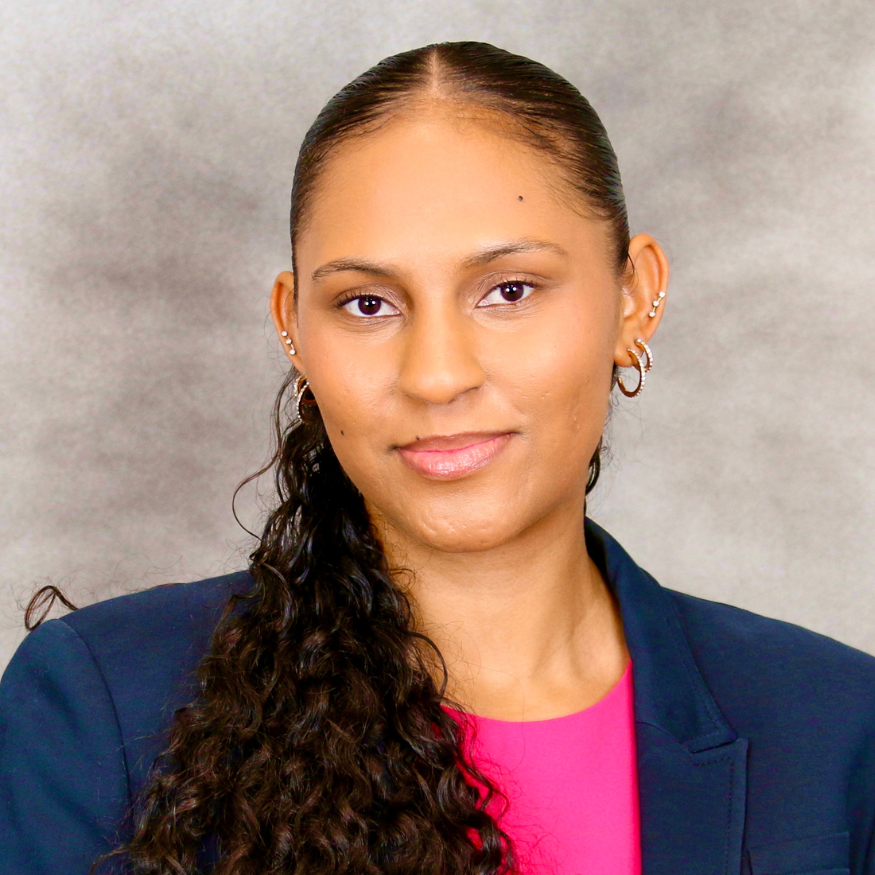
Adoris Gibbs plans to work with Brown's Promise to evaluate Georgia’s school choice programs to ensure that students have equitable, constitutionally sound access to integrated, well-resourced public education.

Regina Macias aims to help close the SSI disability benefits enrollment gap for Philadelphia’s Spanish-language communities. She will work at Community Legal Services of Philadelphia to build outreach and community education in support of this goal.

Samantha (Sam) Phillips will work to advance litigation strategy, legal coordination, policy development, and advocacy for the Coalition for Tribal Sovereignty as its first staff attorney. This project aims to unify 35+ Tribal organizations to defend sovereignty and enforce trust and treaty obligations.

Will Cassou will work with the Inner City Law Center to assist unhoused veterans by creating a weekly clinic in Los Angeles that will provide full-scope services to chronically homeless veterans and empower clients and advocates with educational sessions.

Hannah Grage is working with Alaska Legal Services Corporation to partner with Native health providers. She will use these connections to build a medical-legal partnership and provide legal advocacy to indigenous communities in Interior Alaska.
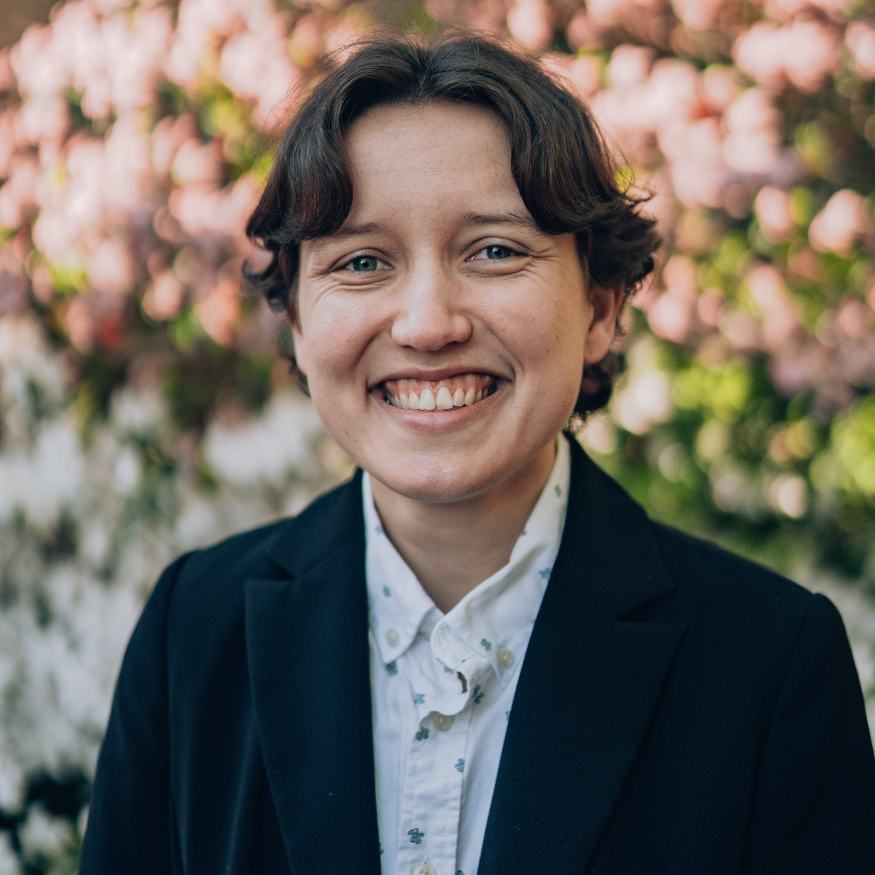
Max Parker’s project will empower incarcerated people navigating the parole review process to tell their stories on their own terms, through direct representation, education, and systemic litigation. To accomplish this, Max will work with the Southern Coalition for Social Justice.

Alexandra Sarkis plans to challenge the detention of individuals who have been unlawfully detained through habeas petitions. She will work with the Immigrant Defenders Law Center to develop training materials, engage in advocacy, and work on bond cases for unaccompanied children.
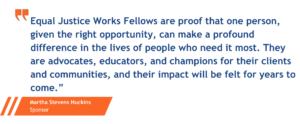
Your tax-deductible gift brings us closer to fulfilling our nation’s promise of equal justice for all.
As 2025 comes to a close, Equal Justice Works is reflecting on the accomplishments our Fellows and programs have achieved this year. Here’s our year by the numbers:
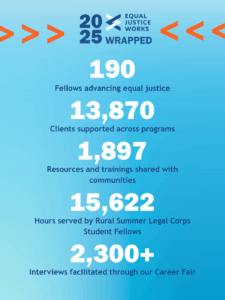
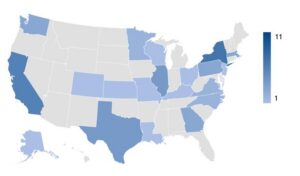
In 2025, our community helped expand access to justice on a national scale. We mobilized 190 Fellows across 28 states:
And so much more! Collectively, Fellows served 13,870 clients and created 1,897 resources and trainings that will continue supporting communities long after their Fellowships end.
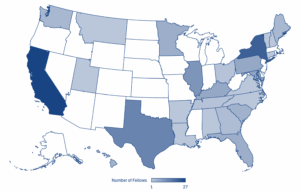
From coast to coast, our Fellows worked alongside communities to create change. Each number on the map represents a project improving clients’ lives and reducing the justice gap.
Throughout the year, we’ve shared stories from Fellows making a difference across the country. Here are some highlights:
So, how does this break down by program?
This year, 158 Fellows in the Design-Your-Own Fellowship program worked across 31 issue areas, building capacity for organizations addressing emerging community needs, advocating alongside community members, building relationships supporting their work, and increasing understanding of laws, processes, and rights.
In addition to Design-Your-Own Fellowships, Equal Justice Works also operates cohort-based Fellowship programs – issue-focused models that place multiple Fellows in communities across the country to address a shared challenge through coordinated training, technical assistance, and collective impact. Through these cohort programs, Fellows drove measurable impact across the United States. This year:
You can see the full span of our Fellowship programs on this page.
 During our 2025 Public Interest Summer Internship Primer, we helped more than 200 law students receive training in trauma-informed lawyering, housing law, community lawyering, and client interviewing – building early exposure to public interest careers.
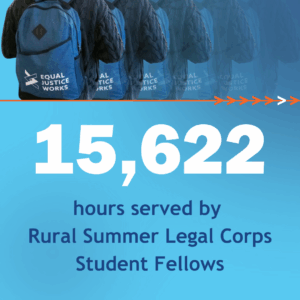
We also expanded opportunities for law students to launch their careers through our summer internship program, the Rural Summer Legal Corps (RSLC). Funded by the Legal Services Corporation, 50 RSLC Student Fellows from 36 law schools served with 44 legal aid organizations to serve “legal deserts,” rural communities that are isolated with little to no access to legal aid. Together, these Student Fellows:
These students extend the reach of legal aid in rural communities while building the next generation of public interest leaders. We are already gearing up for the next class of 2026 Student Fellows, so stay tuned for more information on law student opportunities in January!
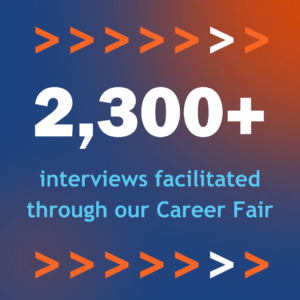 At our 2025 Career Fair, we facilitated:
This remains one of the largest public interest career fairs in the country.
Our Alumni community also grew this year, as did our Alumni outreach.
On an executive level, we expanded our Board of Counselors to 96 members this year, broadening our circle of support and drawing perspectives from across professions.
We thank our supporters for making this impact possible! We are so grateful to our Fellows, Host Organizations, Alumni, our staff, and our community for the growth you have helped facilitate this year! Thank you for your commitment to equal justice, and we look forward to building on this impact together in years to come.
The opioid crisis is often told in numbers, but the real impact is found in the daily challenges people face when seeking stability and treatment. Equal Justice Works’ Opioid Crisis Response Program was created to place legal services directly where communities need them most. Read on to learn about the impact of the inaugural class of Opioid Crisis Response Program (OCRP) Fellows.
In September 2024, Equal Justice Works mobilized six OCRP legal Fellows in Kentucky, Ohio, and New York to help confront the devastating impact of the opioid epidemic. These Fellows work at the intersection of health care, legal services, and community recovery — reducing barriers to treatment, advocating for stable housing, and increasing community understanding of how legal assistance opens pathways to long-term recovery.
For individuals living with Opioid Use Disorder (OUD), legal challenges often derail progress towards stability. A criminal record, domestic violence, unsafe housing, or a custody dispute can make it nearly impossible to sustain employment or keep a family intact. OCRP Fellows receive training in trauma-informed care and stigma-free advocacy, ensuring clients are met with dignity while their legal needs are addressed.
![Graphic reads: In the first year of the Opioid Crisis Response Program, Fellows helped [GRAPHIC IMAGE OF A HOUSE] 1,000 + households achieve housing stability, clear criminal records, and resolve critical family matters. The Equal Justice Works logo sits at the bottom.](https://www.equaljusticeworks.org/wp-content/uploads/2025/12/OCRP-Recap-Graphic-300x300.png) To date, this cohort of Opioid Crisis Response Fellows has served more than 500 individuals and helped over 1,000 household members achieve housing stability, obtain criminal record expungements, and resolve family matters such as divorces and custody cases. For those affected, these cases reflect a fresh start and renewed hope for the future.
To date, this cohort of Opioid Crisis Response Fellows has served more than 500 individuals and helped over 1,000 household members achieve housing stability, obtain criminal record expungements, and resolve family matters such as divorces and custody cases. For those affected, these cases reflect a fresh start and renewed hope for the future.
In 2024, Fellows dedicated about 81% of their time to criminal record expungement work. A criminal record is one of the strongest predictors of economic instability; removing that barrier is often the gateway to employment, stable housing, and long-term recovery.
2024 Fellow Maegan Pirtle illustrated this impact when she successfully expunged a felony drug conviction that constrained her client’s opportunities for over a decade. Although the client transformed her life, the lingering conviction continued to dictate her future. Thanks to Maegan’s skilled advocacy, the court granted the expungement — allowing the client to move forward free from the weight of the past.
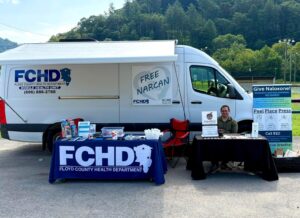
Clients served this year reported feeling more confident in understanding their legal rights after working with an OCRP Fellow. The Fellows also strengthened community knowledge by conducting outreach and trainings that reached more than 2,500 community members and stakeholders and collaborated with 104 community partners.
One of the most effective elements of the OCRP has been the Fellows’ consistent presence in health care settings, where trust is built and stigma is reduced. Our Fellows built and maintained 22 Medical Legal Partnerships (MLPs) across the Opioid Crisis Response Program. These MLPs provide clients with a single point of access for their legal needs. Fellows also trained 82 medical providers, case managers, and recovery specialists to identify common legal problems affecting patients in recovery — extending the program’s impact far beyond individual cases.
2024 Fellow Julia Cummings saw firsthand how a consistent presence in the clinic is critical to building trust with patients and staff. She established a Legal Help Desk at Urban Health Plan’s Equality Clinics, which serve primarily LGBTQIA+ patients, to ensure clients can meet her in a safe, familiar environment. This model has already deepened relationships with clinic staff and increased patients’ comfort in seeking legal support.
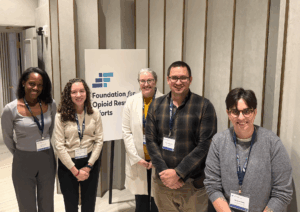
In addition to direct services, OCRP Fellows engaged in policy advocacy to uplift the needs of the communities being served. Fellows participated in 16 policy and advocacy meetings, providing recommendations on how to address barriers to recovery. Fellows successfully advocated for education of court personnel and established referral relationships with judges.
For example, Fellow Carrie Stambaugh worked with the Kentucky Access to Justice Commission to address statewide inconsistencies in citation expungements, leaving eligible individuals with records that should have been cleared. Because of Carrie’s zealous advocacy, the Commission agreed to implement statewide trainings for clerks to ensure uniform treatment of expungement cases going forward. This change will benefit future applicants long after Carrie’s Fellowship ends.
As the OCRP enters its second year, Equal Justice Works is proud and committed to supporting these dedicated Attorney Fellows who are expanding access to justice for individuals and families affected by OUD. As one supervisor shared, “Without the opioid grant from EJW, our organization would not have been able to provide full representation for clients.”
Without the opioid grant from EJW, our organization would not have been able to provide full representation for clients.
Anonymous Supervisor /
Opioid Crisis Response Program
By addressing an unmet need, reducing barriers to stability, and advancing systems-level solutions, Fellows in the OCRP are not only transforming lives — they are reshaping the systems that impact recovery.
The Opioid Crisis Response Program is made possible thanks to the generous support of the Foundation for Opioid Response Efforts (FORE). To learn more about the Opioid Crisis Response Program, click here. Interested in supporting the OCRP? Reach out to [email protected] for more information on how to get involved!
Each Fall, Equal Justice Works brings together its community of Fellows, alumni and supporters for a series of cornerstone events: the Scales of Justice celebration and Leadership Development Training (LDT). These gatherings celebrate our shared commitment to advancing equal justice and supporting the next generation of public interest law leaders.
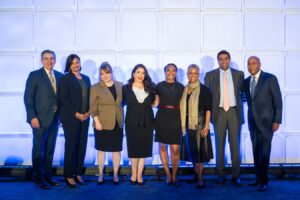
On November 5, 2025, Equal Justice Works convened with over 900 supporters in Washington, D.C. for the 2025 Scales of Justice, the organization’s premier fundraiser and recognition of the incredible public interest work accomplished by our community.
This year’s event honored Rishi Varma, for his commitment to service and recognized Equal Justice Works alum, Taylor Sartor with the 2025 Distinguished Alumni Award, for her leadership in building infrastructure to support systems-impacted youth in Florida.
This year, we raised over $3 million to support Equal Justice Works in mobilizing a community of lawyers committed to public service and equal justice!
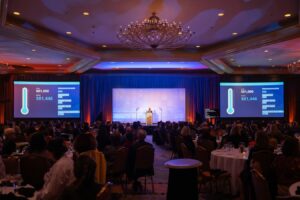
Hosted by Board Chair Frank Jimenez, the event highlighted Text-to-Give Fellow Bri Crawford who advocates for systems-impacted youth. In response, attendees texted in donations totaling more than $81,000 to fund a 2026 Equal Justice Works Fellow who, like Bri, will pursue their passion to help individuals and communities in need. Guests also heard from 2022 Fellow Adrieanna Hutson, who shared her work providing legal aid to tenants who were impacted by disasters. Click the image below to watch Adrieanna’s video:
Thanks to everyone who made the 2025 Scales of Justice possible: Champion of Justice sponsors Cargill; Greenberg Traurig, LLP; and Wilkinson Stekloff LLP, as well as our other event sponsors, the 2025 Steering Committee, additional event speakers Ernest Greer and Archi Pyati, our staff, and all who attended and supported the Scales of Justice!
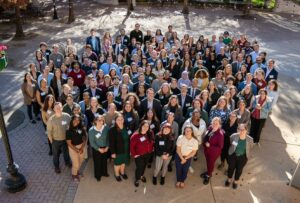
Leading up to Scales of Justice celebration, 169 of our current Fellows had an opportunity to learn, network, and hear from 22 experts at the Leadership Development Training (LDT) 2025. LDT is our annual networking and career development event for Fellows, and this year focused on “Movement Building: Power, Purpose & Public Service in Challenging Times”.
Through a series of community collaboration sessions and skill-based workshops, facilitators provided expertise in areas such as storytelling, community organizing, and movement lawyering. Our Alumni community was also instrumental in making this year’s LDT a success, with 19 Equal Justice Works alumni returning to speak on panels, facilitate issue area-focused networking sessions, and the Alumni Advisory Council stepping up to host a networking event for Fellows on the first day of the event.
We are so grateful to our community for joining us for another successful year of fall events. If you missed out this year, consider donating here. We are already looking forward to next year, when we will celebrate Equal Justice Works’ 40th anniversary. We hope to see you there!
For nearly forty years, Equal Justice Works has mobilized passionate public service leaders to address the most pressing legal needs in underserved communities across the nation. We write in strong support of the proposal to establish a Community Justice Worker (CJW) program in the District of Columbia. As a national nonprofit organization dedicated to expanding access to justice and building a more inclusive legal profession, we believe that the implementation of a CJW program is not only a necessary innovation, but an urgent moral and civic imperative.
The Legal Services Corporation reports that 92% of low-income people’s needs go unmet in this country. According to some scholars, between 150 and 250 million legal issues go unresolved annually. Making matters worse, fewer than 1% of the nation’s 1.3 million attorneys are paid legal services attorneys. This shortage of justice occurs in high stakes matters, such as evictions, child custody disputes, and benefits proceedings. Against the backdrop of this untenable situation, states across the country are piloting the use of community justice workers. At this writing, 11 states have relaxed their regulations prohibiting the unauthorized practice of law (UPL regulations) and another 20 are considering such a move given the dimensions of this crisis.
The scope of work for CJWs often includes common matters affecting community members that are not sufficiently met by traditional pro bono and legal aid services: housing and eviction cases, family law and guardianship, public benefits assistance, immigration filings, and other matters that critically impact people’s lives.
Jurisdictions authorizing community justice workers have found them to be essential to meeting these legal needs. By offering guidance, referrals, and limited legal assistance under appropriate supervision, CJWs relieve pressure on overburdened legal aid systems and courts. Their community-driven approach also fosters trust and accessibility, particularly for marginalized populations who face barriers to engaging with traditional legal institutions. As a result, jurisdictions that have integrated CJWs into their justice frameworks report improved outcomes in legal problem resolution and greater public confidence in the fairness and responsiveness of their justice systems.
For example, in Alaska the state supreme court authorized the Alaska Legal Services Corporation to supervise CJWs to address rampant food insecurity suffered by that state’s residents. Frontline Justice reports that CJWs in Alaska have secured approximately $1.4 million in food assistance benefits for clients and have seen positive outcomes in 84% of cases they handled. In Arizona, CJWs are active as Domestic Violence and Housing Stability Legal Advocates and have had such a positive effect that the state court plans to expand the program to other areas of law. These models reflect a broader shift: states are modifying UPL restrictions, introducing trained and supervised professionals who are not attorneys, to fill critical legal help gaps.
The District of Columbia should join the growing movement to increase access to justice. Access to legal help remains out of reach for thousands of residents even in a city with a robust legal services community. Unmet civil legal needs persist in critical areas such as housing, family law, public benefits, consumer protection, and immigration. According to a 2019 report from the District of Columbia Access to Justice Commission, the vast majority of such cases (75-97%) include at least one unrepresented party.
When people try to navigate the legal system alone, they face significantly worse outcomes with lasting consequences for their families and communities such as higher rates of eviction, lower benefit and compensation awards, and other barriers to justice. The blocks to legal representation and information are most pronounced in historically marginalized communities, where economic disparities and systemic exclusion continue to prevent individuals from seeking or obtaining legal help when they need it most. The stakes are high, and representation can be the difference between stability and crisis.
As the nation’s largest facilitator of public interest legal fellowships, Equal Justice Works has seen how important CJWs are to ensuring that communities get the legal assistance they need.
For example, EJW’s Housing Justice Program includes a cohort of organizer Fellows who work alongside lawyers and legal aid organizations to share valuable resources, build community trust, and mobilize tenant households tosupport systemic change. Over a 2-year period, our housing organizer Fellows in Maryland, Virginia, and South Carolina have worked with over 350 community leaders to host large tenant gatherings, facilitate 60+ education sessions on tenant rights and recourses, and raise public awareness through hundreds of media placements at a local level.
In Texas, EJW is partnering with the Texas Immigration Law Council to place community justice workers supervised by licensed attorneys in low-income and immigrant communities to provide limited legal services. These Fellows are helping individuals and families navigate housing law, consumer debt defense, estate planning, and other legal areas that are critical to people’s lives. In our experience, CJWs are often deeply embedded in the communities they serve. They speak the language, understand the cultural context, and bring credibility and trust to situations where individuals face legal challenges. This model demonstrates the transformative potential of lawyers workingwith trained community advocates and supportive services to provide an accessible, cost-effective, and community-driven solution to the justice gap.
Across the country, this model is gaining momentum. DC should be among the jurisdictions leading the movement by adopting a carefully designed CJW program to diversify and strengthen its public interest workforce. Many CJWs are community organizers, paralegals, and non-traditional legal professionals—people who may not pursue a J.D. but have the dedication, skills, and insight to make a real difference. Licensing these passionate individuals creates new pathways into the justice system and honors their role as legitimate and essential legal advocates. Just as nurse practitioners transformed access to healthcare, CJWs can transform how we provide legal services—expanding the ecosystem without replacing the need for fully licensed attorneys.
We also recognize that ensuring quality, ethical practice, and appropriate oversight is critical. We support a regulatory framework that provides rigorous training, supervision, and continuing education for CJWs, alongside clear scopes of practice and accountability measures. These standards should be developed in consultation with legal aid providers, bar associations, community organizations, and the CJWs themselves. The regulatory structure must balance accessibility and innovation with the need for equitable public protection and should be transparent and responsive to feedback from the communities it intends to serve.
Importantly, this proposal comes at a time when traditional legal service delivery models are under strain. Federal funding fluctuations, political pressure on nonprofit and pro bono legal work, and burnout among legal aid attorneys have created structural vulnerabilities.
Expanding the pool of qualified legal advocates through a CJW program is one of the most promising, scalable, and community-centered solutions available. It is also a concrete step toward fulfilling our shared constitutional promise of equal justice for all, not just those who can afford it.
We urge District leaders to embrace the opportunity to pilot a Community Justice Worker program that can become a reliable and trusted resource for Washingtonians. By doing so, you are investing in equity, resilience, and the power of community to drive legal change.
We thank the DC Bar, the Office of the Attorney General, and all stakeholders who have engaged in this critical dialogue. Equal Justice Works stands ready to support the development, training, and deployment of community justice workers in the District—and to continue working alongside our partners to build a more just and inclusive legal system for all.
Thank you,
Verna Williams
CEO, Equal Justice Works
Last week, the Department of Education released its final rule, which threatens to undermine the program and disrupt the lives of those who rely on PSLF to make their career choices sustainable. The final rule would remove eligibility from employers that the Department deems to have engaged in illegal activities, thus limiting access to PSLF beyond the plain language of the statute.
The Public Service Loan Forgiveness (PSLF) program is a vital federal initiative that honors a fundamental promise made to public service workers: after ten years of service and consistent student loan payments, their remaining federal student loan debt will be forgiven. This program was never solely about financial relief; it was about strengthening communities by enabling dedicated professionals, such as public defenders, teachers, veterinarians, first responders, mental health workers, veterans, and others to remain in public service roles that often pay less than the private sector.
“This rule change is a major blow to the public servants who rely on the PSLF program,” said Verna Williams, CEO of Equal Justice Works. “For many, PSLF is the only reason a career in public service is even possible. Without it, countless teachers, nurses, and attorneys—whether they work in blue or red states—could be forced out of the work their communities depend on. By giving the Department of Education the power to disqualify employers dedicated to helping underserved populations based on vague, unsubstantiated allegations, this policy change turns PSLF into a political weapon rather than a nonpartisan, common-sense support for those who serve. It could strip organizations of eligibility without due process, thus leaving public servants in limbo. Policymakers must act now to protect PSLF and ensure that public service can continue free from political interference.”
“AccessLex is deeply disappointed by the decision to narrow the definition of qualifying employers under the Public Service Loan Forgiveness program,” said AccessLex Institute President and CEO Christopher P. Chapman. “This new regulation threatens to undermine the very purpose of PSLF: encouraging talented professionals to pursue careers in public service. This risks destabilizing critical services in legal aid, education, healthcare, and social support, which will harm the communities that rely on these services every day.”
On behalf of the more than 120 organizations in the PSLF Coalition, we strongly oppose this rule. It is essential that the federal government protects the integrity of a program that has empowered thousands to serve the public good. Now is the time to reaffirm our nation’s commitment to public service, not roll it back.
For many, PSLF is the only reason a career in public service is even possible... Policymakers must act now to protect PSLF and ensure that public service can continue free from political interference.
Verna Williams /
CEO, Equal Justice Works
By Karen A. Lash, former Equal Justice Works Vice President of Programs, board member, Leadership Development Training speaker, consultant, and student organizer
Hurricane Katrina’s landfall on August 29, 2005, brought not only physical devastation but also an avalanche of legal needs, exposing a critical gap: Who helps survivors navigate the complex legal challenges that follow disaster?
In the aftermath of the storm, I supported efforts to deliver legal help to the people who needed it most and to push for a more equitable recovery. These combined efforts jumpstarted Equal Justice Works’ disaster resilience work, which continues today, and helped lay the foundation for what is now known as disaster law.

Katrina devastated the southern half of Mississippi, destroying or rendering uninhabitable most of its housing stock. A staggering number of legal needs emerged. First came the immediate issues related to Federal Emergency Management Agency (FEMA) benefits, insurance claims, and housing. Then came secondary challenges: contractor fraud, custody disputes when families were displaced across state lines, and more.
The legal infrastructure was overwhelmed. Roughly half of Louisiana Bar Association members were displaced, with some attorneys working out of tents or cars after their offices were destroyed.
Equal Justice Works heard these legal horror stories and mobilized to get a squadron of lawyers to the region. At the time, I was working for the Mississippi Center for Justice, and Equal Justice Works enlisted my help in finding legal aid offices where Fellows could assist.
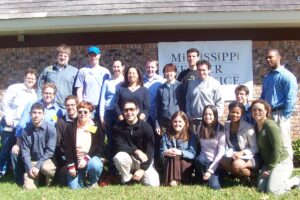
Within six months of the storm, 19 Equal Justice Works Katrina Fellows were on the ground!
The Katrina Legal Initiative soon expanded into three components, all hosted by nonprofit legal aid organizations across the Gulf Coast:
Together, these programs served more than 17,000 individuals, mobilized over 5,000 volunteer attorneys and law students, and forged hundreds of collaborative partnerships among organizations.
But numbers tell only part of the story. The Fellows didn’t just represent individual clients — they fought for systemic reforms that affected hundreds of thousands more.
One such effort was led by Reilly Morse, a 2006 Equal Justice Works Katrina Fellow at the Mississippi Center for Justice, where I was also working. I witnessed firsthand his masterful advocacy in the battle to restore housing to Katrina’s most vulnerable survivors.
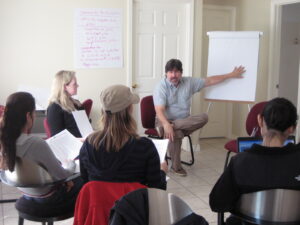
When Mississippi secured $5.4 billion in federal housing recovery aid, the initial joy gave way to despair as so many elderly, low-income, and minority communities were systematically deprived of the rebuilding funds available to disproportionately white and middle-class victims. When the state declared the recovery “over” and moved to divert nearly $600 million of disaster grants to expand the Port of Gulfport, we at the Mississippi Center for Justice took the fight to Washington.
Once Mercedes Márquez, the newly confirmed U.S. Department of Housing and Urban Development (HUD) Assistant Secretary for Community Planning and Development, got involved, things began to change. Reilly, working with her and her team, led negotiations that ultimately required Mississippi to set aside $132 million — later growing to more than $210 million — for low-income households who needed it most.
This was just one win among many. Through individual representation, class action litigation, and policy advocacy, the Katrina Fellows stopped FEMA from clawing back survivor benefits, secured accessible housing for disabled victims, and reformed federal disaster assistance programs.
What began as an emergency response evolved into a regional and national collaboration among legal aid organizations, law schools, and law firms providing pro bono aid, leaving a legacy that reshaped how the legal profession approaches disaster relief.
The Katrina Legal Initiative not only created a more equitable recovery from the hurricane — it also informed the first guidebook for delivering legal services in disaster-affected communities and established a replicable model.

Today, the Equal Justice Works Disaster Resilience Program places Fellows and Student Fellows in disaster-prone areas throughout the country, building capacity for both preparation and response.
As natural disasters grow more frequent and severe, Katrina’s legacy reminds us that disaster law is not just history but a living practice. Through the Disaster Resilience Program, the audacious goals born in the storm continue to guide Equal Justice Works and its legal aid and pro bono partners in creating real change for real people when it is needed most.
The Equal Justice Works Design-Your-Own Fellowship program serves a dual purpose: to jumpstart the careers of aspiring public interest lawyers, and to build crucial capacity at legal services organizations nationwide. Equal Justice Works does not match candidates and their host organizations; instead, both parties collaborate closely to design a project and apply for the Fellowship together.
Applications for the 2026 Design-Your-Own Fellowship are open until 11:59 PM ET/8:59 PM PT on September 10. Visit here for more details about the Fellowship, and to access resources and information about the application process. Be sure to review the Applicant Guide and Host Organization Guide.
To identify a host organization, consider the following:
We also recommend reviewing our Fellow archive; recent host organizations may be more likely to host a future Fellow.
If you are a 2026 Fellowship candidate who does not yet have a host, check out listings below for organizations still seeking candidates. If you are a host organization still seeking prospective Fellows and would like your solicitation listed here, email us at [email protected] to add your listing.
*Note: this list is not comprehensive, and the postings are subject to change. Please communicate directly with prospective host organizations for up-to-date information. Inclusion on this list does not signify endorsement of any organization or its views.
GBLS is interested in collaborating on a project with prospective Fellows on issues impacting predominantly low-income communities. The people who seek our assistance most often are women and children who need protection from abuse; families and elderly who face eviction from their homes; the homeless who have been denied temporary or permanent shelter; and single parents who have been inappropriately refused welfare, food stamps, or medical benefits. Deadline: August 1
Georgia Legal Services Program seeks to host one Fellow for the Fall 2026-2028 fellowship term. The Fellow will be based in Atlanta but will engage with communities and clients outside of metro Atlanta. The proposed Racial Justice Fellowship will focus on language rights and access. A Language Rights Fellow will work with the Respecting Individuality and Supporting Empowerment (RISE) Team and other GLSP attorneys to identify and challenge racial and national origin discrimination against persons who are English Language Learners, also called persons who are Limited English Proficient. Deadline: August 1
Georgia Legal Services Program seeks to host one Fellow for the Fall 2026-2028 fellowship term. The Fellow will be based in one of GLSP’s regional offices but will engage with Veteran communities and clients throughout the state of Georgia. GLSP will support the fellow with relevant training, direct supervision, and opportunities for professional development throughout the fellowship. The Fellow will be sponsored by Equal Justice Works, Skadden, or other fellowship set to begin in the fall of 2026. The proposed Upgrade Brigade Fellowship will specialize in veteran legal services with a focus on assisting Veterans in discharge upgrades, character-of-service appeals, and applying for VA disability benefits. Veterans with a discharge of “other than honorable,” “dishonorable” or “bad conduct,” are often ineligible for some or all VA benefits. With a discharge upgrade, veterans can have access to VA healthcare, VA disability compensation, education benefits, home loans, and other benefits. Deadline: August 18
DREDF works intensively with prospective fellows to develop projects that address critical disability civil rights law issues. Our advocacy priorities include defending and advancing the rights of disabled people in: education; access to government programs and services; housing; health care including long-term services and supports; transportation; technology; parenting and the dependency system; and self-determination and decision-making. Deadline: August 1
Impact for Equity seeks to host a dynamic and dedicated advocate as a Legal Fellow. The successful candidate will possess a commitment to racial and social justice, creativity, and leadership ability and will be comfortable working independently and within a team on multiple projects of varying complexity. When applicable, our staff will work with the candidate to develop their proposals for submission, helping tailor the proposal to address an important racial or social justice issue aligned with Impact for Equity’s mission and focus areas. Deadline: August 1
Texas RioGrande Legal Aid is eager to support thoughtful, community-driven projects that address real legal needs in the Texas border communities. As the largest civil legal aid provider in Texas, TRLA offers robust mentorship and the chance to work alongside experienced attorneys across more than 40 practice areas. If you are committed to direct advocacy and want your work to matter from the first day on the job, we will collaborate with you on developing your project and help you build a career with legal aid at the border. The need is high, the law is complex, and the impact is real. Deadline: August 1
AFC is particularly interested in working with a candidate to craft a project to increase access to early childhood education, focused on either children living in shelter or children with autism. Deadline: July 18
BDS is looking for a Fellow to join the Education Team in the Civil Justice Practice and work collaboratively with BDS to design a project focused on protecting the educational rights of parents with children in the foster system. Deadline: July 15
TakeRoot Justice is interested in sponsoring candidates who either already have a vision for their project or would like to work with TakeRoot Justice staff to develop a new proposal. Any proposal must consider TakeRoot Justice’s model of partnering with community-based organizations. A list of our current partners can be found on our website at takerootjustice.org. Deadline: August 20
This fellowship opportunity allows Fair Shake Environmental Legal Service to work collaboratively with a candidate to identify unmet legal needs within environmental law that you are passionate about to build your dream job. The project must have a geographic focus within the Appalachian Basin. Deadline: Rolling
L4GG will consider well-researched projects in any of its existing focus areas, including democracy and rule of law, civil and human rights (immigration, reproductive rights, LGBTQ+ rights, racial justice), and climate change and environmental justice. L4GG is also particularly interested in projects that 1) help leverage impact litigation on issues of government overreach / harm, or 2) provide transactional support to nonprofits and frontline community organizations, including assistance with congressional investigations, federal compliance, and nonprofit defense matters. The Fellow will work closely with experienced attorneys and leverage L4GG’s network of 150+ law firms and 125,000+ volunteer attorneys to mobilize pro bono support. Deadline: Rolling
We have two main practice areas. First, we track pro se conditions of confinement litigation and offer representation or other aid to incarcerated pro se plaintiffs on appeal. Second, we identify particularly troubling carceral facilities or practices that incarcerated people, their families, or their communities are already organizing against and use litigation as another pressure point to end them. We are open to project proposals for which an applicant has expertise or a particular passion but we are also happy to work with our selected fellow to develop a project. Deadline: Rolling
To view current and past Equal Justice Works host organizations, click here.
By Richard Luong, senior director of development at Equal Justice Works
I recently joined Equal Justice Works CEO Verna Williams, Network Manager Leeja Patel, and other Equal Justice Works staff in the privilege of visiting two remarkable host organizations in Chicago: Uptown People’s Law Center (UPLC) and Legal Aid Chicago. Both expand access to justice through frontline legal work—and both reminded us why our collective efforts matter now more than ever.
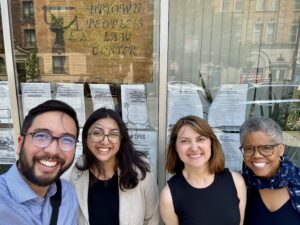
Nestled in one of Chicago’s most diverse neighborhoods, UPLC has been a cornerstone of community-based legal advocacy since its founding in 1975. Originally established to help disabled coal miners secure black lung benefits, it has evolved into a legal clinic with deep expertise in prisoners’ rights, tenants’ rights, and a Social Security disability practice.
During our visit, we head from Executive Director, Kate Walz, about their class-action work challenging solitary confinement in Illinois prisons. For years they’ve litigated cases like Davis v. Jeffreys, advocating for incarcerated individuals confined in isolation for months – even years – as part of a broader national campaign. Their legal team, supported by pro bono partners, amplifies systemic reform through their work on these cases.
In addition to impact litigation, UPLC prioritizes deep community connections—organizing bus trips for families to visit incarcerated loved ones, hosting community trainings on tenant and disability rights, and engaging deeply in grassroots advocacy.
UPLC’s incoming Equal Justice Works Fellow will focus on investigating instances of custodial sexual assault & harassment reported by incarcerated women at Logan Correctional Center and coordinate pro bono lawyers to eliminate the pervasive culture of sexual abuse in Illinois’s main women’s prison.
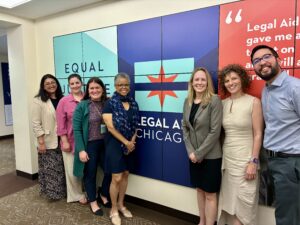
Next, we journeyed downtown to Legal Aid Chicago—a powerhouse legal aid provider that champions civil justice for low-income individuals across Cook County. As they note in their mission statement, “equal justice under law… must be the same in substance and availability, without regard to economic status.”
We met with Katherine Shank, the CEO and Executive Director of Legal Aid Chicago; Deputy Director and General Counsel, Teresa Sullivan; and Barbara Bertini, the Director, Pro Bono and Community Partnerships. The staff showed us how Legal Aid Chicago takes a comprehensive approach to tackling the most pressing issues facing its communities, including: preventing evictions and homelessness, aiding survivors of domestic violence and human trafficking, securing benefits for veterans and seniors, combating consumer fraud, and advocating for children’s education rights.
Legal Aid Chicago’s 32 legal clinics and court-based help desks serve as entry points for individuals confronting injustice. Their pro bono initiative enlists more than 1,000 volunteers, logging over 10,000 hours in 2023—showing how community partnership strengthens legal access.
Legal Aid Chicago’s current and incoming Fellows have projects that focus on removing future barriers to education, employment and housing for Students; working with low-income families on tangled title and estate planning matters; family defense services to parents in or formerly in foster care; and eviction prevention.
Though their practices differ, UPLC and Legal Aid Chicago share a vision to bridge the justice gap through community-grounded advocacy, strategic lawyering, and systemic change. At UPLC, that can look like fighting solitary confinement and defending tenants in Uptown. At Legal Aid Chicago, that can mean supporting survivors, seniors, families, and workers across Cook County. Whether recruiting volunteers for pro se clinics or mobilizing families to support incarcerated loved ones—these host organizations demonstrate thoughtful, strategic approaches to closing the access to justice gap.
Our site visits left us inspired and energized. The work at UPLC and Legal Aid Chicago underscores the potential of the design-your-own fellowship, where early-career attorneys create innovative and meaningful impact in underserved communities. We look forward to deepening our partnerships, supporting fellowships that embed attorneys in their groundbreaking work, and amplifying their success stories in the years ahead.
To view a comprehensive list of Equal Justice Works host organizations, click here.
Though their practices differ, UPLC and Legal Aid Chicago share a vision to bridge the justice gap through community-grounded advocacy, strategic lawyering, and systemic change.
Richard Luong /
Senior Director of Development,
Equal Justice Works
By Stetson University College of Law students Liam Cortez and Cecilia Chase
Last month, Equal Justice Works hosted its second Disaster Resilience Symposium in partnership with the American Bar Association’s Standing Committee on Disaster Response and Preparedness, and Stetson University College of Law. Set against the vibrant backdrop of Stetson’s Gulfport campus during Disaster Resilience Awareness Month, this year’s symposium gathered a dynamic mix of legal professionals, scholars, advocates, and community leaders committed to reshaping how we approach disaster preparedness, response, and recovery.
Held March 18-19, 2025, the event marked a pivotal moment for the disaster resilience movement. With programming that reflected the Symposium’s theme – Resilience Redefined: Charting the Path Forward – attendees engaged in deep reflection on the 20th anniversary of Hurricane Katrina, examined pressing issues through an equity lens, and explored actionable strategies to build stronger, more just communities.
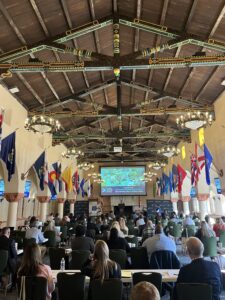
From interactive workshops and policy-driven panels to thought-provoking keynotes, the Symposium offered not only insights but space for collective visioning and connection across sectors.
With over 100 participants and 13 engaging sessions, the Symposium focused on urgent topics now facing the disaster law field – from disability accessibility and equitable FEMA aid to the continually evolving need for having local partnerships to drive effective response. One message was continually emphasized: resilience is no longer just about bouncing back – it’s about reimagining relationships, responsibilities, and responses before the next disaster strikes.
One message was continually emphasized: resilience is no longer just about bouncing back – it’s about reimagining relationships, responsibilities, and responses before the next disaster strikes.
Sessions throughout emphasized the growing need for locally led, community-centered, strategies. As noted by keynote speaker Ranie Thompson, Equal Justice Works Katrina Legal Fellow Alumni & Executive Director, Disability Rights Louisiana, who said: “To be effective and impactful, you must be on the ground.” This idea was further elaborated on by FURIA, a not-for-profit organization from Puerto Rico, which shared an innovative method for preparing communities to operate independently and have more agency knowledge within them.
The Symposium also addressed the ever-existent issue involving lack of communication between federal disaster policy and local realities. A panel of experts was at the helm of this issue, examining and explaining the application of FEMA’s 50% rule and the need for local implementation.
To be effective and impactful, you must be on the ground.
Ranie Thompson /
Equal Justice Works Katrina Legal Fellow Alumni
Executive Director, Disability Rights Louisiana
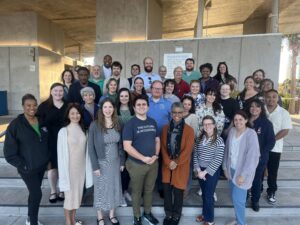
On the second day, attendees participated in a disaster and poverty simulation – a hands-on workshop made to showcase barriers faced by many in getting necessary disaster relief. Navigating insecurities in accessing food, housing, and medical care during the simulation, participants were able to develop a deeper understanding of how disaster response often fails to provide for the needs of underserved and low-income communities. A thoughtful debrief followed, which was a useful tool to dissect how a community does not have a monolith of experiences.
As our country reflects on 20 years since Hurricane Katrina – an event that opened our eyes to deep seeded inequities – the 2025 Disaster Resilience Symposium reaffirmed our commitment to moving forward with conviction, compassion, and collaboration. In redefining resilience, we are not only preparing for future disasters but rather charting a course for a more equitable and just future.
