Equal Justice Works Announces Leadership Team Changes
By Sara Morello, executive vice president & chief of staff
At Equal Justice Works, we are fortunate to have a strong and committed leadership team that supports its staff, Fellows, alumni, sponsors, and partners in creating opportunities for lawyers to transform their passion for equal justice into a lifelong commitment to public service. Change is inevitable, though, and this month we bid farewell to our colleague and friend Steve Denne as he retires from 43 years in public service, closing out this chapter as our vice president of institutional advancement. Steve brought his extensive experience—which began with a public service fellowship—to Equal Justice Works and helped us reach new levels of success even during the past, challenging year. We wish him all the best and send him off with sincere thanks for leading an outstanding development team that will surely continue to thrive and welcome more people into our community.

I am pleased to announce that Mia Sussman is stepping into the role of vice president of institutional advancement. Mia just celebrated her 10-year anniversary with Equal Justice Works, having led the unit that supports our signature Design-Your-Own Fellowship program, and expanding the community that supports our Fellows to include law firms, corporations, individuals, and foundations that share our vision of equal access to justice in America. Mia has an unwavering commitment to Equal Justice Works and our Fellows and has strong relationships with our sponsors, pro bono, and host site partners; her ongoing connection with our alumni speaks to the fondness she has for them, and they for her. During her tenure, our Design-Your-Own Fellowships program has grown tremendously as Mia strengthened our sponsor relationships, supported the launch of our new alumni engagement program, and built a terrific team of portfolio managers who will continue to foster this pipeline of future public service leaders. As she steps into her new role, Mia will bring her experience, enthusiasm, skills, and savvy to work across the organization to build support for Equal Justice Works and its Fellows who are helping to ensure that our country lives up to its promise of equal justice for all.

With Mia’s role change, we took the opportunity to adjust our internal structure to recognize the unity of our Equal Justice Works Fellows during their Fellowships and beyond. Kristen Uhler-McKeown, who has led the team supporting our cohort Fellowship programs for four years, will be our vice president of fellowships, taking the reins of a new single unit that brings together both of our post-graduate Fellowship programs and our alumni engagement program under one roof. Over the last four years, Kristen has transformed our cohort Fellowships into focused, responsive, and robust programs that move the needle on critical issues, build stronger communities of practice, and demonstrably increase capacity in legal services organizations across the country. Whether the issue is housing instability, elder abuse or disaster resilience, Equal Justice Works Fellows have worked and learned together under her guidance and with increased support from both public and private funders. Kristen has also worked with Mia to enrich the fellowship and alumni experiences, developing more opportunities for our Fellows and alumni to connect and learn from each other. Kristen will bring her substantial skills and experience in program design, management, and fundraising to lead a team of first-rate professionals dedicated to our Fellows and alumni, and will build from a position of strength to one of even greater impact driven by the passion of our Fellows and alumni.
I am so delighted to support the continued leadership development of these valued and visionary colleagues in advancing our work. I hope you are as excited as we all are to see where they will lead use, our Fellows, and indeed, the entire Equal Justice Works community in the future.
The following letter was sent from David Stern, Equal Justice Works Executive Director, to staff in response to the rise in anti-Asian attacks during the COVID-19 pandemic.
Colleagues –
Since the start of the COVID-19 pandemic, there has been a significant increase in anti-Asian attacks. Hatred, discrimination, and racist violence are not new to the American experience but have no place in the promise of all that America can and should be. The recent attacks in Atlanta resulted in nine shot, eight fatally, six of whom are women of Asian descent.
My thoughts are with the victims and their families, as well as with the Asian American and Pacific Islander community. I am also thinking about our Fellows, Alums, supporters, and host organizations in the Atlanta area. As always, I am grateful for our Fellows whose commitment to service and passion help lift up our ideal of equal justice for all. The work of our community gives me hope in distressing times like these.
In solidarity,
David Stern
Equal Justice Works Executive Director
By Linda Anderson Stanley, senior program manager at Equal Justice Works and director of the American Bar Association Young Lawyers Division Disaster Legal Services Program
Lawyers play a critical role in helping communities prepare for, respond to, and recover from disasters. Disasters, whether natural, human-made, or pandemic, disproportionally affect people who have already been marginalized—those who struggle with physical and mental disabilities; people of color; and low-income individuals and families who don’t have the resources to travel, evacuate, repair their homes, or access an attorney.
This past year—with the combined effects of the COVID-19 pandemic, a heightened hurricane season, intense winter storms, and much of the west coast being fiercely ablaze—has been especially devastating for low-income families. Not only has the crisis of COVID-19 created its own civil legal issues such as mass evictions, unemployment, and ballooning debt, it has also significantly hindered the ability of disaster survivors to justly recover after a natural disaster. We are seeing in real time the need for both preparedness and rapid response.
At Equal Justice Works, we believe that building a strong pipeline of legal talent committed to equal access to justice will advance a more equitable recovery period after disasters and create more resilient communities in the future.
As the frequency and severity of disasters continues to rise, lawyers play a critical role in improving preparedness by working with community members and leaders to avoid or mitigate disaster-related legal challenges.

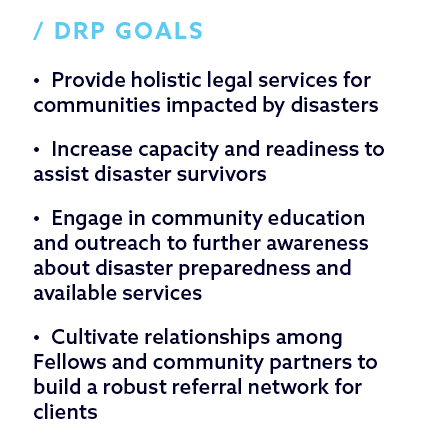 In 2020, we launched the Disaster Resilience Program to help fulfill the need for critical legal assistance before, during, and after disasters. Through the program, we have mobilized an initial cohort of six lawyers (Fellows) to work at legal services organizations in Texas and Florida to assist individuals and families with their COVID-19 related legal issues. The Fellows are also helping these individuals and families recover from the abundance of natural disasters that they have experienced, while working to build stronger and more resilient communities for the future.
Our Fellows accomplish more when they work together. What makes our cohort Fellowships model unique is that program participants have the opportunity to work alongside each other and share resources with one another, so they can be more effective advocates in disaster law. The model also allows for resource-sharing among community partners and national organizations focused on disaster response and recovery such as The National Disaster Legal Aid Advocacy Center.
“The Equal Justice Works Disaster Resilience Program facilitates the ability of Fellows to concentrate on a specific marginalized population. But more importantly, it facilitates the cross-collaboration among Fellows to uphold the rule of law for all populations as we grow and learn from each other’s strengths or specialization,” said Stephanie Duke, Equal Justice Works Fellow.
The Equal Justice Works Disaster Resilience Program facilitates the ability of Fellows to concentrate on a specific marginalized population. But more importantly, it facilitates the cross-collaboration among Fellows to uphold the rule of law for all populations as we grow and learn from each other’s strengths or specialization.
Stephanie Duke /
Equal Justice Works Fellow
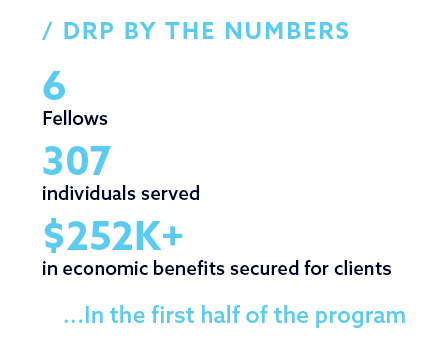 In the first half of the program alone, these six Fellows served 307 individuals (90% were below 200% of the Federal Poverty Guidelines), secured more than $252,057 in economic benefits on behalf of their clients, conducted outreach and educational trainings in response to COVID-19 and disaster preparedness, and engaged in numerous public service and leadership development opportunities.
The legal needs of disaster survivors are complex and difficult to navigate alone. The Equal Justice Works Disaster Resilience Program is committed to ensuring that all disaster survivors have an equitable recovery and are resilient for the future, not just those who can afford an attorney.
Since 2005, Equal Justice Works has mobilized more than 80 passionate public service lawyers to deliver legal services to disaster-affected communities.
Our Fellows have responded to Hurricanes Hanna, Harvey, Ike, Irma, Katrina, Laura, Maria, Sally, Sandy, and Rita; Tropical Storm Imelda; flooding in the Gulf Coast; tornadoes in Missouri and Oklahoma; the immigration crisis; the Deepwater Horizon oil spill in the Gulf of Mexico; and most recently COVID-19.
Read more stories about the work of our Fellows and how they are supporting communities with disaster-responsive lawyering:
- Equal Justice Works Fellows to Host Disaster Legal Aid Trainings
- Responding to the Increased Demand for Disaster Legal Aid
- Challenges on the Disability Community Amid Coronavirus Outbreak
- Renters’ rights and aid for repairs from burst pipes
- Be Prepared! – Disaster Planning Tips for Lawyers & Law Firms
- They have chronic illnesses. Then, the power went out in Texas. ‘It’s been emotionally exhausting.’
We continue to explore ways to expand the program into new areas across the country, and are seeking partners to help us do so. If you’d like to learn more about partnering with the Disaster Resilience Program, please reach out to [email protected].
The Equal Justice Works Disaster Resilience Program is funded by Carnegie Corporation of New York, the Center for Disaster Philanthropy, the Bigglesworth Family Foundation, and individual contributions.
The following letter was sent from David Stern, Equal Justice Works Executive Director, to staff in response to yesterday’s hate-filled siege on the U.S. Capitol.
Colleagues –
Yesterday’s hate-filled violent siege on the Capitol was scary and upsetting, especially considering it was the president and certain members of Congress who incited the mob. As our Board Chair, Ivan Fong, said, “A sad, disappointing and candidly disgraceful day for us as a nation that professes to be a representative democracy governed by the rule of law.”
The actions we saw yesterday were designed to intimidate, silence, and undermine our democracy. These actions are directly inconsistent with our core organizational values: equal access to justice, opportunity, service, community, and passion. The behavior we witnessed was particularly frightening because we are based in Washington, D.C., and many of you and our Fellows live in the local area. My thoughts are with all of you, our Fellows, and our community, as we continue to navigate this upsetting time.
It was also deeply troubling to see the contrast with how these violent rioters were treated in comparison to the peaceful protestors in support of Black Lives Matter, who were subjected to tear gas, rubber bullets, and batons. I believe yesterday’s events would have resulted in more violent reactions from the police had the rioters been Black.
We believe in our nation’s promise of equal justice for all, and we condemn anti-democratic and violent acts that seek to block the American ideal of a peaceful transition of power.
I hope you all stay safe and are taking care of your emotional well-being in these very troubling days.
David Stern
Equal Justice Works Executive Director
This year’s elections bring with them a slew of emotions for all us because we know so much hangs in the balance. We are in the midst of a global pandemic with no immediate end in sight. Hundreds of thousands of Americans have died, and millions of Americans are jobless and at risk of being evicted, or having their power and water shut off because of unpaid bills. Black people and people of color in America face the added burden and danger of centuries of racism.
This general election will lay out how we as a country proceed in navigating our way through these and so many other known and unknown scenarios. Like many of you, I am anxious. But even in the face of that fear and anxiety, we will press forward.
No matter the outcome, we will continue our work to build a community of lawyers committed to public service and equal justice in order to fulfill our nation’s promise of equal justice for all. Equal Justice Works was recently mentioned on a special episode of The Daily Show remembering Justice Ginsburg. Host Desi Lydic stated,
“Yes vote, but also we should be thinking long game… no matter what happens on November 3, we have to keep fighting for change.”
I agree and am so grateful for the Equal Justice Works Fellows fighting daily for that change. Our Fellows are passionate public service leaders, and I am confident that like Ms. Lydic states, they are the future RBGs, following her example of a lifelong commitment to public service and equal justice.
I am inspired by Fellows including Mitchell Brown, Hannah Klain, and Dana Paikowsky, who are advocating for voting rights to protect our democracy. And knowing that Equal Justice Works Fellows and alums, among so many others, are out there right now—protecting communities from unlawful evictions, advocating for racial justice, and navigating recovery for so many of us in the midst of disaster—gives me great hope for our future.
At our recent Leadership Development Training (LDT), Marbre Stahly-Butts and 2010 Fellow Gina Clayton-Johnson delivered our closing remarks, during which Gina quoted Esther Cooper Jackson: “No small amount of change could do.” I think about this quote and what it means to me and to this organization. The power of 200 Fellows in the field and thousands of Fellow alums, unafraid of big change, of systemic change. Together, with all those who continue to push for justice, we are making big change!
I have also reflected on another quote from 1999 Fellow Tirien Steinbach who kicked off this year’s LDT:
“I know that all of us who are committed to work that’s about justice or fairness, freedom or equality…that this is a time when the world is creating such disconnection that we have to strive and work even harder and find connection with each other.”
In a time of social distancing and of deep fear, I hope you will seek out connection as we go through this next trial of our democracy. Together, we will make our shared vision of equal justice for all a reality.
David Stern
Equal Justice Works Executive Director
More than 1,500 friends and supporters from all corners of the legal community tuned in on October 13, 2020 for The Scales of Justice virtual event to celebrate Equal Justice Works Fellows and honor Laura Stein, executive vice president and general counsel—Corporate Affairs at The Clorox Company, with the Scales of Justice Award. Michel Martin, Weekend Host of NPR’s All Things Considered, served as emcee for the event.
Thanks to generous donors, we raised $2.9 million to support our efforts to mobilize a community of lawyers committed to public service and equal justice.
Throughout the program, we shared powerful stories of Fellows who are answering the needs of their communities. Fellows Joseph Longley, Crystal Pardue, and Daniel Pham spoke about how they are helping clients disproportionately affected by the health and economic repercussions of the pandemic; and Fellows Emma Shakeshaft, Mitchell Brown, and Molly Griffard shared how they are challenging systemic injustice and building a better future for everyone. These stories highlight how Equal Justice Works Fellows are bringing lasting change to our communities, our justice system, and our country.
A memorable moment in the program occurred when Fellow Clarence Okoh spoke about his work to address how artificial intelligence is being used to shape and govern lives, and how this technology is specifically harmful to Black people and people of color.

During our event, we had the opportunity to watch 2020 Scales of Justice honoree Laura Stein in conversation with her father, Robert Stein. Laura reflected on her family values, commitment to pro bono work, and hopes for our justice system.
“I know the power of an Equal Justice Works Fellow. Fellows challenge systems of injustice to make meaningful and lasting change in their community and help us realize our nation’s promise of equal justice for all,” said Laura.
The program was rounded out with special appearances from longtime friend and CNN political analyst, David Gregory who encouraged attendees to support the public interest law community; and from our former Board member Sherrilyn Ifill, president and director-counsel of the NAACP Legal Defense and Education Fund, who echoed David’s sentiments and shared her organization’s experience hosting Fellows.
Thank you to our Champion of Justice sponsor Greenberg Traurig, LLP, our other incredible event sponsors, the 2020 Steering Committee, and all who attended and supported us in making The Scales of Justice a momentous success. The generosity and dedication of our community is helping to bring us closer to fulfilling our nation’s promise of equal justice for all.
Check out the video highlights here.
I know the power of an Equal Justice Works Fellow. Fellows challenge systems of injustice to make meaningful and lasting change in their community and help us realize our nation’s promise of equal justice for all
Laura Stein /
2020 SCALES OF JUSTICE AWARD HONOREE
Justice Ginsburg was a champion of gender equality and a fervent fighter for equal justice for all. We join our nation in mourning her loss.
We had the privilege of hosting Justice Ginsburg at the Equal Justice Works Conference and Career Fair in 2017 where she was interviewed by retired U.S. Court of Appeals Seventh Circuit Judge Ann Claire Williams. True to character, Justice Ginsburg shared words of inspiration and insight with the hundreds of law students in attendance eager to begin their public interest law careers. Her words then serve us now as we reflect on her life and service to our country.
To law students that day, she shared, “Don’t give way to emotions that are unproductive like anger, jealousy or remorse. They will not move you forward. That was the advice that my wonderful mother gave me.”
When asked her hope for the future, she replied, “Well, I will borrow a line from Dr. Martin Luther King Jr. who said, ‘the arc of the moral universe is long, but it bends toward justice,’ and to that I add, if there are enough people who care about a safe and just world to do the work necessary for us to keep our planet safe for our children and grandchildren, and to see that our most enduring values are fully respected.
I am so glad that there are so many bright young people who want to make the world a little better. Who want to repair the tears in our community… and if you’re a true professional, then you will use at least some of your time to work to make life a little better for people less fortunate than you are. So, I applaud this audience and I wish you very satisfying careers working in the public interest.”
She concluded the interview by responding the ever-present question of when she would retire, responding, “My answer is as long as I can do the job full steam, I will do it.”
And do it full steam she did. May Justice Ginsburg rest in peace, rest in power, and in the words of her Jewish heritage, may her memory be a blessing.
With gratitude,
David Stern
Equal Justice Works Executive Director
By Arthur Smith, program coordinator for Equal Justice Works
Despite its relatively small population, Richmond, Virginia, has the second-highest eviction rate among large cities in the United States. Between poverty, high unemployment rates, and laws that favor landlords, Richmond’s housing situation has become a systemic crisis: in any given year, nearly 31% of all the city’s renters will receive an eviction notice.
Richmond’s history of redlining and segregation have compounded racial and economic inequalities in the city. The life expectancy of residents in Gilpin, a predominantly black neighborhood, is 63 years. In contrast, just three miles away in Westover Hills, a predominantly white neighborhood, residents’ life expectancy is 83 years.
Launched last fall, the Equal Justice Works Housing Justice Program was created to help families currently or at risk of experiencing housing instability in the Greater Richmond Region.
Over the past several months, the six Fellows and two Community Organizers in the Housing Justice Program have worked as a unified front to respond to the housing challenges exacerbated by the COVID-19 pandemic and the racial inequalities that it has brought to the fore.
In August, Housing Justice Program Fellow Palmer Heenan secured a huge victory for tenants at Henrico County Court, successfully petitioning the court to dismiss a number of eviction cases from tenants at Glenwood Farms Apartments. The property owner had filed unlawful detainers for nearly 30 residents, in violation of the CARES Act eviction protections. After the judge dismissed the 20 cases scheduled for the first day, the property owner voluntarily dismissed additional cases that were on the court’s docket for the following day.
In addition to direct legal representation, Fellows and Community Organizers have been focused on broader advocacy before the courts, leading to the filing of memoranda in support of both CARES Act eviction protections and state-level eviction protections (via House Bill 340). Due both to direct legal representation and this broader advocacy, along with requests from local community groups, courts in the Greater Richmond Area and across the state have adopted additional protections—such as requiring that landlords submit an affidavit attesting as to whether they are covered by the CARES Act—culminating in the Richmond General District Court dismissing nearly 100 eviction lawsuits in one day, all of which had been filed in violation of the CARES Act.
Another key component of their work has been sharing information and resources with the public. Palmer has been featured twice on WTVR CBS 6 Richmond to share important information to renters. In his first segment, Palmer discussed how landlords are circumventing the eviction moratorium. In his second segment, he gave tips on what tenants should tell their landlords to help avoid eviction.
The ramifications of eviction have always been profound, but during a global pandemic, they are more than that: they are life-threatening to the families being evicted and will have far-reaching impacts on our community.
Palmer Heenan /
Equal Justice Works Fellow
“The tragic reality of representing tenants facing eviction during a global pandemic that has already claimed nearly 200,000 American lives is about so much more than huge numbers of evictions,” said Palmer Heenan, a 2019 Fellow hosted by the Central Virginia Legal Aid Society. “Families are being displaced and exposed to the coronavirus. Elderly Americans are at risk of becoming homeless. Nurses, accountants, and construction workers are all facing a new reality: that they and their families may soon no longer have a place to live. Children are unable to attend virtual classes because they have no Internet access in the car their family is now living in. The ramifications of eviction have always been profound, but during a global pandemic, they are more than that: they are life-threatening to the families being evicted and will have far-reaching impacts on our community.”
Fellows and Community Organizers have played a critical role in pressuring the Virginia state government to implement and extend the eviction moratorium. Fellows at Virginia Poverty Law Center (VPLC) have worked closely with Legal Aid Justice Center, New Virginia Majority, tenants, and other legal services organizations in Virginia to put pressure on Governor Ralph Northam to issue and extend the eviction moratorium. After the first eviction moratorium was announced, VPLC and its partners continued their campaign and successfully helped pressure Governor Northam to request another extension of the eviction moratorium. While this extension was not granted by the Virginia Supreme Court, the Center for Disease Control (CDC) has recently issued a nationwide ban on evictions that is in effect through December 31. However, that ban only applies to certain categories of tenants and is only effective if tenants provide their landlord with a declaration that they are covered by the CDC moratorium.
We look forward to sharing more successes from the Fellows and Community Organizers in the Housing Justice Program as their great work continues. The Housing Justice Program is made possible thanks to the generosity of The JPB Foundation. Learn more about program here.
The following letter was sent from David Stern, Equal Justice Works Executive Director, to staff in response to ongoing racial injustices and police brutality throughout the country.
All,
As I know you are all aware, Jacob Blake was shot several times in the back by police in Kenosha, Wisconsin on Sunday evening as his three sons watched. He survived the shooting and is in serious condition. Black Americans should not have to continually suffer in order to take this epidemic of racist violence seriously. This is horrific and deeply upsetting, and my thoughts are with Mr. Blake and his family.
My thoughts are also with all of you. These are already stressful and anxious times, and the ongoing onslaught of violence against Black people in our country perpetuates an environment that makes focusing on work difficult to say the least.
I’m so grateful for our Fellows who are taking on the issues that address systemic racism. I believe continuing to mobilize passionate public service leaders who are fighting for equal access to justice is a critical role this organization plays in fulfilling our nation’s promise of equal justice for all. But I also know that this work is draining and that we are in a particularly difficult time. Please take care of yourself and check in on your friends and colleagues.
Best,
David Stern
Equal Justice Works Executive Director
The COVID-19 pandemic has upended lives and livelihoods across our country and around the world. It has also laid bare the injustice and inequity that is ingrained in many of our systems and caused even greater hardships for people already left behind by our nation’s promise of equal justice for all.
Compounding the challenges many people are facing having the most basic necessities of being safe, healthy, and home, new law school graduates who want to put their time and talent toward helping them can’t move forward because of licensing and bar admission requirements that are unresponsive to the current climate. These graduates are on the cusp of a new legal career and are eager get to work using their education, talent, and passion for public service without delay.
It has been widely reported that bar exams this year have been fraught with challenges and in many cases have perpetuated inequities for law school graduates. Some jurisdictions have implemented diploma privileges and others have recognized diploma privilege with additional requirements. However, there remain jurisdictions that have held fast to systems and requirements that create unreasonable and unnecessary risks for the graduates—and worse, prolong the untenable denial of access to justice in so many communities, especially for Black people and people of color across our country.
The Equal Justice Works community includes law students and law school professionals, public interest lawyers and those who financially support their work, pro bono partners, and the many legal aid and nonprofit organizations that work tirelessly to ensure that the promise of equal justice isn’t an empty one. This community is speaking up in response to the unreasonable burden the bar exam presents this year, and we urge courts and bar examiners to listen.