What You Need to Know: Applying for the Disaster Resilience Program
Our Disaster Resilience Program mobilizes full-time lawyers (Equal Justice Works Fellows) to provide free civil legal aid in disaster-prone areas to ensure vital legal services are accessible to rebuild lives, stabilize communities, and create resilience. As a current law student, you have an opportunity to support an Equal Justice Works Fellow as a Student Fellow.
Participants, called Student Fellows, have a unique opportunity to explore their passion for equal justice by serving some of the most marginalized communities in Texas and Florida—all while working toward a $5,000 stipend.
Interested in joining this incredible program? Here’s what you need to know about applying.
Who is eligible?
The Disaster Resilience Program is open to current law students who have completed their first year of law school by the start of the program (summer 2021).
How do I submit a strong application?
A standout application would showcase a law student’s passion for public service and access-to-justice issues. Additionally, a strong display of interest for or prior experience in legal disaster preparedness, response, and recovery work also holds significant weight in the decision process. If you have a personal connection to disaster legal aid, highlighting that connection is another way to make a positive impression.
What type of training do Student Fellows receive?
All Disaster Resilience Program Student Fellows will attend a virtual orientation meeting before their service begins. This training is made up of a series of workshops and panels on substantive and professional development topics, as well as networking opportunities, and time for outstanding questions. Throughout the summer, Student Fellows will attend monthly Disaster Resilience Program Fellow meetings, which alternate between substantive topical discussion to professional development trainings. Equal Justice Works is also available for technical support throughout the summer. Student Fellows will receive additional training and support from their individual host organizations.
What type of work can I expect to complete during my Student Fellowship?
Student Fellows will take on a wide range of responsibilities regardless of the specific project focus area of their host site or Fellow. These assignments can include direct client services, client intake consultations/interviewing with supervising attorneys, legal writing opportunities, and court appearances. Projects may also include non-legal assignments such as community outreach, education, and pro bono coordination. You can find a list of host organizations and their position descriptions here. You can find all current Disaster Resilience Program Fellows and their Fellowship descriptions here.
Can the Disaster Resilience Program Summer lead to long-term opportunities following law school graduation?
Yes! Several Student Fellows from Equal Justice Works Summer Law Student opportunities have been hired by their previous host sites as full-time staff attorneys after graduation. For example, Ana Laurel, a 2018 Equal Justice Works Fellow in our Disaster Recovery Legal Corps, previously served in the Rural Summer Legal Corps.
What do I need in order to apply?
Applicants will be asked to provide a résumé and a summary of professional qualifications and interest in the program. An applicant may apply to more than one host organization; however, a full and separate application is required for each organization.
For more information about program eligibility and to apply, visit here. If you have any questions, email us at [email protected]. Be sure to submit your application before the deadline on February 16, 2021 at 11:59 p.m. ET.

Daniel Hartman-Strawn, a law student at the University of Arizona James E. Rogers College of Law and a 2020 Rural Summer Legal Corps (RSLC) Student Fellow, recently chatted with Equal Justice Works about how his RSLC participation has strengthened his commitment to working in public service law.
What are some of the biggest challenges facing rural communities?
Though I knew that there was a shortage of lawyers working in rural communities, I did not realize how dire the need was until I went through the orientation for the Rural Summer Legal Corps. Providing legal services in rural Michigan this summer has shown me that it is crucial to have lawyers committed to serving tribal communities. Consistently serving tribal communities helps lawyers familiarize themselves with the specific laws of the tribes in the region and the complex jurisdictional issues that arise.
What inspired you to apply for the Rural Summer Legal Corps and why did you choose to work at Michigan Indian Legal Services?
I decided to attend law school because I wanted to get back to serving tribal communities. Having a legal education gave me the ability to make an enhanced impact through the law. The opportunity to receive instruction from Equal Justice Works about serving rural communities, combined with seeing how my host organization Michigan Indian Legal Services specifically addresses the needs of tribal members, seemed like an incredible learning opportunity.
Can you tell us a bit more about your work at Michigan Indian Legal Services and what a typical day at the organization looked like for you?
Despite COVID-19 changing my project, I have had an incredible time assisting attorneys on everything from indigent clients’ rights to producing materials for clients to use for estate planning on their own. My supervising attorney made an effort to make sure I received a wide range of experiences, which was fantastic.
What has been one of the biggest highlights of your summer of service?
I generally ended up researching narrow legal issues for the cases, and it was great to continue to develop the legal research and writing skills that I had begun to learn as a 1L. To have my work impact a client’s case is gratifying and has reinforced why I wanted to attend law school in the first place.
As a Student Fellow, you’ve spent the summer developing valuable skills and experience. What is your biggest takeaway from this experience?
The biggest takeaway that I had from my experience as a Student Fellow is the power of being a lawyer and understanding the law. The law is so complex, particularly in a criminal defense context. Many clients are facing a set of charges that are designed to intimidate and coerce them into taking a plea. The ability to help clients navigate the legal process and get their life back on track is rewarding.
How do you think your participation in the Rural Summer Legal Corps will help grow your career? Is public interest work something you’re interested in pursuing after law school?
Participating in the Rural Summer Legal Corps has absolutely allowed me to grow my career. I gained valuable new skills and insights while strengthening my commitment to working in public service law after I graduate from law school. The need for legal services in rural communities is even greater than I had thought when I entered law school. It was exciting to be a part of the effort to expand access to legal services in rural communities.
If you are interested in embarking on a summer of service like Daniel, apply to the Rural Summer Legal Corps by 11:59 p.m. ET on February 14, 2022. For more information about program eligibility and requirements, please visit here.
In honoring Dr. Martin Luther King Jr.’s legacy, we celebrate the work of our Fellows who are bringing us closer to Dr. King’s vision of a “Beloved Community”—a society based on justice, equal opportunity, and love of one’s fellow human beings.

“Service is how I express my gratitude to my community for supporting me and how I ensure other children of immigrants have the opportunity to succeed. Service is a part of me, and I strive to show others the importance of reaching back and empowering their local communities,” said 2020 Equal Justice Works Fellow Anne Piervil who is sponsored by The Florida Bar Foundation.
At Florida Legal Services, Anne provides direct legal services through a Medical-Legal Partnership (MLP) with a local clinic serving Haitian farmworkers in Central Florida to improve work-related social determinants of health. Haitian farmworkers have difficulties accessing legal aid and face unique barriers to healthcare access, including unfamiliarity with preventative medicine, concerns about the safety of Western pharmacological medicine, and mistrust of the public health system. Anne works to build trust in her community and educate Haitian farmers about the resources available to them, including the importance of MLPs and the need for a holistic approach to health and wellness.

2020 Fellow Carlos Andino designed a project that would allow him to be an ally and advocate for communities of color, as he himself has witnessed how racism can stunt growth through systemic barriers. At Washington Lawyers’ Committee for Civil Rights and Urban Affairs, Carlos—whose work is supported by an anonymous sponsor—provides litigation, advocacy, and community programming to meet the identified needs of Black and Brown residents in the Washington, D.C. area, who are plagued by unjust racially motivated police practices. Like Anne, he too is focused on building trust with communities that have been betrayed by their institutions, and is working hard to find new approaches and arguments to empower individuals who have been left behind.
“I feel summoned to listen and understand the burdens of those around me and to lift their voices. This means actively denouncing voices that try to drown theirs out and becoming comfortable with being uncomfortable,” explained Carlos on the challenges he faces serving his community.

In Virginia’s Greater Richmond Region, where evictions are significantly higher than the national average, 2019 Fellow Kateland Woodcock works with Fellows and Community Organizers in the Housing Justice Program* to help reduce housing instability and combat systemic inequities impacting residents in the region.
“Community is the thread that binds us all together, and it’s important to take care of each other for our community to be its best,” noted Kateland, on what motivates her to do this work.
Community is the thread that binds us all together, and it’s important to take care of each other for our community to be its best.
Kateland Woodcock /
2019 Equal Justice Works Fellow
Over the last year, Kateland has been responding to the housing challenges exacerbated by the pandemic by assisting with emergency eviction cases, educating the community about the government’s responses to evictions, and collaborating with legal aid organizations to inform government actors about the eviction crisis itself and its effects on health.
We are proud of all our Fellows for bringing lasting change to our communities, our justice system, and our country. Learn more about their commitment to public service here.
*The Housing Justice Program is made possible thanks to the generosity of The JPB Foundation.
If you are interested in embarking on a summer of service in 2023, apply to the Rural Summer Legal Corps by 11:59 p.m. ET on February 8, 2023. For more information about program eligibility and requirements, please visit here.
The Rural Summer Legal Corps (RSLC) connects passionate public service-minded law students with civil legal aid organizations to address pressing legal issues facing rural communities. The program—a partnership between the Legal Services Corporation (LSC) and Equal Justice Works—supports 45 dedicated law students who want to spend their summer exploring a career in civil legal aid.
In 2020, 35 RSLC Student Fellows had the opportunity to work at 31 LSC-funded civil legal aid organizations across the country, providing legal assistance to people in rural areas affected by the coronavirus pandemic. Student Fellows worked remotely to support the efforts of their host organizations, helping clients virtually through video conferencing and online intakes—all while working toward a stipend!
Ella Russell, a second-year law student at Antonin Scalia Law School, served as a RSLC Student this past summer. At her host organization Legal Services of Greater Miami, Ella supported the Mobile Home Park Advocacy Project, which serves mobile home park residents in the greater Miami area.
During her Student Fellowship, Ella helped to amplify the voices of mobile homeowners fighting for affordable, sanitary, and safe housing. “The mobile home parks in Florida are the last vestiges of affordable private housing and enable their residents to maintain a life in dignity,” said Ella.
Many residents who live in mobile home parks are traditionally elderly, have a disability, and/or are low-income workers. When forced to leave the mobile park due to redevelopment or constantly rising rent prices, residents face homelessness and housing instability that is hard to overcome. Ella worked closely with her supervising attorney to assist with intakes and legal research, draft legal documents and correspondence, and provide legal assistance to mobile park residents.
“As part of my exploration of a career in public interest law, I learned one of the most important components of community lawyering—listening to what your clients need and trusting that they know what is best for them,” said Ella.
As part of my exploration of a career in public interest law, I learned one of the most important components of community lawyering—listening to what your clients need and trusting that they know what is best for them.
Ella Russell /
2020 RSLC Student Fellow
By Allie Yang-Green, senior program manager at Equal Justice Works

January is National Slavery and Human Trafficking Prevention Month, a time to recognize the efforts made by dedicated professionals, volunteers, and communities to prevent trafficking and support those who survived it. Every year, millions of men, women, and children are trafficked worldwide. All victims of human trafficking deserve to feel safe and supported, and civil legal aid is an essential tool to help them ensure their safety and recover from their victimization.
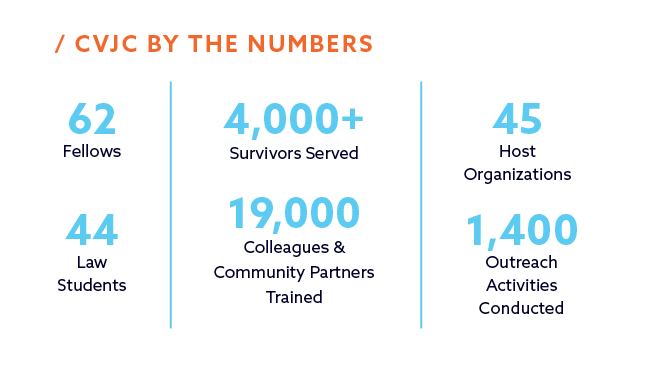
Between 2018 and 2020, Equal Justice Works mobilized a network of 62 lawyers (Fellows) and 44 law students to deliver civil legal assistance to trafficking survivors and other crime victims through its Crime Victims Justice Corps. Funded by the U.S. Department of Justice, Office for Victims of Crime, Fellows in the program were hosted at 45 legal services organizations across the country, where they provided direct legal services to survivors, enforced crime victims’ rights, and conducted education and outreach activities.
Collectively, Fellows assisted more than 4,000 survivors, including 2,336 trafficking survivors, through legal advice, brief service, and full-scope representation. They filed T-visas for qualified survivors to help obtain legal immigration status and eliminate their vulnerability for further exploitation stemming from their immigration status. Fellows in the Crime Victims Justice Corps also represented survivors in family law matters to gain custody over their children and obtain divorces, and helped survivors assert their rights as victims in criminal cases. For example, 2018 Fellow Phatchara Udomsin, hosted at the Thai Community Development Center, represented several victims in a large scale sex trafficking case. Phatchara and his colleagues helped their clients with T-visa applications, family reunification, victim impact statements, and restitutions.
Additionally, the Fellows increased their host organizations’ and communities’ capacity to serve victims by providing trainings to their colleagues and community partners, including service providers, volunteers, court staff, and law enforcement. As a cohort, they trained more than 19,000 individuals through 960 education activities, and conducted about 1,400 outreach activities including distributing pamphlets at community fairs and holding office hours at medical-legal partnership programs and local shelters.
Following the two-year Fellowship, 41 of the Fellows accepted staff attorney positions at their host organizations, and many continue to work with survivors of human trafficking and other crimes, leveraging the expertise and connections developed during their time in the Crime Victims Justice Corps.
2018 Fellow Angela Martinez-Alvarado accepted a staff attorney position at her host organization Texas RioGrande Legal Aid and continues to work with trafficking survivors. This past fall, Angela was selected to participate in the Human Trafficking Leadership Academy at the U.S. Health and Human Services, Office of Trafficking in Persons, which aims to develop survivor-informed services and create leadership development opportunities to survivor leaders and allied professionals. As the only attorney to join the class of 12, which includes six survivors, Angela collaborates across disciplines and works toward developing recommendations to reduce incidents of labor trafficking.
“I could not have gotten to where I am without the Fellowship,” commented Angela, on her Fellowship experience. “From my previous career, I know it takes years to build a network. But thanks to the Fellowship, I have a wealth of connections—professionals with great knowledge and experience I can call on.”
Thanks to the Fellowship, I have a wealth of connections—professionals with great knowledge and experience I can call on.
Angela Martinez-Alvarado /
2018 Fellow in the Crime Victims Justice Corps
2018 Fellow Precious Odum also continues her work serving trafficking survivors as a staff attorney at Public Law Center in California. Precious’s work now focuses on immigration-related legal issues faced by trafficking survivors, specifically T-visas and removal defense work.
“I still connect with the Fellows from the program and still ask questions, which I’m grateful for,” said Precious, about the professional network she established during Fellowship. “I’m also grateful for the connection with the anti-trafficking world the Fellowship helped establish, which has been an amazing help for me and my clients.
We are proud of what Fellows and law students in our Crime Victims Justice Corps have achieved over the last two years in helping trafficking survivors and other crime victims heal, recover, and rebuild their lives.
To learn more about our newest initiative to mobilize Fellows to advocate for crime victims, visit here to read about the Elder Justice Program, addressing the gap in civil legal services for victims of elder abuse and exploitation.
The Crime Victim Justice Corps was supported by an award from the U.S. Department of Justice, Office of Justice Programs, Office for Victims of Crime, Award Number 2017-MU-MU-K131, and private funding. The opinions, findings, and conclusions or recommendations expressed in this product are those of the contributors and do not necessarily represent the official position or policies of the U.S. Department of Justice.

Lora Church, a rising 3L at University of New Mexico School of Law and a 2020 Rural Summer Legal Corps (RSLC) Student Fellow, recently chatted with Equal Justice Works about her summer of service, and the challenges facing rural and isolated communities.
You described becoming a lawyer as your “second career.” What inspired you to go to law school?
My inspiration to attend law school didn’t happen overnight. It stems from a trajectory of three life-changing experiences.
My first experience occurred while playing kickball as a fifth grader at my elementary school. Before a classmate rolled the ball to me, she made a racial remark about my Navajo identity. Something inside me pushed out the words, “I’m proud, I’m proud!” Thinking back, I believe it was resiliency that moved me to take a stand against my first encounter with racism.
My second experience occurred during my last semester of undergrad. At the time, I worked with the Associate District Judge at the Cherokee County District Court in Tahlequah, Oklahoma. There, I overheard one lawyer say to the Judge, “These law school students nowadays can’t even find the Courthouse ….” I interpreted that to mean graduating law school students spent most of their time in academics and less time gaining practical work experience. Based on that, I postponed my law school admissions endeavors and kept myself in the workforce. Since my undergraduate years to the present, which is more than 25 years, I have had the opportunity to serve in health & human direct services and administrative positions with county, state, tribal, nonprofit and university entities; plus I got married, had five children, and earned two Masters degrees!
My final experience sealed the deal in 2017. One of the federal REAL ID requirements to renew a New Mexico’s driver’s license was to have a birth certificate. At the time, my father’s driver’s license was getting close to its expiration, and I learned Navajo Nation had documented three different birth dates for my father. You see, he was born in a Hogan, a one-room home located on the Navajo reservation, and the formalities of recording one’s birth was not readily accessible. He filed a Petition to Change Record with Navajo Nation Family Court to reconcile the multiple birthdates by determining July 8, 1932 as his official birthdate. Within a month, he passed away to the Heavenly realms. By the following month, my mother, siblings, and I were substitute petitioners. The Navajo Judge gave us two choices of laws: follow Navajo traditional/customary law or Navajo Nation Code. If we chose traditional law, the case would be dismissed according to Navajo teachings. If we chose the Navajo Nation Code, we would redirect the focus of our petition to convey how the requested birthdate affects our family. We chose the latter. I spoke carefully to ensure I followed Navajo contemporary law, while still respecting our Navajo traditions. Our Petition was granted. My courtroom experience had intersected four legal jurisdictions of law: federal, state, Navajo Nation Code and Navajo traditional law. I was awestruck to experience four choices of law that impacted our family’s legacy! As I stood outside the courthouse that crisp September morning, I knew it was time to go to law school.
In your opinion, what are some of the biggest challenges facing rural and isolated communities?
There is a lack of sustainable programs and services in rural and tribal communities. Sustainability is critical and ought to be an essential component discussed at the program or service design phase. There also ought to be a community-based participatory system in place that invites rural and tribal residents to participate in the planning, implementation and evaluation of the services. It is the community’s contribution that heightens the value-added to the project.
A lack of or limited technology capacity in rural areas remains another challenge. In New Mexico, some tribal and rural communities are tucked inside small canyons, and the WiFi and bandwidth are very weak to sustain on-going internet connection. Therefore, it makes video conferencing services impracticable. Additionally, I think, too many urban organizations remain comfortable in the cities and urban areas, and outreach to rural residents is an “after-thought.” Throughout my career, I have heard urban organization leaders say, “We don’t know how to reach the tribal communities….” I have two suggestions: (1) become willing to step out of one’s comfort zone and visit Native American communities and organizations that are within one’s state or region; and (2) embrace the diversity and richness gained from maintaining ongoing tribal partnerships.
You were hosted by New Mexico Legal Aid, where you spent your summer helping the organization expand its community presence in Native American Nations. Can you tell us a bit more about your project and what a typical day at the organization looked like for you?
There are twenty-three federally recognized tribes, pueblos, and nations in New Mexico. The New Mexico Legal Aid (NMLA) established a partnership with one of the 23 federally-recognized tribes, the Pueblo of Laguna. The NMLA-Laguna Pueblo partnership is an inaugural Low-Income Tax Clinic (LITC) Personal Income Tax Pilot Project for eligible low-income Laguna tribal members who reside on the Pueblo reservation. All tribal and non-tribal services and businesses adhere to the Laguna tribal governance mandates and executive orders, who carry sovereign nation authority since time immemorial. The pilot project implemented a three-prong approach, once the Laguna Governor re-opened its reservation to non-tribal residents, which had been closed for many months due to the COVID-19 pandemic. An eligible client underwent a comprehensive COVID-19 safe practices intake process to determine whether they needed to
- file their 2019 personal income tax with a tax practitioner;
- file a claim for the Economic Impact Payment, aka, “Stimulus Check;” and/or
- seek civil NMLA legal services (such as housing, consumer, economic security, domestic violence, etc.).
I worked closely with an Albuquerque-based Tax Attorney and a Project Liaison. The Project Liaison is a Keres-speaking Laguna tribal member and was the clients’ first point of contact. Three days a week, I traveled 116-miles round trip to conduct three client intake appointments per day, and devoted an hour and a half per client. I administered a battery of civil legal screening tools with the clients, created electronic client records in NMLA’s LegalServer database, and made referrals for tax preparation services, and/or legal service referrals to NMLA practice groups. At the conclude of the appointment day, the Project Liaison and I would debrief with our LITC supervising tax attorney.
You spent the summer developing valuable skills and gaining experience providing direct legal services. What specific skills did you hone in on this past summer?
I learned, as well as, enhanced several of my skills sets. I learned more about federal and state tax law and conducted legal research on tax law and rules. I underwent LegalServer training and sought technical assistance. I became a LegalServer database user and applied Legal Services Corporation and NMLA’s policies and procedures to determine clients’ eligibility for NMLA services.
Additionally, I enhance my client interviewing skills by administering a Legal Wellness Survey. This tool helped to guide an initial intake, spot issues and prioritize issues. As part of my Fellowship, I followed tribal consultation processes and adapted our project plan to comply with the Laguna Pueblo Governor’s COVID-19 Executive Order to practice safety measures in all aspects of our direct services with the clients. I also learned to maximize all available tribal communication outlets (e.g. tribal/community newspapers, board-based texts and emails, flyers, Facebook posts, and word of mouth) to reach all tribal resident. Lastly, my interpersonal skills was enriched by working closely with our supervising Tax Attorney and our Project Liaison. The RSLC fellowship was such a rewarding summer legal services experience!
If you are interested in embarking on a summer of service like Lora, apply to the Rural Summer Legal Corps by 11:59 p.m. ET on February 8, 2021. For more information about program eligibility and requirements, please visit here.
Put your legal education and passion for public service to work this summer while gaining experience in disaster law.
The unprecedented crisis of COVID-19 has heightened the level of uncertainty and disparity for marginalized communities—including immigrants, low-income individuals, people with disabilities, and people of color—at the same time as it has restricted access to essential social services. The need for legal services is especially critical for the parts of the country hard hit by the pandemic and prone to natural disasters such as hurricanes, flooding, and wildfires.
In response to this need, Equal Justice Works created the Disaster Resilience Program in early 2020. The Disaster Resilience Program mobilizes Fellows to provide free civil legal aid in disaster-prone areas to ensure vital legal services are accessible to rebuild lives, stabilize communities, and create resilience.
If you’re a 1L or 2L law student, apply to the Equal Justice Works Disaster Resilience Program as a Student Fellow to work alongside Disaster Resilience Program Fellows at their host legal services organizations (virtually and/or hybrid; see host site preferences and accommodations) in Texas and Florida. Participants, called Student Fellows, gain exposure to legal disaster preparedness, response, and recovery work. This eight-to ten-week opportunity is available to six law students during the summer of 2021.
Through the program, Student Fellows learn valuable skills outside of the classroom, such as providing civil legal services, engaging in community education and advocacy efforts to increase disaster preparedness and awareness of legal rights, and building capacity at the organizations where they serve. Additionally, law students receive trainings in disaster law prior to the start of the program in May and will have opportunities to attend trainings and network with other Equal Justice Works Student Fellows throughout the summer. Student Fellows receive a $5,000 stipend upon completion of the program.
Applications are due at 11:59 p.m. ET on February 16, 2021. For more information about program eligibility and requirements and to apply, please visit here.
My Impact is a conversation series from Equal Justice Works, using interviews with alumni to shine a light on what’s possible with an Equal Justice Works Fellowship. Brooke Meckler, director of law school engagement and advocacy, recently spoke with Kace Rodwell, a 2017 Rural Summer Legal Corps Student Fellow and 2018 Equal Justice Works Fellow hosted by Oklahoma Indian Legal Services, Inc.
Like many lawyers, Kace Rodwell was drawn to a career in public interest in response to issues within her own community. Having grown up in the capital of Cherokee Nation, Kace was well versed in the types of legal barriers facing other Native Americans: “land issues, reservation land issues, water rights, the Indian Child Welfare Act…obstacles Native Americans face just based on their status as Native Americans.”
Kace cited her “Cherokee values” as a solid foundation for her work, such as, “how can we help our families? How can we help our communities? How do we build and maintain our culture, our language, and our land?”

In 2017, Kace became a Rural Summer Legal Corps (RSLC) Student Fellow at Oklahoma Indian Legal Services, Inc. (OILS), where she worked throughout the entire state of Oklahoma on estate planning issues, particularly American Indian Probate Reform Acts; worked with trust land; and helped members of the Five Tribes with land status laws.
The hands-on nature of RSLC was, Kace noted, a highlight of the program: “I got to go out to the communities and serve—and that’s really what showed me I was on the right path, because I wanted to do public interest but didn’t have that kind of experience until Rural Summer Legal Corps, of actually being there [in the field].”
Kace was determined to continue working with OILS after law school, and built upon her previous relationship with the organization to collaborate on an Equal Justice Works Fellowship application. In 2018, she became an Equal Justice Works Fellow at OILS, working specifically with parents involved in Indian Child Welfare Act cases. Kace encouraged other law students to follow a similar path and leverage existing relationships when creating their own Fellowship projects.
Kace’s other advice for law students following a public interest path? “Take as many litigation courses—or moot court, or mock trial [courses]—as possible,” she said, emphasizing the importance of venturing outside of one’s comfort zone to build practical skills, necessary even in the age of COVID-19. “It doesn’t stop, even if you don’t meet physically in a court room. Life keeps going—these families still need help.”
Following her Fellowship, Kace continues to work at OILS as a staff attorney, much like the 85% of Equal Justice Works Fellows who remain in public service after their projects end. “In short,” she said, “this is my life now. I can’t see not [working on] the Indian Child Welfare Act. I can’t see not continuing helping the communities I’m helping right now.”
Applications for the RSLC program are due at 11:59 p.m. ET on February 8, 2021. To learn more about becoming a 2021 Rural Summer Legal Corps Student Fellow, visit here.
Interested in embarking on a summer of service in a rural community? If you’re a first or second-year law school student, apply to the Rural Summer Legal Corps (RSLC)—a partnership between Equal Justice Works and Legal Services Corporation (LSC) that supports 35 law students in serving rural communities each summer.
Participants, called Student Fellows, spend eight to ten weeks hosted at LSC-funded civil legal aid organizations, where they take on challenging projects that address a range of legal issues including affordable housing and evictions, labor protections for farmworkers, and family law matters in Native American communities and tribes.
This year, RSLC Student Fellows remotely served people in rural areas affected by the pandemic—here is more on how they spent their summers.
Through RSLC, law students have the opportunity to explore their public interest passions as they gain experience providing direct legal services, engaging in community outreach and education, and building capacity at the organizations where they are hosted—all while working toward a $5,000 stipend!
“This program allows you to see the ground work and whole view of the barriers people experience with legal matters and regardless of what area of law one intends to practice, this program provides one with the foundation of compassion and how to best serve those in need,” said 2019 RSLC Student Fellow Shanelle Staten.
Applications for the program are due at 11:59 p.m. ET on February 8, 2021. For more information about RSLC eligibility and requirements and to apply, please visit here.
Each year on December 10, Human Rights Day gives us a chance to reflect on the work that needs to be done to ensure that every single person—regardless of race, sex, nationality, ethnicity, language, religion, or any other status—can access their unalienable rights and freedoms. It is also a chance to celebrate the work of Equal Justice Works Fellows who work tirelessly to protect our universal human rights and advocate for underserved communities across the country.

Madeline Middlebrooks, a 2020 Equal Justice Works Fellow sponsored by Faber Daeufer & Itrato PC, supports low-income African American families on the lead contamination water crisis in St. Louis area schools. While the United Nations General Assembly has recognized the human right to clean drinking water, the United States does not recognize this right under any federal laws. In 2016, water samples from 16 schools in the Saint Louis area contained high levels of lead contamination. Madeline is working with her host organization, Great Rivers Environmental Law Center, to address this issue through advocacy efforts at the state level and by representing affected community members.
“Environmental statutes and public health regulations should benefit everyone, not just the wealthy. Your ZIP code or the color of your skin should not dictate your quality of life in regard to exposure to toxins and pollution,” said Madeline.
Environmental statutes and public health regulations should benefit everyone, not just the wealthy. Your ZIP code or the color of your skin should not dictate your quality of life in regard to exposure to toxins and pollution.
Madeline Middlebrooks /
2020 Equal Justice Works Fellow
By connecting with community members in the field, sending record requests to state agencies, and analyzing water sampling results, Madeline is helping to address this environmental disparity and ensure that children have access to clean drinking water in St. Louis schools.
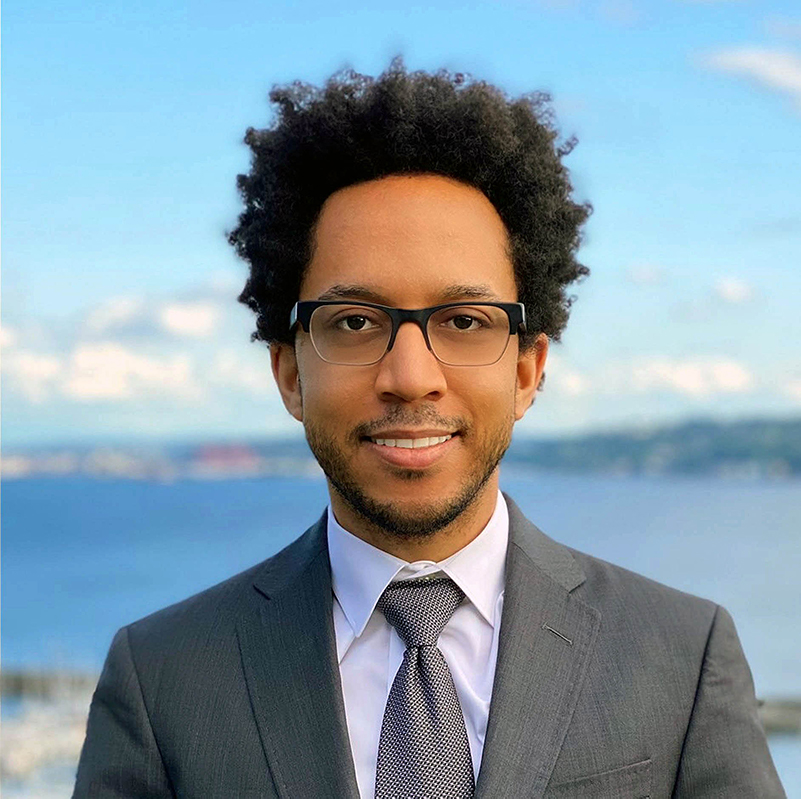
The United Nations General Assembly has also identified housing as a fundamental human right, yet millions of Americans struggle to afford a place to live. At Bet Tzedek Legal Services, Archie Roundtree, Jr., a 2020 Equal Justice Works Fellow in the Elder Justice Program, works on preserving homeownership and home equity for senior homeowners who are victims of fraud and elder abuse.
The pandemic has exacerbated fraud targeted at senior homeowners, such as deed theft and home improvement scams. Archie advocates for clients through negotiations, appeals, and civil legal options to obtain much-needed relief and protections. He also conducts community outreach and education on social service resources, home equity protections, and crime victims’ rights, to reduce older individuals’ susceptibility to these scams.
“Standing up for equality and justice means not allowing the systemic oppression for those who cannot speak for themselves. It is about empowering the community and having the humility to understand it is not about you,” said Archie, on what service means to him.
Standing up for equality and justice means not allowing the systemic oppression for those who cannot speak for themselves. It is about empowering the community and having the humility to understand it is not about you.
Archie Roundtree, Jr. /
2020 Equal Justice Works Fellow

In an environment like jail or prison, where incarcerated people face serious human rights violations daily, Sarah Nawab, a 2020 Equal Justice Works Fellow cosponsored by General Electric Company and Choate, Hall & Stewart LLP, is determined to bring incarcerated women and the unique challenges they face during incarceration to the forefront of prisoners’ rights advocacy.
Incarcerated women face a lot of the same challenges as incarcerated men—inadequate medical and mental health care, brutality, and poor conditions of confinement—in addition to more unique challenges such as inadequate pregnancy and reproductive health care, and sexual violence by staff. The pandemic has also greatly exacerbated existing issues of inadequate medical care, and the use of lockdowns to limit the spread of COVID-19 has been “detrimental to my clients’ mental health,” Sarah noted.
With her host organization Prisoners’ Legal Services of Massachusetts, Sarah provides trauma-informed advocacy and rights education to ensure that women can access adequate medical and mental health care and are protected from predatory assaults. She is also building relationships with community-led organizations to strengthen advocacy.
Service means letting my clients lead, and showing up for my clients the way that they want me to, rather than presuming their needs. Equality and justice mean using the resources and systemic access I will have as a lawyer, not to speak for my clients, but to pass them the mic.
Sarah Nawab /
2020 Equal Justice Works Fellow
We are proud of how Madeline, Archie, and Sarah are standing up for equality and justice and doing critical work to uplift lives and communities. To learn more about how our Fellows are creating a lasting impact in their communities, click here.
The Elder Justice Program is supported under grant 2019-V3-GX-K033, awarded by the Office for Victims of Crime, Office of Justice Programs, U.S. Department of Justice. The opinions, findings, conclusions or recommendations expressed in this press release are those of the author(s) and do not necessarily represent the official position or policies of the U.S. Department of Justice. This federal funding is supplemented by funds from private donors.