My Impact: A Conversation with 2008 Fellow Koert Wehberg
My Impact is a conversation series from Equal Justice Works, using interviews with alumni to shine a light on what’s possible with an Equal Justice Works Fellowship. Board Member and 2021 Rural Summer Legal Corps Fellow Vivian Martinez spoke with Koert Wehberg, a 2008 Fellow in the Design Your Own Fellowship program. As a Fellow, Koert was hosted by New York Lawyers for the Public Interest.
Koert Wehberg has always been interested in disability rights advocacy. As someone who has experienced both visible and invisible disabilities himself, Koert knows how important it is to listen to his clients and ensure that their needs and perspective are heard.
Koert kickstarted his career in disability law while he was in law school by working in the Disability Rights Clinic at the Syracuse University College of Law. “I got to work in a clinic actually working with faculty who had disabilities themselves, and fellow students with disabilities,” said Koert of this experience. “It was really great to see other folks like me.” He later went on to become an Equal Justice Works Fellow at New York Lawyers for the Public Interest (NYLPI), where he advocated for disability rights in low-income communities of color.

Throughout his Fellowship, Koert learned the importance of using a community-centered approach to identifying needs, instead of centering his work around preconceptions of his clients. He engaged in frequent dialogue with community members and groups, which helped him identify and focus his work on the highest-priority issues.
“Listen to your clients—listen to what they want,” Koert advised. “The more you know, the better you can advocate.” Through his discussions with the community, he learned that accessible housing—which he hadn’t included in his original project proposal—was a big area of need for his clients.
This focus on community also led Koert to hone his knowledge and experience, by interacting directly with veteran attorneys and fellow young professionals. “It’s great to learn how law is really practiced in the real world, instead of a casebook,” he said. One of the biggest lessons learned? Not everything requires litigation as a response. Instead, some solutions are as easy as making a phone call or filling out the right form.
Though still early in his career, Koert witnessed the value of this community-led approach firsthand. At one large public university in the city, Koert was able to raise awareness for the need to add Braille and assistive technology, without the need for litigation. Elsewhere, at a low-income apartment building, he was able to get ramps installed for a tenant having issues accessing their home. “I think the best part of the Fellowship was actually seeing concrete change… getting barriers removed,” said Koert. “We can actually help somebody and have them be happy. We can’t fix everything, but just to see something [change] really gives you a boost.”
After his Fellowship, Koert continued his work by advocating with Disability Rights Pennsylvania, becoming the Executive Director of the Mayor’s Office for People with Disabilities in Philadelphia, and eventually taking a position with the U.S. Department of Education’s Office for Civil Rights. Fourteen years after he graduated law school, he is still in the field advocating for disability rights.
When asked how the evolution of his work has made him a better advocate, Koert said that his experiences have made him a more confident lawyer. Additionally, he has learned the value of plain language and teaching others how to advocate for themselves—whether that is bringing up an issue with their landlord, speaking to a local business owner about how they can make their practices more accessible, or attending school district meetings to have their perspective heard.
When going into disability advocacy, there is certainly a lot of work to do. If you are looking to get involved with disability rights advocacy, Koert’s resounding advice is simple: to listen to others. “I have increased my compassion, realism, and knowledge of how the law works,” said Koert, of his experience. “The law is not static—it does change, and you can have an influence on how it’s developed.”
To learn more about Koerts’s work advocating for the rights of disabled people and greater accessibility in his community, watch the full interview here.
Interested in kickstarting your own public interest law career? Visit here to apply for a 2023 Design-Your-Own Fellowship before the September 13, 2022, deadline!
This summer, Equal Justice Works is expanding its successful Housing Justice Program to communities in Maryland and South Carolina. The program began as a cohort of eight Fellows in Richmond, Virginia, in 2019 and has grown to offer 31 Fellowships for attorneys and community organizers across three states. The Housing Justice Program and host organizations are currently seeking 20 Fellows in cities throughout Maryland and South Carolina to start as early as August. The expansion of the Housing Justice Program is due to the tremendous achievements of the first cohort of Fellows, which are detailed in a report by Philliber Research and Evaluation, an independent research firm.
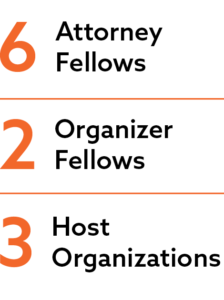 Equal Justice Works launched the Housing Justice Program in 2019 to provide legal assistance to those facing eviction and advance systemic reforms to address underlying inequities related to housing in Greater Richmond. Three civil legal services organizations in Richmond partnered with Equal Justice Works as host organizations for the 2019 cohort, which included six Attorney Fellows and two Organizer Fellows. These Fellows combined direct legal services, education, outreach, and impact litigation to advance the rights of renters and hold bad-actor landlords accountable.
To understand the impact of the Housing Justice Program, Philliber Research & Evaluation used a mixed methods approach to evaluate its success. This analysis determined that the Housing Justice Program strengthened the legal community’s capacity in Greater Richmond and increased access to justice for low-income tenants.
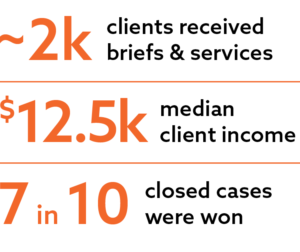 According to Philliber’s evaluation, the first cohort of Housing Justice Program Fellows increased access to justice by providing direct legal services and filing group action cases on behalf of low-income tenants. Fellows delivered briefs and extended services to nearly 2,000 low-income tenants, who had a median income of $12,528. Seven in ten of their closed cases were won and only 3% of the cases were noted as lost. In addition to direct legal services, Fellows filed and won three affirmative group cases that could impact larger groups of tenants with similar bad-actor landlords. Other cases, such as an ongoing Richmond Redevelopment and Housing Agency voucher denial case, could set precedence and ultimately benefit many public housing tenants.
Philliber also found that the Housing Justice Program strengthened low-income tenants’ capacity to advocate for themselves by facilitating “Know Your Rights” trainings and tenant town hall meetings. Through their outreach efforts, Housing Justice Program Fellows reached more than 40,000 people. Fellows further mobilized tenants by helping them to form or strengthen fifteen tenant organizations. Tenants became more engaged in advocating for their interests, with many renters attending meetings at the Richmond Redevelopment Housing Authority (RRHA) as it was reviewing an annual plan, policies, and planning for redevelopment. As a result, RRHA instituted an eviction moratorium in November 2019, and followed many of the Housing Justice Program team’s recommendations. Additionally, they succeeded in making changes to RRHA’s Admission, continued occupancy policies, and practices; and the agency agreed to participate in Richmond’s eviction diversion program, which has prevented hundreds of evictions in the city by facilitating payments plans for back-rent and connecting tenants with financial assistance.
Finally, Philliber’s evaluation showed that Fellows and their host organizations contributed to system advocacy efforts, which achieved changes to Virginia’s landlord-tenant laws that provided more protections for tenants. They strategically produced more than 100 media placements, conducted meetings with policymakers at the local and statewide level, published policy papers associated with General Assembly advocacy, and raised the voices of tenants during the legislative session. Through their efforts, Fellows supported the passing of legislation, including a bill to the right of redemption which allows tenants to pay rent-owed and cancel an eviction, and bills to strengthen protections against unlawful evictions.
Learn more about the key findings of the Housing Justice Program Evaluation by reading the summary report.

Michael J. Harding, a rising third-year law student at Villanova University and a member of both the Equal Justice Works Board of Directors and the National Advisory Committee (NAC), recently chatted with Equal Justice Works about serving on his campus and in the community and how these experiences have helped to set the foundation for his legal career.
You have a clear passion for public interest law as shown by your work on campus at Villanova University and in the community. What inspired you to become a public interest leader?
I always believed that the true reflection of our character is how we treat people living on society’s margins. Bryan Stevenson, my role model and the founder and executive director of Equal Justice Initiative exemplifies this foundational principle through his work. In my view, lawyers like Bryan advance justice by harnessing the law’s immense potential for good. As an aspiring public interest lawyer, I aim to leverage diverse voices to challenge existing power structures and legal frameworks that perpetuate systemic injustices.
One of the ways you serve on your campus is through the Equal Justice Works National Advisory Committee. What are some of your responsibilities as a member?
The primary responsibility of a National Advisory Committee (NAC) member is to serve as a link between Equal Justice Works’ Law School Engagement and Advocacy team (LSEA) and our law school communities. In part, this includes sharing the resources and opportunities that Equal Justice Works has to offer with my peers and career service professionals. Further, NAC members report back to Equal Justice Works staff on public interest legal issues, trends, and events happening in our regions. Additionally, we assist Equal Justice Works in planning the annual Conference and Career Fair and select recipients of the Regional Public Interest Awards.
What are some projects and/or initiatives you are working on at your law school?
I’m launching a new public interest law blog at Villanova University School of Law, where I will serve as its Editor-in-Chief. This blog will function as a student-run online publication where law student writers will concisely analyze and discuss current public interest legal issues and trends. Additionally, it will help promote and coordinate the Anti-Poverty Symposium held at Villanova Law. While the website for the blog is currently being built, it will be up soon so that the incoming staff writers will have a platform to publish their work.
As a public interest leader, you have served as a role model to young Black and brown students. Why is it important to provide law students access to mentors who have experienced similar challenges and difficulties?
We’ve all seen the disappointing statistics showing how few Black and brown lawyers and law students there are in our profession. The legal profession, including law school, reflects an essential, yet often difficult to attain, vocation. Many Black and brown law students struggle with imposter syndrome while trying to navigate the highly competitive, established, and white-dominated arena in their pursuit of a career in law. As one such student, I have made a concerted effort to connect with mentors who look like me while also reflecting a world full of endless possibilities in the profession.
It’s important for law students, especially those who are first-generation, to have access to mentors who relate to them for several reasons. First, these mentors understand the unique struggles of students and see us for more than grades or rankings. Such a mentorship reminds students why we entered law school and whom we aim to serve once we graduate. Second, these mentors expand the scope of what students believe we can achieve despite the explicit and tacit forces suggesting that we don’t belong. Finally, connecting Black and brown law students to mentors who can relate helps students remember that we can transform our feelings of fear or self-doubt into fuel to persist, overcome, and achieve.
What are some steps law schools can take to better provide career and academic support for Black and brown students?
Law schools should fund opportunities and programs that recruit, retain, support, and graduate Black and brown law students. It would be helpful for them to publicly advertise and financially support existing programs like The Appellate Project that are designed to provide support for Black and brown students. Law schools should also ask their Black and brown students what specific support they need, collaborate with them to provide it, and then ensure those students’ needs are met on a regular basis. These are just a few examples of many, but I believe they will help Black and brown students thrive in any law school environment.
Last year, you became a member of the Equal Justice Works Board of Directors. How has the experience been so far?
My experience on the Board has been surreal. Go look at the list of members and you’ll see why I feel this way. The list includes general counsels of major companies, chairpersons of Am Law 100 firms, federal circuit court judges, law school deans, President Obama’s former Solicitor General, public interest leaders, and more. It’s been an incredible opportunity to work with and learn from some of the brightest legal minds in the country. As a Board member, I’ve been fortunate to learn the inner workings of a national nonprofit organization, and to assist its mission to mobilize future public service leaders. In short, I’m eternally grateful for this experience and look forward to helping Equal Justice Works thrive in the years ahead.
In what ways have these opportunities—from the National Advisory Committee to the Equal Justice Works Board of Directors—helped to set the foundation for your legal career?
These experiences have reaffirmed my commitment to pursue a career serving those on society’s margins through justice-oriented lawyering and policy making. Moreover, the extraordinary network I’ve cultivated within the NAC and Board will allow me to access opportunities to advance my public interest legal career. Serving in these two groups has been an honor, and I’ll take the lessons I’ve learned with me wherever my career leads me.
Lastly, what advice would you give to law students interested in becoming public interest leaders at their schools but unsure of where to start?
My three pieces of advice are to serve as an Equal Justice Works student representative on your law school campus, to become an Equal Justice Works ambassador and join its National Advisory Committee, and to sign up to volunteer at events hosted by your school’s pro bono society. Whatever you decide to do, get involved. You won’t regret it!
Visit here to learn more about ways that you can serve on your law school campus.
The following is a list of resources for Juneteenth. Equal Justice Works is not a direct affiliate of any of these resources, unless otherwise noted.
Juneteenth Resources
Learn more about the history of Juneteenth.
- Juneteenth, A Celebration of Resilience, from the National Museum of African American History & Culture in Washington, D.C.
- “What Is Juneteenth?” by Henry Louis Gates, Jr., from PBS.org.
Racial Justice Resources & Organizations
- The Law Firm Antiracism Alliance: a coalition of nearly 300 law firms formed to “facilitate opportunities for action in pursuit of racial justice in the law and racial equity in our country,” created in June 2020.
- An Interview with Brenna DeVaney on the Law Firm Antiracism Alliance: a discussion on the Law Firm Antiracism Alliance with Brenna DeVaney, director of pro bono programs at Skadden, Arps, Meagher & Flom LLP.
- Lawyers for Good Government, on Racial Justice: ‘Lawyers for Racial Justice’ is an initiative to “mobilize critical pro bono legal services in the fight for racial justice” by promoting long-term reform and the creation of remote pro bono clinics.
- Law for Black Lives: a “national community of radical lawyers and legal workers committed to transforming the law and building the power of organizing to defend, protect, and advance Black Liberation across the globe.”
- Law Deans Antiracist Clearinghouse Project: the Association of American Law Schools created a collective space for Law School Deans to share resources on antiracism and engage their institutions with “teaching, scholarship, service, ativism, programming, and initiatives on strategies to eradicate racism”.
- White Supremacy Culture: a resource from Dismantling Racism Works that lists characteristics of white supremacy culture with the aim to “point out how organizations which unconsciously use these characteristics as their norms and standards make it difficult, if not impossible, to open the door to other cultural norms and standards”.
Equal Justice Works Community
Hear from Equal Justice Works Fellows, our Board, and other community members.
- Fighting for My Clients’ Right to Life: by Bailey Russell, February 3, 2022: 2020 Fellow Bailey Russell shares her experience defending people charged with capital crimes in Louisiana and fighting the state’s capital punishment system.
- Michelle Mapp Believes in Public Service: read about 2021 Fellow Michelle Mapp’s journey to become a public interest lawyer in Charleston, helping low-income and Black residents avoid eviction and displacement.
- ‘Sexist,’ ‘Racist,’ ‘Classist’: Georgia 8th Grader Challenges School Dress Code: 2020 Fellow Sabrina Bernadel discusses how dress codes disproportionately restrict women and girls for violations, and especially punish Black students, in this article about how young activists in Cobb County, Georgia responded to the codes.
- Why schools need to abandon facial recognition, not double down on it By Clarence Okoh and John S. Cusick, August 3, 2021: 2020 Fellow Clarence Okoh and 2017 Fellow John S. Cusick write about the drawbacks of facial recognition, with a focus on the detrimental harm it causes to students of color.
- Black Farmworkers Say They Lost Jobs to Foreigners Who Were Paid More: read about how 2020 Fellow Ty Pinkins aided Black farmworkers in the Mississippi delta in filing a lawsuit against their former employers, who asked them to train white guest workers from South Africa before firing them.
- “Embody Black Lives Matter in Every Facet of Your Legal Career,” by Walter Jean-Jacques, July 2020: a member of the Equal Justice Works Board of Directors, Walter shares reflections on 2020 events as a young Black man entering the legal field.
- “To Fellow Young Black Lawyers Seeking Justice,” by Clarence Okoh, June 2020: 2020 Fellow Clarence Okoh addresses fellow young Black lawyers and shares a comprehensive racial justice syllabus.
- “A Plea to Build Something Better,” by Tracie Johnson, July 2020: 2018 Fellow Tracie Johnson writes about the need to disrupt the cycles of generational poverty and violence that stem from over-policing.
- “Making Your Voice Heard at the Ballot Box,” by Mitchell D. Brown, June 2020: 2019 Fellow Mitchell D. Brown reflects on racial justice and voting rights.
- Equal Justice Works Fellows Challenge Racial Injustice Fellows Emma Shakeshaft, Molly Griffard, and Mitchell D. Brown discuss their efforts to challenge racial injustice by addressing debtors’ prisons, police brutality, and voter suppression.
- Racial Justice Beyond Litigation: Working Outside the Legal System to Affect Change: a panel discussion from our 2020 Conference and Career Fair, featuring Jason Bailey of the NAACP Legal Defense and Educational Fund, Inc.; Eliana Green, a 2019 Fellow; and A’Niya Robinson of the ACLU of Louisiana.
To learn more about how Equal Justice Works Fellows are addressing racial justice through their work, visit here.
Juneteenth & Pride
Juneteenth takes place during Pride Month, the annual celebration commemorating the 1969 Stonewall Riots, a tipping point in the Gay Liberation Movement with deep ties to the fight for racial justice.
- LGBTQIA+ Resources—#AllBlackLivesMatter: a comprehensive list of intersectional resources for education, information, entertainment, and empowerment, from the Community Renewal Society in Chicago.
- Black LGBTQ+ Prides: a directory of official Black Pride Celebrations throughout the country.
- 2015 Fellow Tsion Gurmu: featured at our 2015 Annual Dinner, Fellow Tsion Gurmu describes her work with the African Services Committee to secure asylum for LGBTQ+ asylum seekers fleeing persecution for their sexuality.
By 2020 Fellows Taylor Amstutz and Archie Roundtree Jr.
June 15 marks World Elder Abuse Awareness Day, which highlights the widespread issue of harm and exploitation perpetrated against older adults. Anyone can be a crime victim, but specific demographic groups may be targeted and have unique legal needs. To address these needs, Equal Justice Works formed the Elder Justice Program in 2020. Taylor Amstutz and Archie Roundtree Jr. are Fellows in the Elder Justice Program at Bet Tzedek Legal Services in Los Angeles and, in honor of World Elder Abuse Awareness Day, they shared how they collaborate to promote access to justice for older adults in their communities.
Elder abuse is a prevalent and multifaceted issue that demands a holistic, collaborative approach to create meaningful change. One of our goals as Equal Justice Works Fellows is to build a cohesive network of service providers in Antelope Valley, one of Los Angeles County’s most rural locations. With this goal in mind, we began our Fellowships by asset mapping, a “systematic process of cataloging key services, benefits, and resources” within a specified community.
Elder abuse is a prevalent and multifaceted issue that demands a holistic, collaborative approach to create meaningful change.
We reached at least 2,000 community members and partners through asset mapping and developed a network of resources and strategic partnerships with legal organizations, government offices, service providers, community leaders, nonprofits, and religious institutions with the capacity to serve older crime victims. Our Fellowships address different aspects of elder abuse: mitigating abuse through restraining orders and addressing financial exploitation through the Property Assessed Clean Energy (PACE) program. Building an elder resource network has provided a vital intersection where we meet to ensure our clients’ holistic needs are met.
Taylor Amstutz: Elder Abuse Restraining Orders
During my Fellowship, which focuses on elder abuse intervention, I’ve had the privilege to assist and represent many older adults in successfully obtaining protection from abuse through Elder Abuse Restraining Orders (EAROs). These Orders are inherently designed to address the heightened vulnerability of older adults and individuals with disabilities to abuse. Commonly, elder abuse occurs when an older adult allows their grown child to move into their home with the understanding that they’ll help with caregiving or managing the house, but then things go terribly wrong, resulting in an abusive arrangement. Isolation, manipulation, and other forms of abuse are all used to control victims, making even leaving their room a fearful, anxiety-inducing experience. An EARO can protect elders from further danger by keeping abusers from approaching or contacting them and, in some cases, can intervene quickly to have the abuser removed from the home.
Thankfully, not even a global pandemic could stop Bet Tzedek Legal Services from bringing justice to older survivors of abuse. At the beginning of the pandemic, our EARO Clinic pivoted to an entirely remote format. As a result, we are now able to assist individuals throughout the county without unduly burdening them with travel to a single location. Whether my day involves outreach to community partners, raising awareness, going to court, or running our remote clinic, I am incredibly grateful for this opportunity to be part of the journey of so many on the path to justice.
I am incredibly grateful for this opportunity to be part of the journey of so many on the path to justice.
Archie Roundtree Jr.: Homeownership Preservation
Through my Fellowship, I provide coordinated, comprehensive legal services to elder homeowners who are victims of fraud and abuse to preserve their homeownership and home equity. One of my areas of focus is the Property Assessed Clean Energy (PACE) program, which is intended as a method for qualifying homeowners to finance energy-efficient retrofits or water conservation improvements. In its simplest terms, PACE collects payments for home improvements through property taxes to eliminate the up-front costs of energy-efficient retrofits. The program was designed to give access to energy-efficient improvements but has often been used by unscrupulous actors to exploit vulnerable families.
Generally, financing is sold door-to-door by contractors who target older adults, underserved communities, and minorities. These contractors promise home improvements with no upfront costs. Exploitation occurs when a homeowner agrees to costly construction projects and the contractor receives payment directly from the PACE administrator, sometimes without delivering any home improvements. It is only when the next property tax bill arrives that the homeowner learns they’ve been scammed—for example a simple $8,000 work project can cost upward of $79,000 over a 20-year period due to charging exorbitant interest rates. Communities are ravaged by these unfortunate loans because homeowners can suddenly owe far more in property taxes than they can afford to repay. Remedies can be hard to come by because PACE is arguably a tax, and administrators claim that consumer protection law does not apply. Nevertheless, we have been able to help homeowners using a combination of strategies ranging from regulatory complaints to individual and class litigation.
Elder Justice Program Impact
Not only do we provide legal services to older victims of crime, but we also conduct outreach to identify potential victims and spread the word about abuse, exploitation, and victims’ right. Using intergenerational communication, legal services, and education outreach, we’re able to equip the older adult community with tools they need to advocate for themselves and ultimately help remove barriers to achieving justice for those who have been exploited and abused.
Visit here to learn more about the Fellows in the Elder Justice Program who are addressing the gap in civil legal services for victims of elder abuse and exploitation.
The Elder Justice Program is supported by an award from the U.S. Department of Justice, Office of Justice Programs, Office for Victims of Crime (OVC), Award Number 2019-V3-GX-K033. This federal funding is supplemented by funds from private donors. The opinions, findings, and conclusions or recommendations expressed in this product are those of the contributors and do not necessarily represent the official position or policies of the U.S. Department of Justice.
Each year, Equal Justice Works partners with the Legal Services Corporation (LSC) for the Rural Summer Legal Corps (RSLC), a program that addresses the pressing legal issues facing rural communities. Program participants, called Student Fellows, spend eight to ten weeks during the summer serving at LSC-funded civil legal aid organizations where they help to provide direct legal services, engage in community outreach and education, and build capacity at host organizations.
This year, 40 Student Fellows from 36 law schools were selected from 333 applications to work remotely at 37 LSC-funded civil legal aid organizations across the United States and its territories, providing critical legal assistance to people in rural areas.
Meet our 2022 RSLC Student Fellows and learn about how they will be helping to address some of the biggest challenges facing rural communities:

Hannah Atkinson (she/her/hers), Pace University School of Law
At Legal Services of the Hudson Valley, Hannah will help launch a much-needed project to identify with tenants of mobile parks that are at risk of homelessness, have been living in illegal and inhabitable conditions, and have been subjected to other illegal practices.
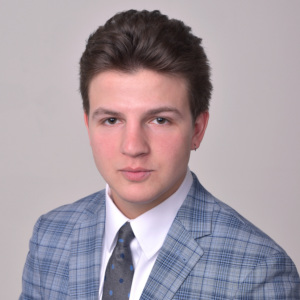
John (J.D.) Barnes (he/him/his), University of Oklahoma College of Law
J.D. will develop litigation strategies and a community education program for Legal Aid of Nebraska’s Native American Program, which provides legal services to Native Americans experiencing legal issues in or involved with courts in Nebraska. He will also provide direct legal services to Native Americans residing in communities on or near reservations or in tribal service areas who have legal issues related to housing.

Elise Baroni (she/her/hers), University of Arkansas, Fayetteville, Leflar Law Center
Hosted at Legal Aid of Arkansas, Inc, Elise will join Beyond Opioids—Breaking Legal Barriers for Families in Recovery—the first collaborative project among legal aid programs focused on people impacted by the opioid crisis and other substance use disorders. There, Elise will help provide direct legal services to low-income Arkansans with Opioid Use Disorder experiencing barriers to treatment and conduct outreach and education in partnership with methadone providers in the underserved Delta Region.

Samantha Beauchamp (she/her/hers), Suffolk University Law School
At Legal Assistance of Western New York, Inc (LawNY), Samantha will assist low-income clients in reducing barriers to employment and accessing unemployment insurance benefits. Additionally, Samantha will help LawNY expand its employment-related legal services provided to rural clients, especially to those who are under-or-unemployed due to having a criminal record.

Tara Blackwell (she/her/hers), Washington and Lee University School of Law
Tara will work with a special initiative at Center for Arkansas Legal Services to reduce generational poverty through home ownership and estate planning. Her work will concentrate on the poorest communities of the Arkansas Delta. As part of this work, Tara will help protect family land through “Wills on Wheels” clinics to prevent title issues before they occur, participate in community outreach, and provide litigation support to staff attorneys at her host organization.

Emily Borbon (she/her/hers), Belmont University College of Law
Emily will work with Legal Aid of NorthWest Texas to provide direct legal services, outreach, and community education to underserved populations in Wichita Falls, Texas. She will focus on housing stability and assist in three priority areas: eviction defense/rental assistance cases, debt collection cases, and expunctions and driver’s license restoration cases.

William (Billy) Bradley (he/him/his), University of California, Berkeley School of Law
At Legal Services Alabama, Billy will support his host organization’s Rural Economic Improvement Project (REIP), an initiative created to improve access to civil justice and build legal empowerment in rural Alabama communities. As a Student Fellow, Billy will help represent clients, conduct community outreach, and organize hybrid responses targeted to the needs of clients and communities.

Patrick Brogan (he/him/his), Villanova University School of Law
Hosted at Ohio State Legal Services, Patrick will assist with defending tenants facing eviction and gathering critical information from multiple counties, including court data and documented stories of individuals with disparate eviction outcomes because of their county location. Additionally, Patrick will attend hearings in these courts, take notes and track the outcomes of cases to help determine where future Tenant Advocacy Project clinics or other eviction diversion tools would be beneficial.

Dayleen Chery (she/her/hers), Southern University Law Center
Dayleen will work with her host organization, Texas RioGrande Legal Aid, Inc, on employment law matters affecting migrant and seasonal agricultural workers. She will assist with negotiations and litigation on current cases, along with intakes and case development for various complaints that the team receives during the summer.

Gabe Cripe (he/him/his), University of Cincinnati College of Law
At Legal Aid Society of Greater Cincinnati, Gabe will support his host organization’s Kinship Care Team, which assists grandparents and others who are caring for children whose parents cannot raise them due to a variety of issues, including substance use, untreated mental illness, or incarceration. He will assist with outreach, maintenance of referral relationships with partner agencies, brief-service legal clinics and legal advocacy to help clients access public benefits like Medicaid, Food Stamps, and cash payments to support the children they are raising.

Monte Cole (he/him/his), University of Montana School of Law
Hosted by Nevada Legal Services, Monte will work directly with a farmworker rights attorney and an outreach coordinator to provide legal education, access to justice, and investigation and defenses against rights violations of farmworkers. Monte will also help represent clients when necessary and conduct legal research on labor rights issues.

Hannah Davis (she/her/hers), Tulane University Law School
Hannah will assist Alaska Legal Services Corporation (ASLC) in efforts to empower communities by increasing knowledge of the legal system and local resources. She will also assist ALSC staff with the Pro Bono Training Academy, which is an online resource that trains non-attorney community advocates to assist clients, and BeneFactor, an app that guides caseworkers through the steps needed to assemble a successful disability application.

Jacob Engelhardt (he/him/his), Boston College Law School
Jacob will work with Land of Lincoln Legal Aid to provide outreach, community education, and legal assistance to a growing population of domestic violence survivors who face isolation and economic instability due to the remoteness of rural Illinois which lacks public transportation, childcare, and sometimes even cellphone service. Jacob will also be trained on how to assist and represent these at-risk clients holistically, particularly as these clients often have more than one legal issue at a time.

Rodrigo Fernandez-Ortega (he/him/his), Willamette University College of Law
Rodrigo will conduct outreach to low-income housing communities, mobile home parks, and resource centers with his host organization, Legal Aid Services of Oregon. He will also educate tenants about their rights, work with staff attorneys to provide legal representation in eviction cases, collect data about eviction proceedings; and examine the compliance of courts with various rules and statutes meant to protect tenants.

Maiya Fudge (she/her/hers), University of Florida Levin College of Law
At Legal Service of Greater Miami, Maiya will assist with the Mobile Home Park Advocacy Project which serves mobile home park residents in rural Miami. Through this project, she will help provide access to justice for mobile home park homeowners’ associations, composed of low-income mobile home park owners, in park closure cases and will legally challenge adverse rules, regulation changes, and rent increases.

Cassie Goodnight (she/her/hers), Washington University School of Law
At Oklahoma Indian Legal Services, Cassie will provide legal services through the Indian Child Welfare Act (ICWA) Parent Representation Project. She will provide a variety of legal services to parents and families to help enforce the ICWA, which prevents the arbitrary removal of Indian children from their homes.
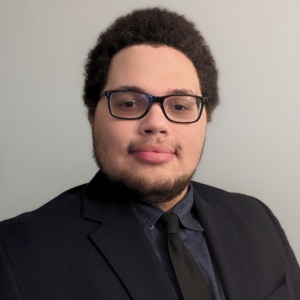
Andrew Green (he/him/his), Villanova University School of Law
Andrew will work on the Legal Aid Society of Middle Tennessee and the Cumberlands’ Rural Reentry Outreach & Legal Clinics Project, which provides access to justice for the formerly incarcerated. He will support legal work to assist low-income, rural individuals facing societal barriers due to prior criminal records, providing services such as criminal record expungement, driver’s license reinstatement, and certificates of employability for private employers and state licensing.

Matthew Gulick (he/him/his), Lewis & Clark Law School
Hosted by Texas RioGrande Legal Aid, Matthew will work with the Community Development and Environmental Justice team to ensure that rural communities are not overburdened by air and water pollution, have access to safe drinking water, and are able to fight predatory foreclosure practices by an irrigation district.
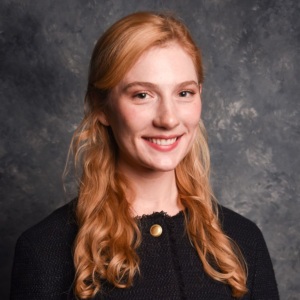
Kelsey Gunvalson (she/her/hers), University of Wisconsin Law School
At Legal Services of Northwest Minnesota Corporation, Kelsey will work on Reach Justice Minnesota, a statewide network of community-based civil justice kiosks and mobile civil legal aid clinics. She will expand the use of the legal kiosk network across northern Minnesota and establish regularly scheduled mobile legal clinics in a variety of court, agency, nonprofit, and other community locations.

Jada Haynes, (she/her/hers) Southern University Law Center
Jada will work with host organization Georgia Legal Services Program to assist rural communities of color in securing homeownership and preserving wealth in communities that are most affected by natural disasters. Jada will conduct needs assessments, draft educational materials for high-risk communities, and create training materials for volunteer lawyers to assist with FEMA recovery.

Anna Henson (she/her/hers), Michigan State University College of Law
At Pine Tree Legal Assistance, Inc, Anna will work within the Basic Unit and the Family Law and Victims’ Rights Unit to provide legal services to low-income clients throughout Aroostook County, Maine. She will combine substantive legal work, research projects, community outreach, and a needs assessment to resolve complex legal issues on behalf of more low-income clients.

Millie Hobaish (she/her/hers), University of California, Irvine School of Law
Hosted by DNA-Peoples Legal Services, Millie will work with the supervision of Navajo licensed attorneys to provide outreach, community legal education, and a full spectrum of legal assistance to residents in the Navajo communities.

Hannah Holmberg (she/her/hers), University of St. Thomas School of Law
At Legal Services of Northwest Minnesota Corporation, Hannah will work on Reach Justice Minnesota, a statewide network of community-based civil justice kiosks and mobile civil legal aid clinics. She will expand the use of the legal kiosk network across northern Minnesota and establish regularly scheduled mobile legal clinics in a variety of court, agency, nonprofit, and other community locations.

Christopher Irsfeld (he/him/his), New York University School of Law
Christopher will address legal issues affecting rural transgender and gender-non-conforming Californians while working at his host organization, California Rural Legal Assistance. He will work with the LGBTQ+ Program to investigate potential harassment and discrimination claims and provide direct legal services in areas such as identity-document updates, immigration, employment, housing, healthcare access, and education.

Paige Kendrick, (she/her/hers), Washington University School of Law
Hosted by North Penn Legal Services, Paige will provide outreach, community education, and representation in rural counties which have significant needs in housing, debt, and consumer matters. Paige will also conduct outreach, create networking opportunities, and use legal information to educate communities.

Haley Kilma, (she/her/hers), University of Mississippi School of Law
At North Mississippi Rural Legal Services, Haley will provide free tax representation for increased numbers of low-income taxpayers who cannot afford to pay private attorneys to address their tax problems. Haley will also expand efforts to reach taxpayers through education and outreach in various Mississippi communities and raise awareness of available resources and clinics.

Robert Lass (he/him/his), University of Missouri School of Law
Robert will help Legal Services of Eastern Missouri, Inc. expand outreach efforts in rural counties and increase their capacity, mainly in serving domestic violence victims living in rural northeastern Missouri. Robert will work with mentors to conduct intake screenings, interview clients, draft pleadings, manage dockets, appear in court, and assist with case closeout, primarily for domestic violence cases.

Maya Madden (she/her/hers), Texas A&M University School of Law
Hosted by Lone Star Legal Aid, Maya will implement the Homestead and Disability Property Tax Exemption project for low-income residents of rural Texas. She will conduct community outreach and education, provide legal counsel, and help represent clients who need guidance securing tax exemptions or are fighting for the return of their homes after unjust tax foreclosure lawsuits led to home loss.

Olivia Marks (she/her/hers), Tulane University Law School
At Southeast Louisiana Legal Services Corporation, Olivia will focus largely on ensuring that communities impacted by Hurricane Ida throughout rural parishes have access to justice and are not left behind in the recovery process. She will provide legal services to help these individuals recover after disasters and will provide significant outreach.
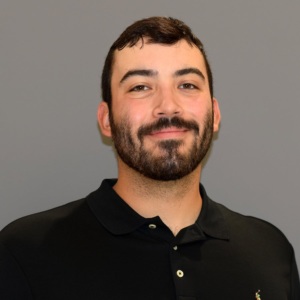
Robert Necciai (he/him/his), University of Pittsburgh School of Law
As a Student Fellow at Neighborhood Legal Services Association, Robert will work closely with experienced attorneys and partners to connect more clients to custody legal services. His work will include establishing regular outreach information sessions to provide information on custody rights and responsibilities and helping with custody cases.

Hana Muslic (she/her/hers), DePaul University College of Law
Hosted by Southern Minnesota Regional Legal Services, Inc, Hana will focus on meeting the challenge of the increased number of housing and eviction matters that will come forth due to the end of the Minnesota Eviction Moratorium Phaseout. With only two housing attorneys available to meet this increasing demand for legal services at Southern Minnesota Regional Legal Services, Hana will help to directly serve clients in landlord-tenant and other housing matters.

Regan Richards (she/her/hers), George Washington University Law School
At Montana Legal Services Association, Regan will conduct intake interviews, provide supervised legal advice to tenants facing eviction, participate in landlord-tenant mediations, and help route clients for full representation, mediation, and other wrap-around services.

Lauren Rowell (she/her/hers), University of Denver Sturm College of Law
Lauren will work directly with attorneys at Legal Aid Society of Northeastern New York on landlord-tenant and family law proceedings involving domestic violence to address problems faced by rural clients in accessing legal assistance and representation.

Gabriella Sayger (she/her/hers), Appalachian School of Law
Hosted by Legal Aid of West Virginia, Gabriella will help provide direct civil legal services focusing on stabilizing clients’ access to housing and economic stability for rural renters at risk of eviction. Gabriella will also provide targeted outreach and legal education for community partners and the public on legal issues.

Aaron Schaffer-Neitz (he/him/his), Stanford Law School
At Legal Aid Society of Mid-New York, Inc, Aaron will gain experience with all types of cases from agricultural workers across New York, including trafficking, wage theft, workplace health and safety, discrimination, and civil rights. His work will have a special emphasis on housing issues experienced by New York farmworkers living in employer-provided housing such as brown drinking water, mold, sewage backup, cracked windows, exposed wiring, overcrowded conditions, and a lack of heat during cold months.

Maryn Sommerfeldt (she/her/hers), University of Oregon School of Law
Hosted by Utah Legal Services, Maryn will work closely with experienced attorneys to conduct outreach and serve clients in rural and frontier areas of Utah. She will help provide targeted outreach to underserved populations, organize a community education and outreach plan to assist with debt collection cases, and provide direct services to clients in debt collection cases.

Gabe Spellberg (he/him/his), Chicago-Kent College of Law, Illinois Institute of Technology
At Colorado Legal Services, Gabe will work with the Migrant Farm Worker Division to meet the legal needs of farmworkers in the Western Slope region of Colorado. His work will focus on working conditions, wage issues, civil rights, sexual harassment, human trafficking, and immigration.

Autumn Westhoff (she/her/hers), University of Missouri School of Law
Autumn will help Legal Services of Eastern Missouri expand their outreach efforts and increase capacity by serving domestic violence victims living in rural northeastern Missouri. She will work with mentors to conduct intake screenings, interview clients, draft pleadings, manage dockets, appear in court, and assist with case closeout, primarily for domestic violence cases.
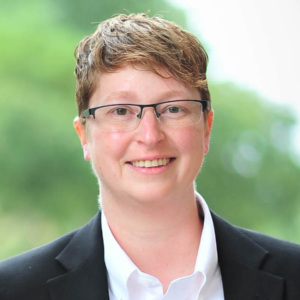
Ashley (Ash) Wilkie (she/her/hers), Michigan State University College of Law
Hosted by Michigan Indian Legal Services, Ash will assist staff with community outreach and planning on-site and virtual clinics. She will also attend three clinics in rural areas and draft estate planning documents, such as wills, powers of attorney, and patient advocate forms.
Visit here for more information about the Rural Summer Legal Corps.
Equal Justice Works is proud to introduce the 2022 class of Disaster Resilience Program Student Fellows. These eight law students will spend their summer working alongside Disaster Resilience Program Fellows in California, Louisiana, and New Mexico as they help communities prepare for, respond to, and recover from disasters.
“Disasters can have a devastating impact on individuals and communities, and the legal needs that emerge following a disaster are complex and difficult to navigate alone,” said Linda Anderson Stanley, senior program manager at Equal Justice Works and director of the American Bar Association Young Lawyers Division Disaster Legal Services Program. “We are proud to support these Student Fellows in their work to expand critical legal resources for families affected by disasters and their efforts to build more resilient communities.”
Through the Disaster Resilience Program, Student Fellows will gain exposure to disaster preparedness, response, and recovery legal work. They will help to provide civil legal services, engage in community education and advocacy efforts, and build capacity at their host organization.
Meet our Disaster Resilience Program Student Fellows and learn more about how they will be supporting a wide range of disaster-related legal issues, including housing, employment, immigration, accessibility, and health care needs.

Megan Brua (she/her/hers), University of Wisconsin Law School
At Southeast Louisiana Legal Services, Megan will work alongside 2021 Fellow Chris Kerrigan to help achieve justice for low-income individuals facing eviction or housing instability. This includes providing legal assistance, advocacy, community education, and resources to those who have experienced housing issues due to disasters or landlord neglect.

Emily Bruell, Stanford Law School
At New Mexico Immigrant Law Center, Emily will work with 2022 Fellows Taylor Noya, Sophia Genovese, and Anna Trillo on the Asylum and Detention team to provide legal aid to noncitizens in immigration detention and non-detained asylum seekers. Emily will also assist Fellows with asylum cases and conduct outreach at New Mexico’s detention centers.

Nora Hendricks (she/her/hers), Seattle University School of Law
Hosted by Southeast Louisiana Legal Services, Nora will work with 2022 Fellow Patrick Doell to provide on-site direct legal services at the Baton Rouge City Court via an eviction help desk. A city court eviction help desk will act as insulation for individuals against future increases in evictions due to disasters or other causes. They will also aid defendants who need legal representation in eviction cases. Together, Nora and Patrick will aid those who are experiencing issues with housing security due to the COVID-19 pandemic.

Abigail Meibaum (she/her/hers), Washington University in Saint Louis School of Law
Abigail will focus on disaster-related advocacy and litigation with 2022 Fellow Skyler Williams at Southeast Louisiana Legal Services. There, Abigail will help provide access to sustainable housing and prevent evictions in Louisiana, which is currently facing an eviction crisis due to COVID-19. The region’s vulnerability to hurricanes requires a focus on overarching housing issues and providing know your rights training for community members, which Abigail will help provide.

Alondra Granados-Diaz, University of New Mexico School of Law
Hosted by New Mexico Immigrant Law Center, Alondra will work alongside 2022 Fellow Sophia Genovese on the Asylum and Detention team to provide legal assistance to noncitizens in immigration detention and non-detained asylum seekers. Together, they hope to aid those affected by COVID-19’s effects on the immigration system, such as medical issues raised by the pandemic in immigration detention centers.

Desiree Robedeaux (she/her/hers), University of California, Hastings College of Law
At Disability Rights California, Desiree will work alongside 2021 Fellow Jordan Davis to address the legal needs of Californians with disabilities affected by wildfire disasters. Together, they will work to address Public Safety Power Shutoff events, housing displacement and accessibility issues, emergency transportation, and the negative health impacts of poor air quality, which all disproportionately affect people with access and functional needs.

Jonathan Thomas (he/him/his), Washington and Lee University School of Law
Hosted by Disability Rights Louisiana, Jonathan will work with 2021 Fellow Kate Thorstad to serve Louisianans with disabilities who were impacted by disasters such as the COVID-19 pandemic and Hurricane Ida. Together, they will work to mitigate barriers to critical programs, services, and housing.

Ernesto Villaseñor, University of Baltimore School of Law
Ernesto will work with 2021 Fellow Jacob Zarefsky at Neighborhood Legal Services of Los Angeles to provide legal aid and assistance to wildfire survivors throughout California. Together, they will work to conduct client outreach to disaster survivors, represent wildfire survivors, and engage with their peers in learning exercises.
Visit here for more information about Disaster Resilience Program.
The Disaster Resilience Program is currently funded by the Bigglesworth Family Foundation, Carnegie Corporation of New York, the Center for Disaster Philanthropy, W.K. Kellogg Foundation, and individual contributions.
We are proud to support these Student Fellows in their work to expand critical legal resources for families affected by disasters and their efforts to build more resilient communities.
Linda Anderson Stanley /
Equal Justice Works Senior Program Manager
By Annie Lee, director of policy at Chinese for Affirmative Action and chair of the Alumni Advisory Council.
Over the past six months, the Equal Justice Works Alumni Advisory Council (AAC) has been collaborating closely with Lynbea Toombs, director of alumni relations to establish goals and corresponding activities that level up to the organization’s strategic plan and vision for its Alumni Engagement Program.
To date, we’ve identified the following goals:
- Create a charter and establish internal processes for a strong foundation for the AAC
- Plan and execute quarterly alumni programming
- Assist in the development of an alumni award
- Utilize social media to promote Equal Justice Works and AAC events and initiatives
- Advise on plans for alumni involvement in Fellowships program recruitment campaign such as the Design-Your-Own Fellowship Program Announcement Day
We’ve established three committees to help us accomplish this work:
- The Governance Committee, which is responsible for developing the AAC’s guiding documents.
- The Outreach Committee, which assists the director of alumni relations in identifying alumni volunteers and raising awareness about the Alumni Engagement Program and getting our network of past, present, and potential Equal Justice Works Fellows active in the alumni community.
- The Programming Committee, which empowers and unites Equal Justice Works Alumni through substantive programming and networking events.
At the 2021-22 AAC’s last quarterly meeting, we voted to accept a charter that will govern the AAC moving forward. Additionally, we celebrated 2021-22 successes, including the impact of AAC consultation on a variety of alumni engagement opportunities, such as the Design-Your-Own Fellowship Program Announcement Day and alumni giving, as well as hosting two events for alumni. In February, we held a government attorneys and academia insights panel, where Equal Justice Works Alumni spoke about their diverse experiences working as government attorneys and shared tips on how public interest lawyers in the nonprofit sector can make the transition into government or academic roles. At the session, participants had the opportunity to network with the panelists and each-other in small groups.
As 2022’s fiscal year winds down, the AAC plans to advise on an alumni programming survey and will hold one final alumni event on mental health. Additionally, we will continue to develop regional alumni events to encourage networking and outreach.
In the 2023 fiscal year, the AAC plans to welcome five new members who represent the diversity of the Equal Justice Works Alumni community. Some of the targeted goals for the new fiscal year will include continued programming for alumni and advising on issues such as effective alumni engagement at Leadership Development Training, as well as the launch of an Alumni Speakers’ Bureau.
We are grateful to our current Council members for their hard work and dedication to the Alumni Advisory Council! The inaugural AAC has laid a strong foundation and set a high bar for what we can accomplish when we work together on behalf of Equal Justice Works Alumni. We’re proud of what we have accomplished over the last year and look forward to what’s to come!
Applications for the five open positions on the 2022-2025 Alumni Advisory Council are being accepted through July 11, click here to apply. For more information about the Alumni Advisory Council, please visit here.
Equal Justice Works recently held an informational session about the Housing Justice Program and what applicants need to know before applying. At the session, staff members Brooke Meckler, director of law school engagement and advocacy, and Hana Hausnerova, director of public programs, also chatted with 2019 Fellow Palmer Heenan about the successes of the Housing Justice Program and how his participation in the program has shaped his career.
The Housing Justice Program is the only Equal Justice Works Fellowship program that employs both lawyers and community organizers, who collaborate as Fellows to empower communities and address housing instability.
“It really is an incredible opportunity to do some amazing good and get some amazing trial experience, litigation experience, client experience, deposition experience,” said Palmer.

At the session, Palmer also shared helpful advice on the application process, as well as some of the benefits of being in the Housing Justice Program.
“I hope all of you give this some serious consideration. It’s an amazing, practical, hands-on legal experience,” said Palmer. “I personally think more lawyers should have that kind of experience. But it’s also a way to uniquely affect people’s lives.”
Currently, Equal Justice Works is expanding the Housing Justice Program from Virginia to South Carolina and Maryland creating more than 20 Fellowship opportunities starting in August 2022.
Applications are available now for Fellowships in South Carolina and Maryland with a start date in August or September 2022.
Message us at [email protected] to be added to our email list for future updates.
It really is an incredible opportunity to do some amazing good and get some amazing trial experience, litigation experience, client experience, deposition experience
Palmer Heenan /
2019 Equal Justice Works Fellow
Housing Justice Program

By 2020 Fellow Victoria Jeon, who is supported by the Paul Rapoport Foundation and hosted at UnLocal, inc.
In legal matters, the needs of the Asian and Pacific Islander (API) community are often overlooked; LGBTQ+ API individuals are overlooked even further, alienated from both Asian and LGBTQ+ communities. I’ve been afforded the opportunity to serve these clients through my Equal Justice Works Fellowship at UnLocal. There, I work with the Queer Immigrant Justice Project, which primarily aids LGBTQ+ asylum seekers in their asylum cases, assists with obtaining Green Cards, and provides various other forms of legal assistance. During my Fellowship, I’ve met and assisted many clients from all over the world, all of whom inspire me with their own strength and resilience.
I’ve met and assisted many clients from all over the world, all of whom inspire me with their own strength and resilience.
Through my work, I also help with connecting UnLocal to local API organizations for partnerships with UnLocal’s education and legal programs. This focus is even more important given the rise in anti-Asian racism in light of COVID-19. The pandemic has emphasized the need to support API and LGBTQ+ API communities and raised new challenges in my line of work. COVID-19 has been devastating for many organizations, especially smaller nonprofits. Although I’ve been able to assist asylum seekers from all over Asia and the Caribbean, where there is a prominent diaspora of Chinese and Indian people and their descendants, the pandemic has compromised the capacity of many API organizations I had hoped to collaborate with. Despite this, I’ve still had the chance to be a liaison, connecting UnLocal to local organizations, like the Caribbean Equality Project, National Queer Asian Pacific Islander Alliance, and more.

Although UnLocal’s specialty is in immigration law, I had little experience with this specific area before joining the organization as a Fellow. Nonetheless, my supervisors at UnLocal gave me the opportunity to learn, and they effectively guided me so that I could handle some trials on my own. As a result, I was able to contribute significantly to a Ghanaian man’s asylum victory and lead a case that resulted in winning asylum for a Haitian LGBTQ+ ally and political activist and his family. These victories at court and my personal progress are what I’m proudest of during this Fellowship.
After completing my Fellowship, I plan to stay on at UnLocal and help with its Queer Immigrant Justice Project. This work continues to be relevant and crucial, especially given the global political tension, and I am thankful to UnLocal for putting the faith in me as they have until this point.
We’re proud of the work that Victoria is doing to advocate on behalf of LGBTQ+ Asian and Pacific Islanders. To learn more about her Fellowship, visit here.