Disaster Legal Aid Trainings: What do Refugees and New Arrivals Need to Know?
On March 4, Robert Flores (he/him/his), Equal Justice Works Fellow at YMCA International Services, hosted a disaster legal aid training titled, “Disaster Preparedness Awareness for Refugees and New Arrivals,” with Kimberly Haynes (she/her/hers), executive director of the South Texas Office for Refugees. This training is part of the first-ever Disaster Resilience Awareness Month organized by Equal Justice Works.
Robert has been an attorney for almost seven years, representing refugees and other new arrivals in claims for asylum, withholding of removal, applying for permanent residency, and applying for United States Citizenship. The South Texas Office for Refugees provides funding to local service agencies for a variety of supportive services including refugee cash and medical assistance, and enrollment in programs that support individuals’ self-sufficiency and successful integration through employment, English language acquisition, and citizenship.
At the session, Robert and Kimberly discussed the systemic challenges to disaster preparedness, recovery, and resiliency within the refugee community. They delved into the nuances of disaster resiliency in the hope of helping refugees and community organizations prepare for the next natural disaster. The United States experiences climate phenomena that are often unfamiliar to new arrivals. From Hurricane Harvey in the Gulf Coast to Super Storm Sandy in the Northeast, the wildfires of the West Coast, tornadoes of the Midwest, and of course the COVID-19 pandemic, the United States has a long and sad relationship with disasters of all kinds.
Refugees and other new arrivals face a variety of roadblocks when it comes to disaster preparedness. They are fleeing in many ways political and other disasters, coming into the United States and now having to navigate all types of disasters, such as the COVID-19 pandemic. Kimberly emphasized the importance of clarifying what we mean when we use the word “disaster,” as it can mean many different things to different people. The Equal Justice Works Disaster Resilience Program uses the International Federation of Red Cross’s definition: “A disaster is a sudden, calamitous event that seriously disrupts the functioning of a community or society and causes human, material, and economic or environmental losses that exceed the community’s or society’s ability to cope using its own resources. Though often caused by nature, disasters can have human origins.”

The discussion also addressed the need for cultural and social awareness of disaster preparedness within the refugee community and making sure advocates take the time to discuss and define the kinds of disasters that may occur in their area with affected communities. Robert and Kimberly examined what the refugee community needs to know about natural disasters and disaster recovery in the United States, such as where assistance might come from or be available from the federal, state, local, and county organizations. They discussed the importance of refugees and new arrivals having a safety plan of who to turn to in the event of a disaster, noting what resources are available, or may become available, and who to look to for accurate information.
Robert and Kimberly also addressed the specific difficulties refugees have in getting the information they need for disaster preparedness, and the obstacles faced by community organizations in getting the correct information to community members like translation to multiple languages, modern technology, and access to good/quality information.
The conversation led to highlighting the ways community organizations can improve their outreach efforts to expand disaster resiliency within the refugee community, such as providers working more closely with the city to distribute information, getting a better understanding of where people go for information, and thinking creatively about ways to engage the refugee community to ensure someone from their trusted circle has access to accurate information that can be shared with others. Robert and Kimberly cited this resource for refugee community and community partners to help better prepare for the next natural disaster:
- Office of Refugee Resettlement Emergency Preparedness Booklet: https://www.acf.hhs.gov/orr/outreach-material/emergency-preparedness
If your organization is interested in teaming up with Equal Justice Works for Disaster Resilience Awareness Month, please reach out to us at [email protected]
Disaster Resilience Awareness Month is made possible thanks to the generous support of Equal Justice Works host organizations: Catholic Charities of the Archdiocese of Galveston-Houston, Community Legal Services of Mid-Florida, Disability Rights Texas, Lone Star Legal Aid, Texas RioGrande Legal Aid, Inc., and YMCA International Services.
The Equal Justice Works Disaster Resilience Program is funded by Carnegie Corporation of New York, the Center for Disaster Philanthropy, the Bigglesworth Family Foundation, and individual contributions.
By Al Roberts, public programs specialist at Equal Justice Works

In the wake of hurricanes Harvey, Irma, and Maria in 2017, Equal Justice Works established the Disaster Recovery Legal Corps (DRLC). Launched in May 2018, this award-winning Fellowship program mobilized 23 attorneys to provide free civil legal services to low-income and marginalized communities affected by these disasters in Texas and Florida. As new challenges came to light, such as Tropical Storm Imelda and the COVID-19 pandemic, Fellows in the DRLC were able to adapt to the needs within their communities and realize profound outcomes for their clients.
The unique nature of the DRLC’s regional cohort Fellowship model allowed the program to achieve its greatest potential, with Fellows leveraging their combined knowledge and expertise to better serve the disparate needs of disaster survivors. The diverse array of specializations among Fellows enhanced their efficacy in addressing the critical legal needs of a similarly diverse client population. Some Fellows’ projects had them addressing labor rights, while others were focused on appealing FEMA benefit denials or combatting improper evictions. Several Fellows’ scope of work targeted specific demographics like individuals with disabilities or undocumented immigrant families. This robust network allowed for client referrals between the Fellows in the program and with community partners at large, connecting disaster-impacted clients to holistic services.
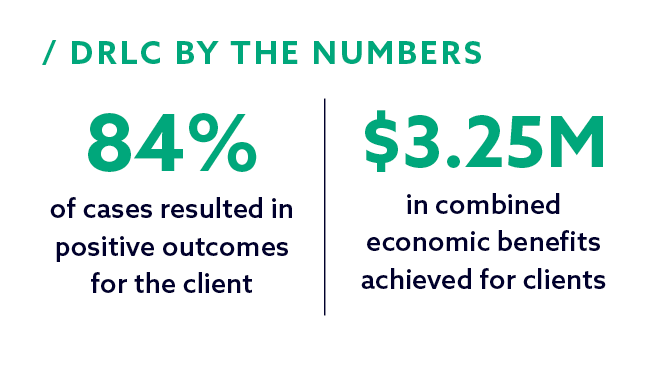
At the end of the program in October 2020, the work of the Fellows rendered some truly impressive feats. Of the cases closed during the program, 84% resulted in a positive outcome for the client, contributing to a staggering $3.25 million in combined economic benefits achieved for clients. These benefits included housing stability, FEMA assistance, resolving title disputes, preserving wages, and more. The magnitude of economic benefits realized illustrates the return on investment enabled by the cohort Fellowship model.
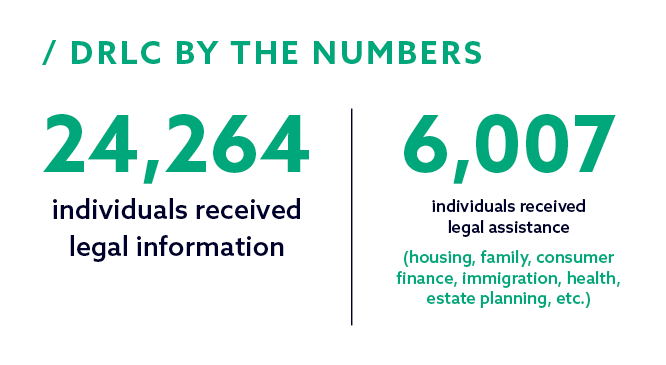
Additionally, community outreach and education efforts by the Fellows led to 24,264 individuals receiving legal information and 6,007 individuals receiving legal assistance on a breadth of issues—housing, family, consumer finance, immigration, health, estate planning, and many more facets of life that can be disrupted following a disaster.
The Disaster Recovery Legal Corps is exemplary of what a cohort Fellowship model can accomplish. Learn more about the work of the DRLC Fellows and Equal Justice Works continued commitment to disaster recovery and preparedness in its latest initiative, the Disaster Resilience Program.
The Disaster Recovery Legal Corps program was funded with support from the American Red Cross, the Bigglesworth Family Foundation, the Carnegie Corporation of New York, Center for Disaster Philanthropy, the Florida Bar Foundation, Houston Immigration Legal Services Collaborative, Hurricane Harvey Relief Fund administered by the Greater Houston Community Foundation, Sharon and Ivan Fong Family Foundation, and the Texas Access to Justice Foundation.
Learn more about the work of our DRLC Fellows here.
On March 2, Maria Vazquez (she/her/hers), Equal Justice Works Fellow at Catholic Charities of the Archdiocese of Galveston-Houston, kicked-off the first training session for Disaster Resilience Awareness Month, titled, “Addressing the Unique Needs of Immigrants During Disasters.”
Maria led a Q&A-style panel discussion to provide valuable information to assist immigrant individuals in the disaster preparation and recovery process. Joining Maria were guest speakers Jill Campbell, director of immigration and citizenship at BakerRipley, and Katy Atkiss, the disaster resilience manager at the Houston Immigration Legal Services Collaborative (HILSC).
The group discussed some of the most common issues for individuals who are seeking adjustment to their immigration status following a disaster—for one, the loss of vital records. The importance of keeping copies of all immigration-related documentation in a waterproof, safe place at all times could not be overstated. This is one of the most profound pitfalls for the immigrant population following a disaster, as replacing such documents can be very time-consuming and expensive, which inevitably ends up impeding immigration proceedings that follow. Though fee waivers are sometimes accessible in the quest to replace lost documents, the panel offered tips to mitigate this risk and avoid the headache entirely, like properly storing physical documentation and retaining a digital copy of all documents via photographs, which can be shared with trusted friends and family and accessed remotely, in the event that a phone or computer becomes damaged. While strongly advocating for individuals to take the appropriate precautions, Jill assured the audience that catastrophic loss of documentation does not mean a loss of a person’s current immigration status, but it is likely to significantly delay progress on the pathway to permanent residency.
Immigration status is not the only element to cause immigrant populations a great deal of anxiety in the wake of disasters. Like many others, folks are in dire need of emergency assistance, which is often sought through federal, state, and local programs. Katy provided a breakdown of the federal programs typically on offer following a disaster declaration by the President of the United States: Federal Emergency Management Agency (FEMA) assistance, loans from the Small Business Administration (SBA), and Disaster Supplemental Nutrition Assistance Program (DSNAP) benefits. Eligibility for most of these forms of assistance requires applicants to be a U.S. Citizen, a “Qualified Alien” (refugees, asylees, other people with some form of legal status), or a Non-citizen National (born in a U.S. territory). However, those falling outside of these categories may still apply for funding through another member of the household, including a child under the age of 18, that fits into one of the above eligible categories.

Combatting some common misconceptions around immigrants seeking public assistance, Jill stressed the importance of knowing that individuals who decide to pursue these disaster-related forms of emergency assistance are not subject to public charge. Furthermore, the Biden administration has recently expressed interest in reviewing the applicability of the public charge rule more generally. While seeking disaster assistance cannot be held against an individual as a public charge in immigration proceedings, it is most important that all information submitted in an application for assistance be entirely truthful. Providing misinformation to a government agency can result in a criminal charge, which could be extremely detrimental to subsequent outcomes on the immigration relief front.
While a disaster can be particularly devastating to immigrants in the United States, the panel reminded attendees that most people in a disaster-affected area are likely experiencing similar troubles. Federal buildings, such as immigration courts, are prone to closures as a result, and there is a good chance that an attorney providing legal advice will be out of reach due to internet and cellular outages. In these instances, it is crucial that individuals take every possible measure to meet requirements, like court dates and annual check-ins with ICE. If an appointment is on the horizon, vigilance and documentation of efforts to make contact with the relevant government agencies is paramount—keep calling and emailing!
The speakers covered many more facets that individuals should be mindful of, such as the importance of filing taxes in a timely manner, the dangers of fraudulent emergency assistance offers, and the benefits of following local legal aid organizations and government agencies on social media platforms like Twitter. Here are some helpful resources for immigrants seeking legal advice in the aftermath of a disaster, as discussed during the session:
- HILSC Disaster Resource Guide: houstonimmigration.org/disaster-resources-for-immigrants
- Houston-Harris County Emergency Rental Assistance Program: houstonharrishelps.org
- FEMA: fema.gov
If your organization is interested in teaming up with Equal Justice Works for Disaster Resilience Awareness Month, please reach out to us at [email protected]
Disaster Resilience Awareness Month is made possible thanks to the generous support of Equal Justice Works host organizations: Catholic Charities of the Archdiocese of Galveston-Houston, Community Legal Services of Mid-Florida, Disability Rights Texas, Lone Star Legal Aid, Texas RioGrande Legal Aid, Inc., and YMCA International Services.
The Equal Justice Works Disaster Resilience Program is funded by Carnegie Corporation of New York, the Center for Disaster Philanthropy, the Bigglesworth Family Foundation, and individual contributions.

By Alison Siczek, 2019 Equal Justice Works Fellow hosted by Beyond Legal Aid. Alison’s Fellowship is cosponsored by Exelon Corporation and Morgan, Lewis & Bockius LLP.
For the past three months, I have spoken to Juana every week. Some weeks are better than others. There are days she can focus solely on caring for her family. Other days, the layered trauma of the past few decades comes rushing back in terrifying waves.
Back in Mexico, a man kidnapped Juana and kept her captive for years. After she escaped with her four children, caring for them became her whole life. She later witnessed a murder by notorious narcotraffickers and testified against them in open court. Local police and prosecutors told her to flee to the United States.
Since she arrived in the United States, she has again been focused on survival. Her granddaughter, who she has cared for her whole life, fled with her, and now Juana helps care for her granddaughter’s children as well. Juana’s final asylum hearing was rescheduled due to the COVID-19 pandemic, so the next traumatic experience, of reliving all of her past horrors in front of an immigration judge, is on hold for now.
The absolute strength and bravery of the mothers I have worked alongside the past year and a half is unwavering. Navigating the complexity of immigration courts, especially with its pandemic-related postponements and delays, can be all-consuming. Removal proceedings in immigration court are life-changing. They can mean a chance at a free life versus the risk of death upon removal.
The injustices of our nation’s immigration courts are well-known. What often gets overlooked is the life outside of the small, cold, windowless courtrooms. Parents who, waiting on final hearings scheduled two or three years down the line, are struggling to feed their families while they are not yet eligible for work permits. Mothers who, on their own, are navigating schools, financial institutions, and housing options, often in a language they barely know.
My Equal Justice Works Fellowship has allowed me to provide holistic representation for these families who are in removal proceedings. In addition to direct representation in their legal matters, I have helped them make connections with counseling services, public benefits programs, and tax filing assistance. Fortunately, I am not alone in this endeavor. Through the community lawyering model of my host organization, Beyond Legal Aid, I am connected with community-based and activist organizations throughout the Greater Chicagoland Area.
This collaboration with community members is what matters the most to me. I am not the one who knows what the communities I work with need the most—the communities themselves do. I do not decide the goals and needs that are prioritized. The autonomous community members, leaders, and activists I collaborate with are the decision-makers.
This collaboration with community members is what matters the most to me. I am not the one who knows what the communities I work with need the most—the communities themselves do.
Alison Siczek /
Equal Justice Works Fellow
Mothers are often the leaders in these communities. For example, Gesenia and Stephanie are both mothers and active members of a neighborhood defense network. While it requires more time and dedication, they have also agreed to be part of the network’s campaign highlighting the separation of families within the United States. The Obama-era policy, exacerbated during the Trump Administration, of family separation at the border may no longer be in the headlines. However, the risk of family separation (due to the limited options for defending against removal) is still very much alive. Gesenia and Stephanie are using their voices and sharing their stories as part of the campaign.
This activist-led campaign aims to bring sustained attention and action to an issue that affects other individual community members. The best chance I have at building sustainable power for other mothers, like Juana, is supporting those fighting for more systemic change in their communities.
My Equal Justice Works Fellowship has allowed me to embrace and learn this community-led approach to lawyering. The incredible mothers and families I meet along the way are teaching me and their communities more than they may know.
At Equal Justice Works, we are proud of Alison’s efforts to bring more attention and assistance to immigrant mothers who are in removal proceedings. To learn more about this Fellowship project, visit here.
By April Hewko, program manager at Equal Justice Works, with contributions from Adriel Orozco, executive director at New Mexico Immigrant Law Center and 2016 Equal Justice Works Fellow

Immigration law is incredibly complex and ever-changing, making it nearly impossible to navigate without the guidance of a lawyer. Through our Fellowship opportunities, Equal Justice Works has made a clear commitment to increasing access to justice for immigrants, asylum seekers, and refugees. Since 1993, we’ve created 386 Fellowship opportunities focused on supporting immigrant populations, most recently mobilizing a network of 7 paralegals and 6 lawyers (Fellows) who were hosted by the New Mexico Immigrant Law Center (NMILC).
From 2016 to 2020, the New Mexico Immigration Corps deployed lawyers and paralegals to provide critically needed legal aid to immigrant children and families throughout New Mexico; the team of 13 paralegal and attorney Fellows served more than 7,400 immigrant individuals through consultations, provision of legal information, and/or direct representation. A primary goal of the program was to create a pipeline of new and prospective lawyers from the immigrant community and communities of color into the public interest sector in New Mexico.

Throughout the four-year program, Fellows partnered with public interest programs at the University of New Mexico School of Law to create opportunities for law students interested in working with immigrant populations; collaborated to increase the representation of historically marginalized individuals in the legal profession; coordinated with more than 40 pro bono attorneys interested in supporting low-income immigrants; and worked with community organizations to provide holistic services and support. More broadly, the program addressed racial equity in the nonprofit and legal sector in New Mexico by ensuring Fellows came from the communities they served, while including impacted communities in decision making, and collaborating with like-minded organizations that prioritized equity.

Restrictive immigration policies at the federal level over the past four years and during the more recent COVID-19 pandemic impacted the Fellows’ work environment and how they were able to serve the immigrant community. However, due to the flexibility of the Fellowship, program participants were able to respond to the increased arrests of immigrants, the continuing needs of DACA recipients, and the detention of asylum seekers throughout the last four years. Fellows were also able to focus their work on the needs that were exacerbated because of the pandemic (e.g., language access, criminal and immigration detention, and screening for additional needs such as housing assistance) by transitioning to electronic formats and collaborating with other organizations to advocate for more protections and resources for the immigrant community. This was a priority for the Fellows as the pandemic disproportionately affects Black, Latinx, and immigrant workers.
 Over the course of the program, Fellows conducted more than 250 legal education community outreach events and activities for over 6,500 participants, such as citizenship and DACA pro se workshops and Know Your Rights presentations and trainings. These events, as well as regular individual consultations with clients, were essential over the last four years, as laws and policies changes caused confusion, fear, and insecurity for clients and the community in general.
Fellows in the New Mexico Immigration Corps benefitted from collaborating with partner organizations and other Equal Justice Works alumni and Fellows in their cohort. The cohort model provides the opportunity for Fellows to have hands-on experience in specific issue areas and become a part of a core group of dedicated practitioners who share a common passion, learn together, share resources, innovate, problem-solve, and build a stronger community of practice.
“I learned a lot and greatly benefitted from being able to meet and confer with other Fellows nationwide. I got a lot of support from the host organization and was given access to all the tools I needed,” said Martha Laura Garcia Izaguirre, 2017 Equal Justice Works Fellow.
I learned a lot and greatly benefitted from being able to meet and confer with other Fellows nationwide. I got a lot of support from the host organization and was given access to all the tools I needed.
Martha Laura Garcia Izaguirre /
Equal Justice Works Fellow
Following the four-year program, NMILC has been able to secure grants to sustain the positions of six of the seven Fellows. Adriel Orozco, executive director of NMILC and 2016 Equal Justice Works Fellow, reflected, “The New Mexico Immigration Corps allowed NMILC to strengthen its supervision and mentorship programs, particularly with a racial equity lens. Additionally, the project allowed NMILC to be responsive to the many challenges that arose for the immigrant community because of anti-immigrant policies at the federal level as well as the onset of the COVID-19 pandemic.”
Equal Justice Works is looking for opportunities to expand its reach of immigration-related cohorts in the future. One such way is by increasing efforts to expand its Disaster Resilience Program, which helps communities, including immigrant communities, before, during, and after a disaster, including COVID-19.
We are proud of what our Fellows in the New Mexico Immigration Corps have achieved over the last four years, providing direct legal services and outreach and strengthening the pipeline of legal talent in New Mexico to serve immigrant families.
The New Mexico Immigration Corps program was funded with support from the W.K. Kellogg Foundation and other donors.
Throughout the month of March, Equal Justice Works Fellows in the Disaster Resilience Program will host trainings in partnership with various organizations, government agencies, and legal services providers to educate communities on legal services available to disaster survivors.
These disaster legal aid trainings are part of the first-ever Disaster Resilience Awareness Month organized by Equal Justice Works. In collaboration with other leaders in the field—the ABA Young Lawyers Division Disaster Legal Services Program, the American Red Cross, Pro Bono Net, and the National Disaster Legal Aid Resource Center—Equal Justice Works is dedicating the month of March to spread awareness about disaster-related challenges and share resources for disaster survivors and lawyers.
The upcoming free sessions will be held virtually and are as follows:
- March 2: Addressing the Unique Needs of Immigrants During Disasters
Time: 1 p.m. ET / 12 p.m. CT
Fellow Maria Vazquez at Catholic Charities of the Archdiocese of Galveston-Houston will share information on how to best support and assist immigrant individuals in the disaster preparation and recovery process. This session will be available on Catholic Charities’ Facebook page on March 2.
- March 4: Disaster Preparedness Awareness for Refugees and New Arrivals
Time: 2 p.m. ET / 1 p.m. CT
Fellow Robert Flores at YMCA International Services will speak with Kimberly Haynes, executive director for South Texas Office for Refugees about issues and barriers facing refugees and other humanitarian new arrivals when it comes to disaster preparedness and recovery. This session will also discuss what resources are available for refugees to overcome these barriers. Register here.
- March 9: A Disaster Survivor’s Guide to SBA Loans
Time: 1 p.m. ET / 12:00 p.m. CT
Fellow alum Brittanny Perrigue Gomez at Texas RioGrande Legal Aid and Fellow Brianna Williams at Community Legal Services of Mid-Florida will discuss how Small Business Administration (SBA) loans can be used to help people after a disaster strikes. Register here.
- March 10: After a Disaster: ID Theft, Scams, and Insurance
Time: 4 p.m. ET /3 p.m. CT
Fellow Stephanie Duke at Disability Rights Texas will team up with Consumer Action to address ID theft, how to protect yourself as a disaster survivor, potential protections as a beneficiary of an insurance policy, and share consumer resources. This session will be prerecorded and shared on Disability Rights Texas’ Facebook page on March 10.
- March 15: Disaster Services and Accessibility within the American Red Cross
Time: 4 p.m. ET / 3 p.m. CT
The American Red Cross will speak with Fellow Stephanie Duke at Disability Rights Texas about its inclusive practices, and discuss functional and access needs for individuals and families and how the American Red Cross can accommodate. This session will be prerecorded and shared on Disability Rights Texas’ Facebook page on March 15.
- March 17: What You Need to Know About Applying for Disaster Housing Assistance
Time: 4 p.m. ET / 3 p.m. CT
The National Low Income Housing Coalition will chat with Fellow Stephanie Duke at Disability Rights Texas about housing assistance following a disaster and the potentially available housing options under FEMA’s housing program, HUD Community Development Block Grant-Disaster Recovery assistance, and Urban Redevelopment Authority obligations for renters. This session will be prerecorded and shared on Disability Rights Texas’ Facebook page on March 17.
- March 22: How to Apply for FEMA Assistance
Time: 7 p.m. ET / 6 p.m. CT
FEMA has several individual assistance programs designed to support disaster survivors. Fellow Hannah Dyal at Texas RioGrande Legal Aid and FEMA Emergency Management Specialist Teresa Lien, will discuss benefits available to those impacted by disasters. Register here.
- March 25: Title Clearing & Property Protection During a Disaster
Time: 3 p.m. ET / 2 p.m. CT
Fellow Meghan Smolensky at Lone Star Legal Aid will team up with AARP to share information on how to legally protect your property and assets before a disaster hits. This session will provide resources for how to best prepare you and your family for the next disaster and discuss ways to avoid scams during recovery efforts from Winter Storm Uri. Register here.
If you are interested in joining us for Disaster Resilience Awareness Month, please follow us on Twitter at @EJW_org. For more information about these trainings, please reach out to [email protected].
The Equal Justice Works Disaster Resilience Program is funded by Carnegie Corporation of New York, the Center for Disaster Philanthropy, the Bigglesworth Family Foundation, and individual contributions.
By Hana Hausnerova, director of public programs, and Arthur Smith, program coordinator at Equal Justice Works
 Evictions cause millions of families across the United States to lose their home, their belongings, their stability, and their community. The deck is stacked against low-income families facing eviction: approximately 99% of tenants go to court without a lawyer/legal representation in eviction proceedings and will likely lose their case. By contrast, most landlords in housing cases have representation—only 4% are unrepresented. This power imbalance results in devastating consequences for tenants, such as job loss, physical and mental health issues, and the disruption of education for school-age children.
The COVID-19 pandemic and resulting economic crisis have heightened the level of uncertainty and despair for families, disproportionately harming low-income women and families, especially poor women of color. With 40 million people currently experiencing housing instability, lawyers play a critical role in helping families with eviction defense, housing code violations, unlawful rent increases, and other legal needs that prevent families from securing safe and affordable housing. When fully represented, tenants win or settle their cases 96% of the time, and are almost twice as likely to stay in their homes as those without representation.
The Housing Justice Program was designed to disrupt the vicious cycle of evictions and housing instability in low-income communities in Richmond, Virginia. This program responds to intersecting crises in the city: epidemic levels of eviction among low-income renters, a critical shortage of legal aid attorneys available to defend against evictions, a deeply entrenched legacy of disenfranchisement and displacement of Black residents, and systemic racism that has perpetuated cycles of poverty and eviction.

The Housing Justice Program mobilizes legal Fellows and Community Organizers to help fight evictions. Our Fellows work with leading legal services organizations to address housing instability at the individual, community, and systemic levels. Working together, the lawyers and organizers uncover patterns of exploitation and oppression. They build deep relationships in the community and help tenants assert their rights. They provide representation to tenants who would otherwise face eviction proceedings on their own, engage in high impact litigation to stop predatory landlords, mobilize tenants to demand systemic change, and advocate for policies and practices that protect and advance the rights of tenants.
Mobilizing Fellows and organizers as a group, a cohort, affords them the opportunity to work together, share resources, apply pressure to state and local governments, and provide resources in a coordinated manner. As a result of their collaboration, their collective impact has been unprecedented. Since June 2019, program participants have:
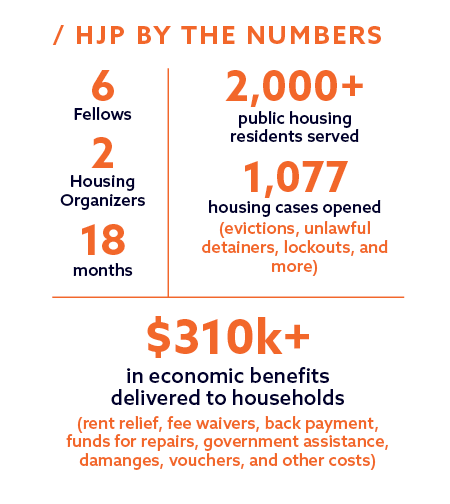 Opened 1,077 legal cases on housing matters including evictions, unlawful detainers, illegal lockouts, voucher retention, and other matters
- Produced successful outcomes for more than 3,100 tenants, including families with children who were able to avoid eviction
- Coordinated an advocacy campaign resulting in an eviction freeze by the Richmond Housing Authority for more than 2,000 residents in public housing
- Saved $310,000 for low-income families in rent relief and fee waivers, back payment in rent, and other costs
“In 2019, the idea of a right to counsel in Virginia was inconceivable. Yet now, a year later, the landscape has completely shifted,” said Laura Wright, 2019 Equal Justice Works Fellow. “Thanks to the work of Omari, LaFonda, and other advocates [in the program], we have a fast-growing tenant organizing infrastructure in Virginia. The ground is fertile for more tenant activism, we just need an infusion of resources to keep the momentum going.”
In 2019, the idea of a right to counsel in Virginia was inconceivable. Yet now, a year later, the landscape has completely shifted.
Laura Wright /
2019 Fellow
Equal Justice Works Housing Justice Program
Since 1993, Equal Justice Works has mobilized more than 147 housing legal Fellows, advocates, and organizers to increase housing stability for low-income communities around the country. Our program participants have:
- Assisted almost 10,000 low-income residents experiencing housing instability in Georgia and Virginia
- Preserved and improved nearly 40,000 units of U.S. Department of Housing and Urban Development (HUD) assisted housing
- Built capacity at 43 nonprofit organizations for housing justice work
- Trained over 16,000 organization staff and volunteers on critical housing issues
Our passionate public leaders have made sustainable contributions to the legal services infrastructure by promoting strong collaboration among host organizations, improving ways of working, cultivating civic and political will, and building the leadership needed to make change happen.
Read more stories about the work of our Fellows and how they are keeping thousands of Richmond residents safely in their homes during the pandemic.
- Equal Justice Works Housing Justice Program Continues to Fight for Tenants as Mass Evictions Loom
- The Right to Safe, Decent, and Discrimination-Free Housing
- Standing Up for Tenants, Close to Home
- Fighting the Eviction Crisis in the Greater Richmond Region
The Housing Justice Program is funded by The JPB Foundation and Equal Justice Works.

Vanessa Arrieta, a 2020 Equal Justice Works Fellow, recently spoke with us about addressing the gap in civil legal services for victims of elder abuse, and shared how she is collaborating with other Fellows in the Elder Justice Program to help improve the national response to elder abuse, neglect, and exploitation.
World Day of Social Justice, an international day recognizing the need to promote social justice and tackle issues such as poverty, exclusion, human rights, and social protections, will be celebrated tomorrow (February 20). In what ways do you promote social justice for the communities you serve?
I work to promote social justice by providing free legal representation and opportunities to people who need them but would otherwise not have access due to lack of resources (not being able to afford a private attorney), or simply lack of information. At my host organization, Legal Aid Society of Palm Beach County, we help with issues that affect underprivileged and often ignored communities, such as housing, discrimination, abuse, and exploitation.
What are some of the barriers your clients face in accessing civil legal services? How are you helping them to overcome these barriers?
The biggest barrier I’ve found is lack of information regarding the services available to them. We do outreach to spread the word about the services we provide, but COVID-19 has made this more difficult particularly in my field. My clients are 60 and up, many of whom don’t really use the internet or have a smartphone. In that sense, inter-agency meetings have been very valuable for spreading the word about the services we provide to others.
The pandemic has drastically changed the legal services landscape. What new challenges have you noticed this past year, both for you and for your clients? How are you continuing to provide key legal services while balancing public health concerns?
I have found that not being able to meet with clients in person, considering my clients are in a high-risk population for COVID-19, has been one of the biggest challenges. I had a case where there was a fear that my client might have been a victim of exploitation by her son, whom she lived with. Every time I would call her, her son would always be around. Our office was not meeting with clients in person, but I had to make a special request and arrange everything to be able to meet with my client by herself, in person, without the presence of her son, in a socially distanced and very sanitized setting.
Through the Elder Justice Program, you have the opportunity to learn from and leverage the expertise of other Fellows in the program. What has the overall experience in the program been like so far? Can you share an example of how you have collaborated with other Fellows in the program?
One of my favorite things about the Elder Justice Program is that it conducts bi-monthly trainings, with the opportunity to ask questions or discuss some of the current cases you have. One of the benefits of this is that you realize that you are dealing with the same issues that other Fellows in other parts of the country are also dealing with. Because of the difference in expertise and background, you can brainstorm and ask questions about how they solved it, or get new ideas on how to tackle some issues.
One of my favorite things about the Elder Justice Program is that it conducts bi-monthly trainings, with the opportunity to ask questions or discuss some of the current cases you have.
Vanessa Arietta /
2020 Equal Justice Works Fellow
Who are some key community partners you work with (or plan to collaborate more with) to facilitate holistic services for your clients?
I would love to be able to collaborate with the State Attorney’s Office, particularly when it comes to tackling the mass amounts of scams targeting the older population in my county. There are other smaller local coalitions, such as the mental health coalition or the veteran’s coalition that I would also love to partner with and be able to provide these services to my clients.
What advice do you have for other public interest lawyers working on the same issue? Can you share a few lessons you’ve learned when it comes to providing legal services to victims of elder abuse and exploitation?
I have three pieces of advice for other public interest lawyers working on similar cases:
- Set aside any preconceptions you may have about the older population in regards to their capacity and decision making. Treat each case individually and determine capacity on a case-by-case basis.
- Don’t be afraid to ask questions. You’ll get all types of different cases, so reach out to other more experienced attorneys or other Equal Justice Works Fellows if you are not sure how to tackle an issue.
- Develop healthy mechanisms to cope with the stress. Public interest jobs can be very stressful and busy, though they make for rewarding work. It’s important to have healthy activities outside of your job.
To learn more about the Elder Justice Program Fellows who are addressing the gap in civil legal services for victims of elder abuse and exploitation, visit here.
The Elder Justice Program is supported by an award from the U.S. Department of Justice, Office of Justice Programs, Office for Victims of Crime (OVC), Award Number 2019-V3-GX-K033. This federal funding is supplemented by funds from private donors. The opinions, findings, and conclusions or recommendations expressed in this product are those of the contributors and do not necessarily represent the official position or policies of the U.S. Department of Justice.
In law school, surrounded by other passionate public service leaders, justice always feels within reach. In rural America, it can be a lot harder to come by.
That’s why Equal Justice Works teamed up with the Legal Services Corporation (LSC) in 2016 to create the Rural Summer Legal Corps (RSLC), a one-of-a-kind opportunity for law students to help ensure that everyone has access to justice—not just those in urban areas.
Last summer, Student Fellows in the RSLC had the chance to explore their public interest passions while gaining legal experience, building their network, and supporting rural residents in need. Selected from 446 applications, the 2020 class of RSLC Student Fellows included 35 students who worked at 31 LSC-funded civil legal aid organizations to provide legal assistance to people in rural areas affected by the pandemic.
All Student Fellows began their work remotely to support the efforts of their host organizations, helping clients virtually through video conferencing, online intakes, and over phone and email. Toward the end of the summer, a handful of students were able to have various in-person interactions with supervisors and other individuals.
Collectively, Student Fellows served more than 10,000 hours, assisting 720 individuals on a range of issue areas including housing, tribal law, family law, and responding to the opioid crisis. Among these cases, students served 134 individuals dealing with a COVID-19-related problem.
It was by far the most positive internship experience I have had, and I would recommend to any law student.
Anna Michel /
2020 RSLC Student Fellow
In addition to direct legal services, Student Fellows in the 2020 class participated in 122 outreach events and created or expanded more than 125 collaborations with community partners.
At West Tennessee Legal Services (WTLS), 2020 RSLC Student Fellow Malaysha Seals conducted a legal clinic for 30 organizations about housing evictions and the CARES Act, in turn helping those who were at risk of being evicted. She developed outreach to faith-based communities in the 17-county, largely rural, service area, which included on-demand and live video training for organizations. This type of outreach and training had never been done before, and was necessary due to the restraints in reaching individuals during the pandemic.
Following their summer of service, 100% of Student Fellows felt that their legal knowledge increased from their Fellowships. Additionally, 80% of students stated that their interest in working with rural communities increased from this experience.
“It was by far the most positive internship experience I have had, and I would recommend to any law student,” said Anna Michel, a 2020 RSLC Student Fellow who was hosted by Legal Services of the Hudson Valley.
Interested in having your own impact on rural communities this summer? Apply for the 2021 Rural Summer Legal Corps by 11:59 p.m. ET on February 8, 2021.
Individuals’ legal needs don’t stop when disasters hit—they get worse. Equal Justice Works created the Disaster Recovery Legal Corps to place 23 lawyers throughout Texas, and Florida to deliver critical legal services to underserved communities affected by recent hurricanes and tropical storms. Brittanny Perrigue, Javier Arturo Dominguez, and Stephanie Duke are three Fellows who joined this program to address a wide range of disaster-related legal issues including housing, employment, immigration, accessibility, and health care needs. Equal Justice Works has placed more than 80 lawyers in areas affected by disaster since 2005, and we know from experience that disaster preparedness is critical to ensuring disaster resilience.

Since 2005, Equal Justice Works has developed targeted programs to place more than 80 passionate public service lawyers delivering legal services to disaster-affected communities.
To learn more about the Disaster Resilience Program, our latest initiative that brings together Fellows and law students to help communities navigate legal issues before, during, and after disasters like COVID-19, visit here.